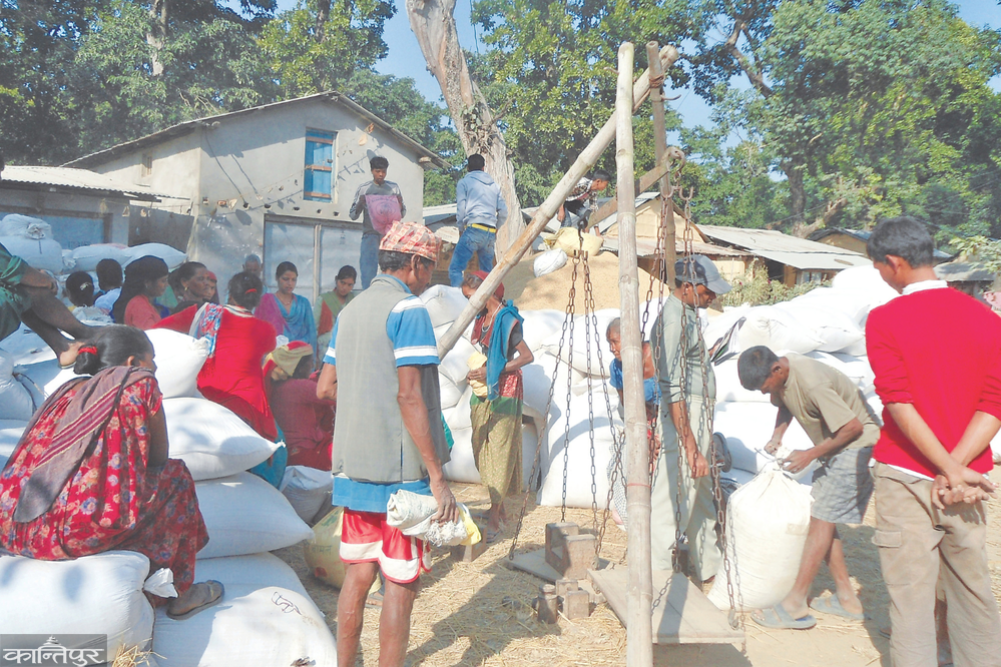
One reason for the loss of grain reserves is the recent decline in food production in Madhesh. The fields of Madhesh, known as the country's granary, are being torn apart by plotting, resulting in a decline in productivity day by day.
We use Google Cloud Translation Services. Google requires we provide the following disclaimer relating to use of this service:
This service may contain translations powered by Google. Google disclaims all warranties related to the translations, expressed or implied, including any warranties of accuracy, reliability, and any implied warranties of merchantability, fitness for a particular purpose, and noninfringement.
There used to be grain markets around the settlements for selling food. The common people would take the food grown according to the season and sell it in the mandi (warehouse). When the markets were not developed in the rural areas, such markets were trading centers. Since food and goods were exchanged, there was a lot of activity all year round.
With urbanization, villages became trading centers. The tradition of buying and selling changed, due to which such grain markets have started disappearing from rural areas. The earlier grain markets have now been transformed into modern markets.
The bargaining between farmers and traders who came to sell their produce in Chandranigahpur, Rautahat was worth watching. At that time, the place to sell agricultural produce produced in the district was the grain market (a place where grain was bought and sold). Until a decade and a half ago, there were about a dozen such buying and selling centers here. Farmers would confidently come to the grain market carrying food grains such as rice, corn, wheat, lentils and mustard grown with great difficulty. Such places were the centers of economic trust for farmers. Since a fair price and market were ensured, they did not have to wander around to sell their produce. Now, traders and industrialists have started reaching farmers' doorsteps in search of food grains.
At present, the old market of Chandranigahpur is mostly deserted. Of the 23 grain warehouses here, which used to be crowded with farmers, not a single one remains. The traders who operated them have also fled. Traders displaced from Chandranigahpur had started business in Garuda. Now, the grain warehouses there are also gradually disappearing. Kameshwor Sah, who is operating a warehouse in Garuda, said that both the production and the farmers' reputation that existed a decade ago have been lost.
‘Now, buying and selling has started in the villages. Everyone from the city markets has been displaced,’ Sah said, ‘As much food as there is in the fields and the little that is left is sold in the villages, the grain warehouses have closed and the traders have fled.’ Sah had fled from Chandranigahpur to Garuda in 2070 BS. He operated a grain warehouse in Garuda for about three years. He said he left after he stopped getting food grains. There are currently only 5/7 grain warehouses in Garuda Bazaar, which had more than 30. Traders say that there is not much business in them either. Although this business flourished in Garuda for a few years, grain warehouses there are also in the process of closing.
As most of the grain is sold in the fields and the remaining in the villages, the grain stores are closed and traders have fled. -Kameshwor Sah, Garudama grain store operator Chandranigahapur was a strong trading center connecting Madhesh and the hills. Farmers from surrounding villages used to come to sell their produce. Recently, grain warehouses have been operating in villages and due to business insecurity, grain traders have been moving towards Garuda, said Sunil Kumar Sah, former president of the Chandranigahapur Chamber of Commerce and Industry. ‘Recently, agricultural production has also been decreasing, grain warehouses have also started operating in villages,’ he said. ‘Due to this, the activity of buying and selling food grains in the market has come to naught.’ The number of small grain warehouses in the inner villages across the district may be more than 100. But Sah said that their condition is also critical.
Chandrapur's mayor Sanjay Kafle says that the decline in grain stores is not just a sign of business closure but also a sign of the collapse of the agricultural economy. 'If we want to protect Madhesh's agriculture and make farmers self-reliant again, the government should immediately make arrangements for purchasing farmers' produce at support prices,' he said. 'The closed small and medium grain stores should be attracted back by providing concessional loans and market guarantees.' In recent years, large food industrialists, modern rice mill operators and big traders from outer districts have started visiting farms and farmers' doorsteps directly. A practice has developed of going to villages with tractors and vehicles and purchasing grain in cash. Due to this, farmers have stopped bringing grain to the grain stores in the old market, bearing the cost of transportation, said Rohan Sah, a trader from Chandranigahapur.
According to locals, the main reasons for the closure of grain stores are the lack of organized markets and government apathy. The entire market has become distorted as farmers do not have a place to sell directly in an institutional manner. There are complaints that they do not get a fair price when they have to sell at small grain stores opened in villages. According to Rangpur farmer Rajaur Chaudhary, those who come to buy food grains on bicycles end up buying them even after bargaining with farmers on the price. ‘In the absence of organized grain stores, farmers are forced to sell grains at the cheap price set by those traveling traders. Earlier, when there was a shortage of grain in the market, they could ask for the price and sell it to the highest bidder,’ he said. ‘Now, we have to accept whatever the traders who come to the village say. If we do not sell, the grain will rot, and if we sell, the cost will not be recovered. The closure of large grain stores has directly affected the farmers.’
There have been complaints that some traders who come to our homes cheat farmers even on weight. In grain stores, payment was guaranteed immediately or within a certain time, but now farmers complain that the risk of traders disappearing by collecting grain on credit has increased.
Another main reason for the disappearance of grain stores is the recent decline in food production in Madhesh. The fields of Madhesh, which are called the country's food store, are riddled with plotting. This is why productivity is decreasing day by day. Production has declined due to lack of fertilizer during the main season and poor quality seeds. Farming is drying up due to the need to rely on rainwater and the decline in groundwater levels. As production has decreased and the collected grain has easily reached large modern rice mills, both the relevance and existence of the traditional grain store seem to be in crisis. The nature of the food trade is changing in Banke. Once, traders used to visit farmers' doorsteps and purchase rice, wheat, corn and other food grains and take them to the grain market. Now, with the expansion of the network of local traders and middlemen in the villages, the process of food collection and sale has changed. This causes farmers to complain that they are not getting the right price for their produce.
Shivshankar Gupta, the owner of Saraswati Food Traders in Nepalgunj, says that during his ancestors' time, traders used to visit farmers' houses and buy food grains. Now, local traders are active in the village. They buy rice, wheat, corn, lentils and other products from farmers and take them to big traders. “Now, every household has a rice weighing scale, and farmers also have auto rickshaws and tractors,” Gupta said. “However, most farmers sell to local traders. When food grains come through middlemen, the price they get decreases.” Most of them farm on one to five acres of land. Some big farmers produce up to four to five bighas.
Farmers depend on local traders because it is expensive to transport small quantities of food grains to the market. Rabindra Rawal, the owner of Rahul Foods Pvt. Ltd., said that farmers are affected by the shortage of labor force and foreign employment in rural areas. “Most of the men in the village are out, and since there are only women at home, local traders reach their homes with tractors and forks and buy food from there,” he said.
Ram Sharan Lamichhane, head of Food Management and Trading Company Nepalgunj, said that farmers are facing problems as the support price set by the government is not being implemented effectively in the private market. “We ask that the farmer’s identity be revealed through the ward office to purchase paddy directly from farmers,” he said. “Last year, it was recommended to buy up to 40 quintals of paddy from a farmer.”
 Farmers are being beaten on price
Since the paddy business is not as good as before, traders are struggling to earn a living, said Pujari Gupta, a paddy trader who runs Shyam Traders in Ramatalaha, Kapilvastu-2. Earlier, grain (paddy, rice and wheat) was brought from villages to the district headquarters in bullock carts and tractors. This made it difficult to sell to traders. Earlier, farmers used to take their produced food directly to traders to save money. For the past two or three years, farmers have not traveled long distances to sell grain. They have to pay bills for long distances. They cannot pay bills without a firm. Therefore, they sell to nearby retailers. Another businessman, Girjesh Jaiswal, said that there is a problem when retailers sell to wholesalers.
When a retailer sells at a profit, farmers get a low price. Wholesalers are also not allowed to sell rice and paddy directly. ‘They have to sell to industries that have registered brands,’ said Jaiswal. ‘They sell to consumers in small packages.’
When wholesalers collect and sell, consumers get food at a cheaper price. But when they sell by registering a brand, it is very expensive. This is putting grain traders in trouble, said Jaiswal. ‘Until three years ago, wholesale traders used to make a profit of Rs 200 to Rs 2.50 on selling a quintal of paddy,’ said Pujari Gupta, a trader from Taulihawa. ‘Now, the profit is only Rs 25.’ Jaiswal said that while they used to make a profit of Rs 100 on selling wheat, now they make a profit of Rs 20 and while they used to make a profit of Rs 300 to 400 on selling rice, now they are having trouble earning a living by making a profit of Rs 50.
Business is disappointing
Balkrishna Lamichhane, a grain trader from Mainapokhar, Badhaiyatal Rural Municipality-6, Bardiya, says that the trade in paddy, mustard and wheat has decreased in the past few years. He says that along with the traders, farmers are also in trouble after the unhindered import of paddy from India started. ‘Farmers are forced to sell food grains cheaply,’ he said. ‘Import of food grains like paddy and wheat should be stopped.’
Lamichhane says that the local, state and central governments should also come up with a concrete plan for food production. Rajapur is famous for its rice in the district. Until four decades ago, rice produced in Rajapur was exported to India and Bangladesh. Birendra Gupta, a rice trader from Rajapur, said that the rice trade here is in a disappointing state due to the decline in production.
‘The government declared Rajapur Municipality and Geruwa Municipality as rice zones 10 years ago. It also gave subsidies to farmers to increase production,’ Lamichhane said, ‘After the sugar mill was operated in Rajapur-5, which was considered a rice zone three years ago, sugarcane was cultivated on about 1,000 hectares. This led to a decrease in rice production and a decrease in rice trade.’ Until a decade ago, Rajapur did not have direct transport links with other markets in the district. Now, there is no place that is not connected by bridges and roads. There are markets in every village. "After the road network was connected, traders from Surkhet, Banke and other districts have started going door-to-door to buy paddy," said Lamichhane. "Grain shop owners are in trouble because they are buying paddy cheaply from farmers."
Shalikram Sigdel, a grain trader from Rajapur-10, said that he had suffered a lot due to the lack of a road network in the past. He said that in the past, rice, wheat, mustard and other food grains were transported by boat from Ladiya to Nepalgunj via the Geruwa River. "The buying and selling was good," he said. "Now, due to the sugar mill, production has decreased and trade has decreased."