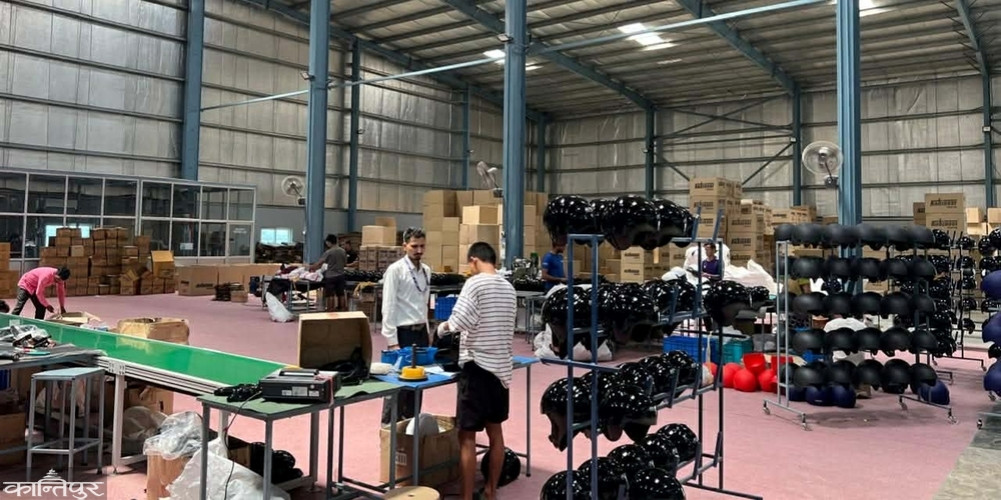
Many industries have been forced to close due to raw material shortages and high prices, with the plastic industry being the most affected.
We use Google Cloud Translation Services. Google requires we provide the following disclaimer relating to use of this service:
This service may contain translations powered by Google. Google disclaims all warranties related to the translations, expressed or implied, including any warranties of accuracy, reliability, and any implied warranties of merchantability, fitness for a particular purpose, and noninfringement.
As the Middle East war drags on, its impact has begun to affect Nepali industries in the border areas. The import of raw materials has been affected due to the Iran-Israel-US war, and the production of Nepali industries has declined. With the rise in the cost of raw materials and consumer goods, its impact has been felt even in the kitchen.
The price of raw materials has increased by 40 percent in the international market. As a result, the raw materials imported by Nepali industries have not been supplied as per demand. Currently, there is an extreme shortage of plastic 'grains', which are used most in plastic-based industries. Along with this, the import of raw materials required for soybean and sunflower oil, which reach Nepali kitchens via India, has also been affected.
The shortage of raw materials is starting to create a situation where industries operating in the Butwal Industrial Zone and Bhairahawa-Parasi Industrial Corridor are closing down. Butwal Industrial Area Industry Association President Upendra Agrawal said that the plastic industry has already faced difficulties in the first phase. The industry is not importing raw materials as per the agreement it had earlier. Less than the requirement is being imported. ‘The price of plastic raw materials has increased by up to 40 percent.’ They are saying that raw materials cannot be provided as per the agreement with the company,’ he said. ‘If this situation happens, there are also reports that raw materials may not be available even at the increased price.’ This has created more confusion and difficulty.’
The crisis in the plastic and packaging industry has deepened due to the lack of plastic grains. Industrialists complain that the production of water bottles, bottle caps, pipes used in drinking water and building construction, motorcycle helmet companies, plastic chairs, packaging plastics, cartons and other materials is being affected. Currently, the supply of stock goods is being done and the industry also has some goods in stock, so the industry is still running. However, if raw materials cannot be imported within the next week, most of Nepal's industries will close, said Ejaz Alam, former president of the Rupandehi Industry Association and director of United Plastic Industries.
According to him, India is not providing the goods for which LCs have been opened for the import of materials as per the agreement. Indian suppliers have stopped taking orders from Nepali industries. He said that companies transporting raw materials from India and third countries to Nepal are sending a message that they cannot send them anymore. 'Industrialists have been in trouble as the price of plastic pellets has increased by 40 percent,' he said. 'The price of petroleum by-products has increased significantly. The price of goods that cost $900 has now reached $1,500.' He said that the production of plastic pipes has also stopped due to the halt in the supply of raw materials for the plastic industry. It is also affecting government plans.
Nepali industrialists purchase plastic pellets from India's Reliance and Indian Oil Corporation (IOC). In Rupandehi alone, there are more than 500 industries that purchase such plastic pellets and process them to produce plastic products. At least 20,000 workers are employed in them. Those industries import goods by opening LCs every 15 days. However, since they are unable to import goods even after opening SLIs, the stock will not last even for the next 10 days. Industrialist Baburam Bohara said that there is no option but to close down. 'Our raw material stock cannot last even for 10 days,' he said. 'The process of importing raw materials from other countries except India has not been carried out yet. That is why a difficult situation is being created.' He also said that it is not possible to import them from China right now.
Nepal's big industries are operating in the Narayani West Rupandehi, Nawalparasi, and Nepalgunj areas. The Belahiya border crossing and the international market are also easily accessible, so there is a lot of private sector investment in this area. From rice industry to cement and rods, Rupandehi has been producing. However, the raw materials for all these materials have been coming through India. However, in the last two weeks, Belahiya Customs Office officer Santosh Neupane said that there has been a slight decrease in goods coming through the Belahiya border crossing. ‘There are reports that Indian suppliers have stopped taking orders, and the impact of that may be seen from next week,’ he said. ‘Although there has already been a slight decrease in the number of loaded vehicles, the exact figure for the decrease in imports has not been prepared.’ He said that there may have been a decline in general imports of 15 to 20 percent. The office has stated that since many goods coming through the Belahiya border crossing come through Indian suppliers, there will not be a significant decline immediately. Most goods coming from third countries come from Birgunj.
Production decline in Nepalgunj
The escalating war in the Middle East has also affected the industries of Nepalgunj. Due to the shortage of raw materials, the production of industries in various areas of Banke has declined. Investors have said that some industries are on the verge of closure. They are suffering due to the decrease in the import of raw materials. Kamal Karki, associate member of the Nepalgunj Chamber of Commerce and Industry and Managing Director of Star Polypipe, informed that serious problems have arisen in the industry sector after the import of raw materials has stopped due to the war.
He said that the lack of raw materials has had a major impact on production. ‘Our production is decreasing due to the non-incoming raw materials. It has been one and a half months since the raw materials were stopped due to the war,’ he said. He said that production has decreased with the stoppage of the import of raw materials. The decrease in production has caused problems in the operation of the industry. According to industrialist Karki, if there is no way to lay off employees in such a situation, it is also difficult to retain employees. Mohan Prasad Sharma, an employee of Laxmi Plastic Pvt. Ltd. in Nepalgunj, said that the industry's production has come to a standstill due to the shortage of raw materials. Sharma suggests that the impact will be reduced to some extent if the government facilitates the long-term storage and supply system of necessary raw materials.
Raw materials related to petrochemicals are entering Nepal from third countries via India. But now, after India has tightened its export restrictions to avoid shortages in its own market, the industries here are in crisis, said Chiranjivi Oli, senior vice-president of the Nepalgunj Industries Association. The shortage of raw materials related to petrochemicals is now affecting not only plastic products but also the production of daily consumer goods. Industrialists expressed concern that the impact will deepen if the international situation remains the same. Information Officer of Nepalgunj Customs Office Pavitra Kumar Khadka said that the supply of raw materials is normal. He claimed that the supply of raw materials used in the industrial sector is easy and regular.
Plastic industry in crisis
There has been a significant decline in the import of raw materials for plastic products entering through Biratnagar customs. The production of more than a hundred plastic industries in the Sunsari-Morang industrial corridor has been badly affected due to the shortage of raw materials. According to Nandakishore Rathi, founder of Bagmati Plastic Industries, raw materials imported from Gulf countries including Saudi Arabia and Qatar have not been able to enter since the war began. Gulf exporters have not been able to send raw materials. Industries used to import raw materials from India as an alternative to the Gulf. After India stopped exports, there has been a shortage of raw materials in industries. ‘A crisis is certain to begin in all industries due to the lack of raw materials,’ said industrialist Rathi. ‘As production costs increase, prices in the market are certain to increase.’
This has had a direct impact, especially on plastic industries ranging from footwear and slippers to cables and wires. Oil industries are also starting to be affected. According to Biratnagar Customs Chief Umesh Shrestha, there is a problem especially in the import of plastic raw materials from Dubai and Saudi Arabia. ‘Most of the letters of credit (LC) have not been opened, and the LCs that have already been opened have also been canceled,’ Shrestha said. ‘If the war drags on, every industry will definitely be affected.’ Shrestha said that the decline in goods imports is likely to hit the revenue collection target at the end of the month. According to Shrestha, problems have also started in plastic products, as well as edible oil, petrol, and cooking gas. Other goods coming from the US, Ukraine, and Canada are also starting to be directly affected. Mustard used to be imported from Ukraine. Now that process has stopped. Industrialists say that the cost has increased as containers of some goods entering Nepal have been stopped on the way for the past 20-22 days. According to customs agent Suresh Bohara, the cost of goods coming from China has also increased. The supply chain of chemical fertilizers coming from Russia and food items coming from Ukraine has also been affected. The increase in transportation costs due to the increase in fuel prices has put pressure on the prices of every consumer good. The current disruption has created further confusion as it takes 40 to 45 days for goods coming from Ukraine to arrive.
'Fuel imports are regular'
The impact of the Middle East war has reduced in Birgunj, the country's main port. The Birgunj Customs Office has stated that the import of fuel and goods imported from third countries has not decreased. The office's information officer Uday Singh Bista informed that an average of Rs 600 million is being collected daily.
‘The situation has been the same before, there has been no significant change now,’ he said, ‘The import of all goods imported through the Birgunj border is happening normally.’ Bista claimed that the import of any goods has not decreased as the highest revenue-generating commodity through the Birgunj border is fuel and its import is also happening normally. Out of the revenue collection target of Rs 24 billion in Chaitra, Rs 4.36 billion has been collected till Saturday. Bista said that an average of 86 to 87 percent of the target is being collected every month. Jitendra Rasaili, operational in-charge of TRS Himalayan Logipark, the operator of the integrated security check post in Birgunj, informed that the import of LPG and aviation fuel is happening smoothly through this border in recent days.
From Falgun 16 to 30, 696 gas bullets carrying LPG gas and 274 tankers carrying aviation fuel entered through this border. From Chaitra 1 to 8, 33 bullet and 192 aviation fuel tankers have entered . Diesel and petrol are entering through pipelines . Rasaili informed that their imports are also happening as usual . He said that while around 700 freight vehicles normally enter through this checkpoint daily, only around 600 are entering these days .