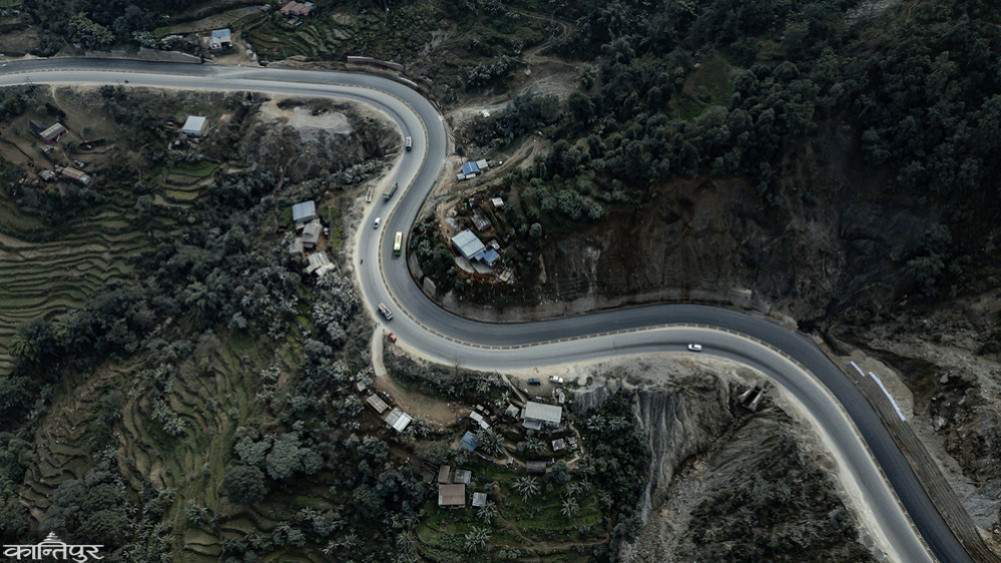
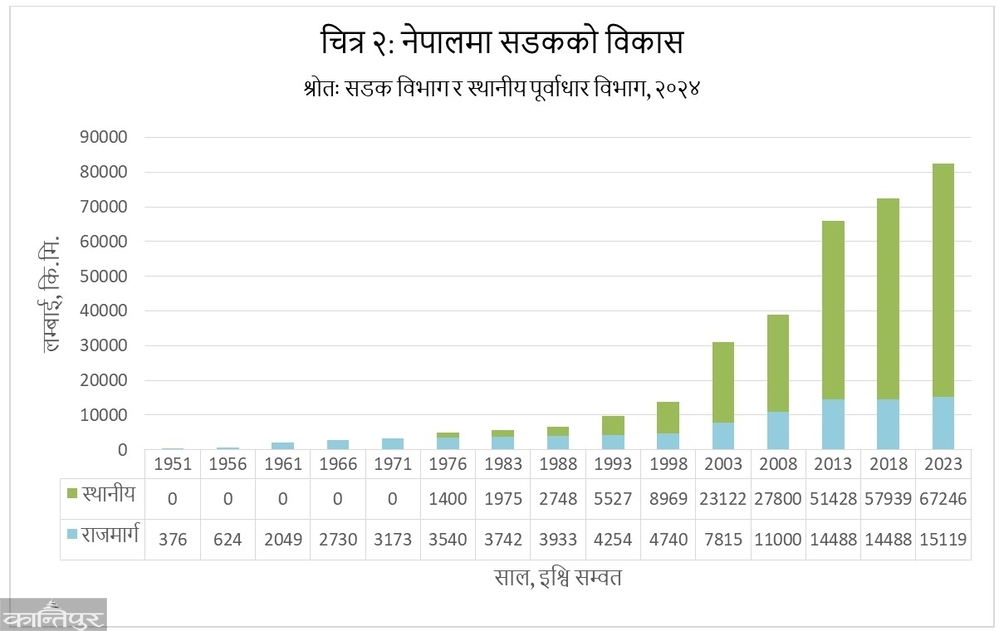
When democracy was established, the total length of roads in some districts of the Terai and the Kathmandu Valley was only 376 km. There were no airports. Currently, 67,246 km of local roads and 82,364 km of highways and strategic roads have been constructed.
We use Google Cloud Translation Services. Google requires we provide the following disclaimer relating to use of this service:
This service may contain translations powered by Google. Google disclaims all warranties related to the translations, expressed or implied, including any warranties of accuracy, reliability, and any implied warranties of merchantability, fitness for a particular purpose, and noninfringement.
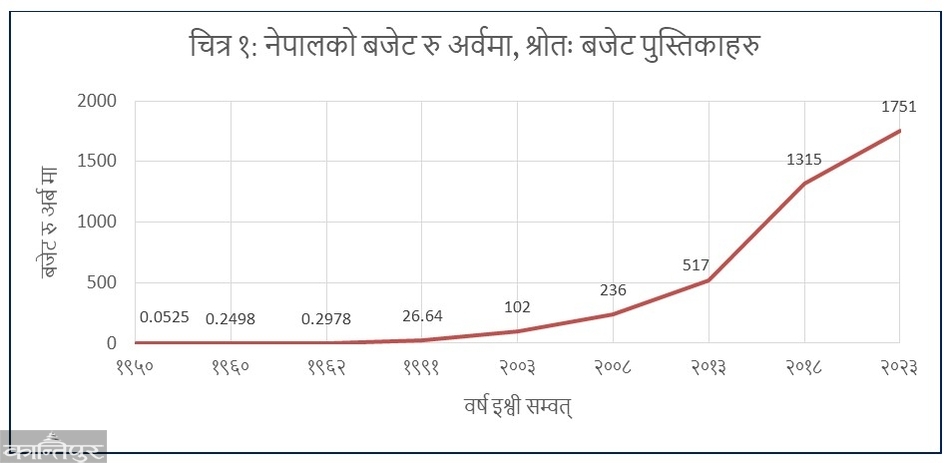
Until 1950, Nepal was trapped in the darkness of the global Rana regime. It was isolated from the outside world and was also far behind in industry and trade. The size of the first budget in 1950/51 after the establishment of democracy was 52.5 million.
Which could not even cover the small aspirations of development . Since the country's internal resources were only sufficient for peace and security and the operation of the bureaucracy, the allocation for development was very low .
When democracy was established, the total length of roads in some districts of the Terai and the Kathmandu Valley was only 376 kilometers . Of the two railways, one ran from Raxaul-Amlekhgunj for 39 km and the other from Jayanagar-Janakpur for 52 km . Till then, there was no airport in the country . The country, which started from such a pitiful state, has now made significant strides in its transport infrastructure .
Since the decade after the establishment of democracy has been marred by political instability, there has been no significant progress in the country except for a few infrastructure projects run with Indian and American grants . The poverty situation in the country can be easily estimated since Nepal's per capita GDP was only 50.2 US dollars in 1960, while India's per capita GDP was 84.9 US dollars at the same time.
Since the establishment of democracy, the country's annual budget has been increasing. The budget, which started at 52.5 million, has increased to 26.64 billion in 1991, 102 billion in 2003, 517 billion in 2013, 1315 billion in 2018, and 1751 billion in 2023. Meanwhile, from 2010 to 2019, the Nepalese government was able to manage investment from domestic resources in the construction of significant large projects.
Transport and Road Master Plan
Although Nepal started implementing the concept of planned development by making periodic plans from 1956, the eight periodic plans up to the end of the Panchayat period could not achieve progress as per the target due to the inability to mobilize resources for the implementation of development projects. Although the periodic plans implemented so far have the concept of poverty reduction and equitable development, they have given high priority to the development of transport infrastructure.
Nepal had started planned development by formulating its first five-year plan in 1956. With the technical and financial support of the US and Indian governments, the Regional Transport Organization was signed on 2 January 1958 and implemented. Its goal was to build 900 miles of roads in Nepal, but after only 28 percent progress was made, it was decided to break its work and in 1962, the responsibility was handed over to the Government of Nepal. It planned highways connecting Sunauli-Pokhara, Kathmandu-Janakpur, Krishnanagar-Pyuthan, Nepalgunj-Surkhet and Dhangadhi-Dadeldhura and some of them were partially constructed.
Meanwhile, with the support of the World Bank, Nepal's 30-year Transport Master Plan was prepared and implemented in 1965. This master plan envisaged an east-west highway and seven north-south corridors in the Terai. Continuing with this, 11 north-south roads are currently under implementation.
Then in 2002, the government prepared and implemented a 20-year road master plan, which successfully met the targets set within the stipulated time frame. Then in 2023, another 10-year road master plan and a priority investment plan were also prepared and implemented.
Priority and progress in road construction
Prioritization and progress in road construction
Until the end of the Panchayat period, major highways were built with priority over minor roads. Till then, due to lack of technicians and competent construction professionals in the country, lack of budget, labor-based construction technology, etc., there was not much significant progress in road construction. By 1988, the length of highways was 3,933 km and the length of local roads was 2,748 km.
After the formation of the Local Infrastructure Department in 1998, it has been arranging for the construction of local roads. Although the Road Department was restructured in 1993 and was told to manage only roads of strategic importance, it has not been able to separate local roads with political reach and some roads that are not even suitable for ward level construction.
In this way, the Road Department, Local Infrastructure Department, Urban Development and Building Construction Department and local bodies are also involved in the construction of local roads, and the length of local roads has increased to more than 67,246 km. The length of highways and strategic roads has reached 18,170 km (2,988 km limited to the plan), taking the total length of roads to 85,353 km. Of this, 82,364 km have been constructed.
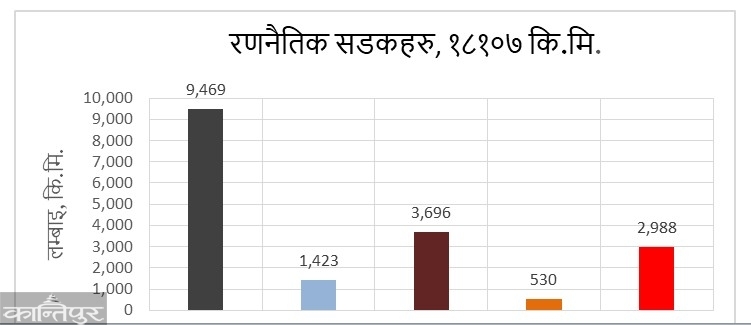
Since records of roads constructed in recent years are not available, it can be estimated that the actual length may be higher. Despite this significant increase in the length of roads, only 17.3 percent, or 4,890 km of local roads, including 9,469 km of highways and 14,278 km of strategic roads, are blacktopped.
Weaknesses
There has been no proper investment in the repair and rehabilitation of heavily used roads. On the contrary, it does not seem to be a situation where the public's taxes are being properly utilized as roads that do not even carry a dozen or so vehicles daily continue to receive budget priority and roads that carry thousands of vehicles lag behind in priority.
The government has been bringing interesting and airy programs from time to time. In the budget for the fiscal year 076/77, a plan to land airplanes on highways was put forward. It is ridiculous to have a plan to land airplanes on highways in a country with more than 55 airports across the country.
The railway line from Jayanagar to Bardibas has not been connected, in the fiscal year 076/77, the program to build the East-West Electric Railway in the Inaruwa-Kakkadbhita section was prioritized and contract agreements and resources were even ensured. Therefore, the practice of unintentionally focusing our development budgets on only a few 3-4 accessible districts, causing injustice to many, is not leading to equitable infrastructure development.
The government prioritizes projects based on accessibility, and accordingly, in the appropriation approved by the parliament, the Ministry of Finance bypasses the parliament and grants arbitrary resource assurance and multi-year contracts based on accessibility. There are many examples of projects that have gone into construction as per the resource assurance given by the Ministry of Finance itself, where the construction contractors are not paid at the time of the allocation, resulting in a lack of liquidity and the contracts becoming unhealthy.
There is not a single road in our country that can be called a highway. Due to uncontrolled settlement development, it is also becoming difficult to build new roads. The road boundary of the Prithvi Highway was set at 25-25 yards to the right and left from the center line, but in BS 2048, the democratic government reduced the road boundary to 15-15 meters.
Now, when expanding the road, that 15-meter limit is seen as an obstacle. Those who have encroached on the highway and forest areas have been encouraged to develop settlements on the highway by quickly distributing red papers. In foreign countries, settlements are not established on highways and expressways for security reasons, but rather removed.
The solution that the new government should adopt
is to formulate a plan with consensus after good preparation and extensive discussions, and all parties should insist on implementing the plans formulated in this way. There are examples of South Korea achieving good results when its periodic plans are implemented exactly in any situation.
When talking about road infrastructure, about 8,000 km of highways and strategic roads that are in a dirt state should be blacktopped or whitetopped within the next 5 years. About 60,000 km of local roads are dirt.
It is not possible to blacktop or whitetop them all immediately. These roads should be classified on a scientific basis as important roads connecting municipal centers, ward centers, tourist attractions and markets. When classified in this way, the length of important roads comes to about 25,000 km. If these roads are blacktopped, it is seen that safe and sustainable transport access will improve. This will bring ease to the people in health, education, tourism and market access.
At the current prevailing rate, it costs 5-6 million rupees per km to build two-lane highways, 25-30 million rupees per km to build a 4-lane road, and about 15 million rupees to build an intermediate lane blacktop road using a less expensive method. To develop about 500 km of roads to 4-lane level, 125 billion rupees will be required, to upgrade 4,000 km of roads to 2 lanes, 250 billion rupees will be required, to upgrade 5,000 km of roads to intermediate lanes It seems that it will take 250 billion rupees to upgrade 75 billion and 25 thousand km of local roads to intermediate lanes using cheap technology.