The purchase of 22.37 percent shares of PhonePe by 10 investors including Khaitan for about one and a half billion rupees, with this transaction, the valuation of PhonePe has reached 6.67 billion rupees.
We use Google Cloud Translation Services. Google requires we provide the following disclaimer relating to use of this service:
This service may contain translations powered by Google. Google disclaims all warranties related to the translations, expressed or implied, including any warranties of accuracy, reliability, and any implied warranties of merchantability, fitness for a particular purpose, and noninfringement.
Industrialist Rajendra Khaitan has also joined the digital payment system operating company 'PhonePay'. 10 investors including Khaitan are going to buy 22.37 percent shares of PhonePay for about one and a half billion rupees. Rastra Bank has approved Khaitan's proposal for the purchase of only 14 percent shares.
"The proposal submitted by both parties to the Rashtra Bank for changing the share structure of PhonePay, which is under the other financial platform maker company Fwansoft along with digital payments, has been approved," says a senior official of the Rashtra Bank. Apart from this, Rapid Investment, which is involved with him, will buy 1 percent, Nepal Impact Fund One will buy 2 percent, Nepal Infrastructure Fund will buy 1 percent, Nepal Impact Global Equity Fund One will buy 1 percent, Sweda Investment will buy 0.5 percent and Lakshmi Micro Invest Pvt Ltd will buy another 0.5 percent. Similarly, DJ Shrestha is buying 0.07 percent and GGC Investments Pvt. Ltd. is buying 0.3 percent of shares. A company called Parsa Holdings Pvt Ltd will buy 2 percent of the shares.
PhonePay is invested by Fwansoft and information technology expert Asghar Ali. 14.37 percent shares under Fwansoft and 8 percent shares under Ali were bought by 10 investors including Khaitan. 22.37 percent shares were traded at 1.49 billion rupees. With this transaction, PhonePay's valuation has reached 6 billion 67 crore rupees.
The paid-up capital of this company, which received an operating permit from Rashtra Bank on 26 Jan 2076 for digital payments, is Rs 500 million.
Khaitan Group's entry into PhonePay, which dominates Nepal's digital payment system, is viewed strategically. Khaitan Group is considered to be a large industrial house of Nepal investing in the banking and financial institutions, insurance and capital market sectors. The Khaitan Group has recently divested its investments in Gorkha Brewery and Carlsberg India to focus on the financial sector. The group recently sold its stake in Gorkha and Carlsberg for Rs 1 trillion.
While the process of investing in PhonePay is going on, Khaitan has recently bought 5.21 percent promoter shares of Lakshmi Bank for 1.26 billion rupees. Now he owns a total of 7.5 percent of the bank's shares," said a Rashtra Bank source.
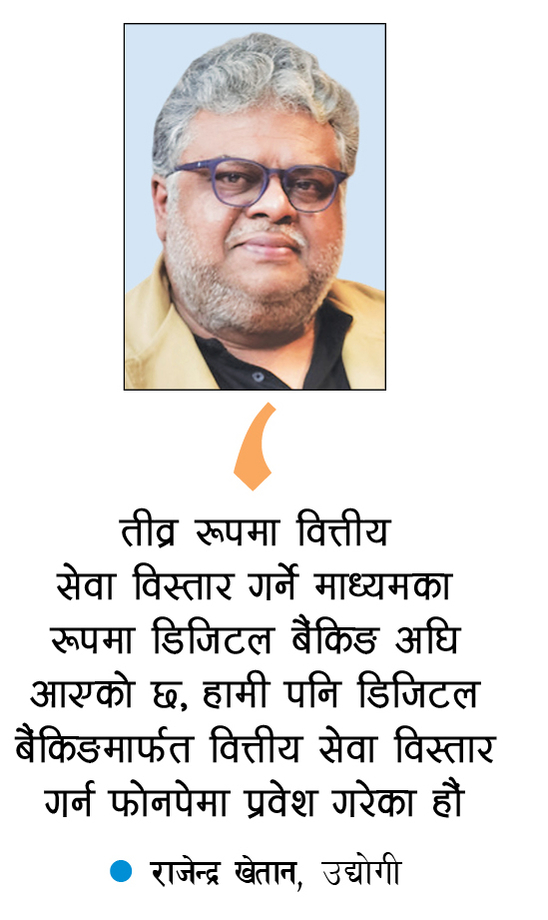 At present, various companies including Laxmi Sunrise Bank, Everest Himalayan Insurance, Mutual Fund Company, Venture Capital are operating under the main investment of Rajendra Khaitan. Along with finance, he seems to be actively involved in the financial-technology sector. Khaitan succeeded in entering PhonePay, which has dominated Nepal's digital payment system.
Rajendra Khaitan says that he decided to invest in PhonePay with the aim of providing banking services to the lower classes of the society who are deprived of financial services and access through modern banking (digital banking). "Investment in the financial sector is not new for me and my group," he says. We also want to expand financial services through digital banking in the backup of the bank.
Khaitan says that the goal is to expand the service so that the lower class of the society can easily get financial services through the app without physical presence. "About 7 million people have already opened demat accounts for investing in shares, our aim is to provide all types of financial services they need through the app," he added.
There was an attempt to bring in investment in PhonePay before. Three years ago, Fonesoft, the Maui company of PhonePe, prepared to sell its 20 percent stake to Dolma Impact Fund. At that time, a memorandum of understanding was signed with Dolma for a total valuation of 2 billion, but the transaction was stopped after the National Bank instructed that domestic investors should be given priority. "At that time, not only Dolma, but International Finance Corporation (IFC) also showed interest," says a Rashtra Bank official who is familiar with Phonepe's share structure at the time, "but they wanted to buy 20 percent." In the permission policy 2079 to be granted to organizations that work on payment, they withdrew after stipulating that there should be 100 percent foreign investment or that there should not be more than 15 percent foreign investment in domestic companies. Khaitan has managed to get that share now.'
Currently, 92 to 94 percent of the transactions through QR codes in Nepal are through PhonePay. The rest is done by Nepal Clearing House Limited. According to the company, 1.8 million transactions are done daily through PhonePe and it is worth 18 billion rupees daily. 1.3 million QR transactions and 5 million transactions per day are done by PhonePay for inter-bank fund transfers. The company has informed that since the QR transaction is free, the income will not be much, but there will be some income from interbank transactions. In this way, the annual income of PhonePay is more than 1 billion rupees and the company has informed that the profit of this year will be about 25 million rupees.
Fonesoft, the Mau company of Phonepay, is expanding new verticals like e-services, phone loans, phone points, micro investments. According to the company, PhonePe shares were sold to raise funds for this expansion. Company co-founder Subas Sharma says about Efwan's sale of phonepay shares, "Efwan is raising new ventures like phone loans and phone points, for which we need money, so we have sold some shares."
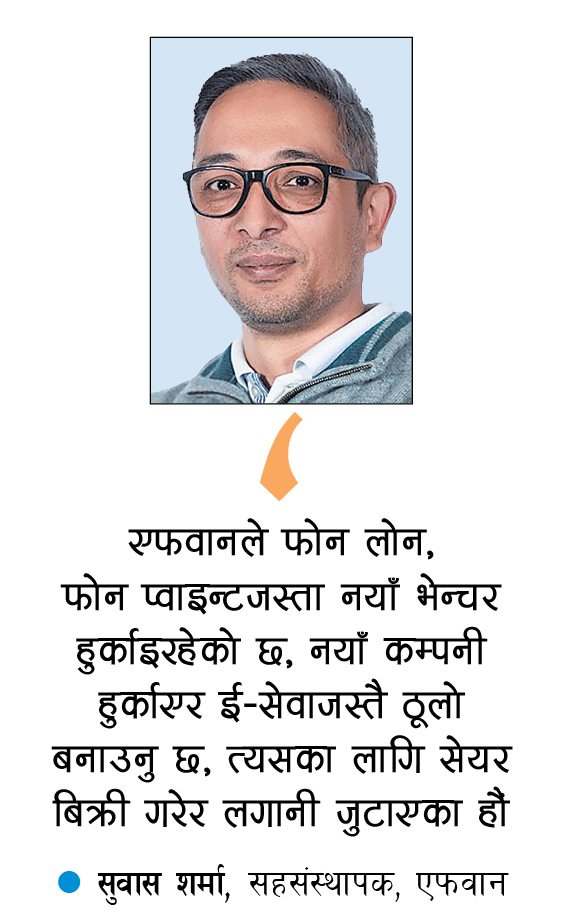 Since PhonePay, which was established in 2018, has been registered as a public company since the beginning, it is bound to go for IPO. Although there was talk of issuing an IPO in 2020 and last year, the company was left behind due to losses. The regulator National Bank is asking why it did not go for an IPO and now it is starting to earn profits, so it seems that it is ready to come to the stock market with an appropriate valuation. Fwan said that the money raised from the sale of shares will be used for new vertical expansion with a plan to spend it for the next four years. The company is also planning to issue an IPO and invest in new verticals.
Phonepe's Maui company Fwansoft has an investment of Biswas Dhakal, Samba Sirohia, Subhas Sharma and Subhas Sapkota. Sirohia is the managing director of Kantipur Media Group, he is on the board of directors of PhonePay. The remaining three investors in PhonePe are startup entrepreneurs. IT expert Asghar Ali was also there during the establishment of Fwansoft. Ali, who exited Fwansoft in 2024, also has shares in E-seva and e-seva money transfer under Fwan along with PhonePay. He is not involved in other new ventures of Fwan like phone loan, phone point. He is a technology expert advisor to Prime Minister KP Sharma Oli. But his share in Fwansoft's subsidiary companies seems to be decreasing gradually. On the question of whether any investor tried to exit by selling shares, Sharma said, "There is no situation where anyone can exit." One is that our work is not over, we have to grow our new companies and make them big like e-services.
On the other hand, PhonePe will have to go to public listing. It is estimated that this transaction may have been done to strengthen the financial situation by selling some ownership recently, as the founders will not be able to sell shares for three years after issuing the IPO. 19 commercial banks, 14 development banks, 14 finance companies, 9 wallets and one micro finance company are affiliated to PhonePay's service.

