We use Google Cloud Translation Services. Google requires we provide the following disclaimer relating to use of this service:
This service may contain translations powered by Google. Google disclaims all warranties related to the translations, expressed or implied, including any warranties of accuracy, reliability, and any implied warranties of merchantability, fitness for a particular purpose, and noninfringement.
Stakeholders have said that if education can be made technology-friendly, jobs can be created in the education and health sectors. They say that since the government cannot invest in every sector, the participation of the private sector should also be increased.
In the third session of the 'Gantavya Gandaki' program organized by Kantipur Media Group in Pokhara on Wednesday, the President of the Federation of Nepalese Industry and Commerce Chandra Dhakal stated that there is a need for skilled manpower in the present, not the future. "Cable cars are growing all over the country, there is a shortage of technicians to work on them," he said, "There is also a shortage of technical manpower in other areas."
He says that the government should strengthen regulation and encourage the private sector to invest in every sector without compromising on quality. "At one time I wanted to invest in a medical college to produce skilled manpower, I was moving forward for that, but when the private sector invests in medical education, it was looked at in a bad light," he said. He said that the government's policy should be changed because it is obstructive.
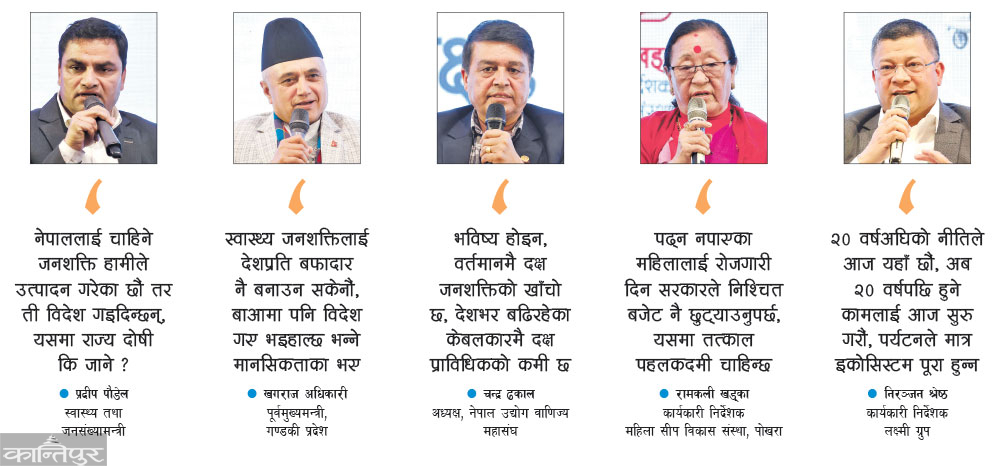
Health Minister Pradeep Paudel said that quotas given in teaching hospitals are interdependent as they are linked to quality and regulation. "The government will give the maximum number based on the maximum capacity, it is not possible to teach 100 students in a 50-bed hospital," he said.
Minister Poudel also claimed that he is trying to increase the maximum number of students in medical education without compromising on quality. "We cannot and should not produce quality health personnel," he said.
Minister Paudel claims that every year 5 lakh Nepali people go below the poverty line because they have to spend 54 rupees on healthcare for earning 100 rupees. He says that there is a need for structural reforms as there are complaints that even people with financial capacity are not getting good treatment. "The priority of the state should be structural reforms along with political reforms," he said, "we have produced the manpower that Nepal needs, but they go abroad, is the state to blame for this?"
Minister Poudel argues that if education and technology can be assimilated, competitive citizens will be produced and employment opportunities will also be created. He said that jobs cannot be created if traditional education is not changed in time. Executive Director of Lakshmi Group Niranjan Shrestha said that education, health and employment are important for the prosperity of Gandaki province. He emphasized that investment should be made now for the results to be obtained after the next 20 years.
"We are here today because of the policy of 20 years ago, let's start today the work that will be done after 20 years," he said. He also said that tourism alone will not complete the ecosystem of Gandaki province. Along with tourism, agriculture and information technology industry should also be promoted together, he said.
'The people needed by the information technology industry may be in Gandaki province, if it happens in Gandaki, the occupancy rate of hotels will increase,' he said, 'Many people working in the information technology sector are under stress, if you look at Google, you should ride a bicycle. If you go out in Pokhara, you can see a beautiful view. It can become a hub of IT.'' He says that even though Lakshmi Group reached this point by running the industry, Gandaki province is becoming unsuitable for production.
After the promulgation of the constitution in 2072, the former chief minister of Gandaki Khagraj Adhikari complained that the health service manpower produced could not be made loyal to the country. "After the promulgation of the constitution, we have not been able to make the health workforce loyal to the country, Baama was also oriented to the fact that it will happen after going abroad," he said.
Earlier, when he was the health minister, he said that 9500 students in Bangladesh went without taking a 'no objection letter', so there was a situation in medical criminology as well. "We have to follow international standards and send them, but we are sending them like that," he said. "Those who have not studied IAC cannot be sent out to study MBBS." is He is of the opinion that rather than encouraging the youth to go abroad, emphasis should be placed on making them stay here by giving them education in new subjects. He said that a new approach is also needed to bring back the Nepali people who have gone abroad and use their skills.
Ramkali Khadka, the executive director of Women's Skills Development Institute, Pokhara, said that the government should release the budget for job creation. He also says that women who have not been able to study should be stopped from going abroad.
'Educated people go to European countries and get opportunities, but uneducated women go to the Gulf countries,' she said, 'a certain budget should be allocated to give employment to women, the government should pay attention to this so that they can stay at home and earn money.' She told that because of this, most of the women went into the handicraft business. "That's why we are taking initiatives to increase the participation of women in the handicraft sector," Khadka said.
According to the data released by the Nepal Handicraft Federation, there are 1 million people involved in this field. Khadka also said that the annual turnover is more than 12 billion from the handicraft sector alone. "There is a situation where daughters who have not passed SLC and are not able to study are forced to go abroad," she said.

