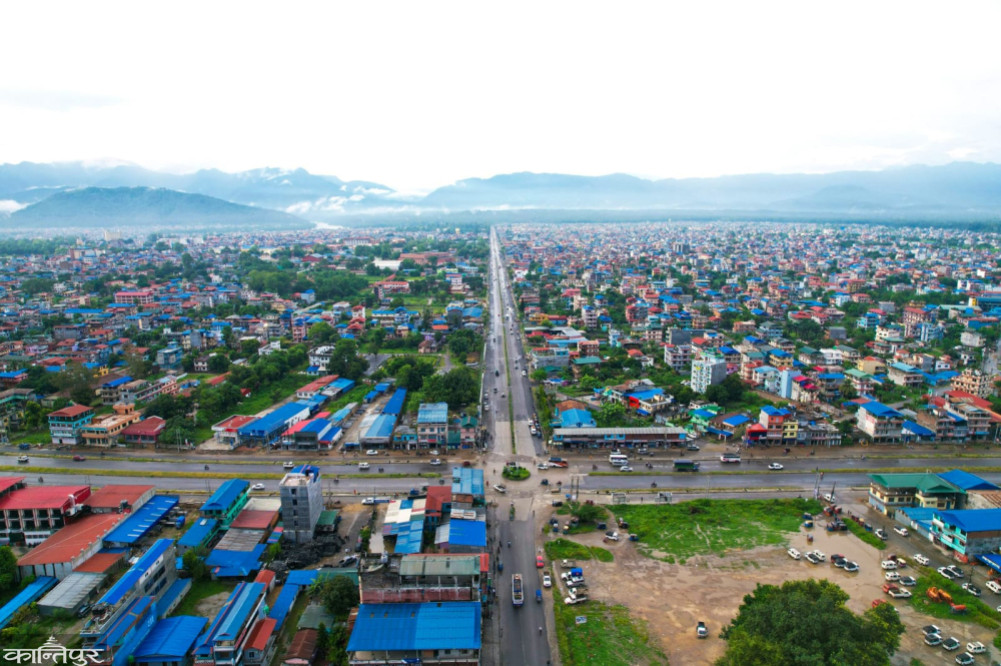
In Chitwan, there is a need for increasing agricultural productivity, business expansion and extensive investment in road infrastructure.
We use Google Cloud Translation Services. Google requires we provide the following disclaimer relating to use of this service:
This service may contain translations powered by Google. Google disclaims all warranties related to the translations, expressed or implied, including any warranties of accuracy, reliability, and any implied warranties of merchantability, fitness for a particular purpose, and noninfringement.
The progress of Bharatpur's medical and business sector and the opportunities created by new and old hotels from Sauraha on the banks of the Rapti River to Meghauli in West Chitwan have recently developed Chitwan as an attractive place to live, visit or invest.
But like in other parts of the country, most of the population of Chitwan is dependent on agriculture. Therefore, there cannot be inclusive progress of Chitwan without the progress of the agricultural sector.
In the hilly parts of northern Chitwan, due to the dry soil, there are many places where cultivation is done only once a year. Citizens dependent on agriculture in these areas are living on low income. If there is a native woman, the possibility of foreign income in such a family is also less. The southern part of Chitwan is relatively more lush, but due to the inability to control the flow of water, they face the problem of inundation during heavy rains and drought during lack of rains.
For the progress of the agricultural sector, timely advanced sowing, availability of fertilizers, embankment of the small streams of East Chitwan and Madi region as well as Narayani river are the major needs of the present time. Apart from that, old irrigation projects like Pithuwa and Khageri require periodic maintenance. Another problem for farmers is the uncertainty of the market. Due to the situation of having to throw away vegetables and milk from time to time, the return of income from cash crops has become uncertain. The private sector now offers some large moisture centers and reservoirs. In order to increase the income of farmers, the government also needs to invest together with the private sector or only the public sector to build interseason storage capacity.
Looking at those living in the hills of East Chitwan and within the park of Madi, the poverty of East Chitwan seems to be relative to the community. Some communities are more disadvantaged than others. Also, the poorer one is, the less skilled and agrarian they are. Therefore, the development of agriculture is a major part of Chitwan's long-term poverty alleviation strategy, it is also a social security program. Rather than sharing money, teaching long-term ways to earn money is the most effective strategy for poverty alleviation.
The underprivileged need water-saving technologies suitable for small and dry land, irrigation and the necessary raw materials (fertilizers, seeds, etc.) for agricultural production. It increases income through increased agricultural productivity. Since the year 2030, the country has adopted a policy that the government should bring in the import-export of agricultural raw materials in a situation where the government is unable to guarantee timely availability. It should be made more effective.
Another interesting fact associated with agriculture is the widespread landlessness in Chitwan. At least five thousand landless families live in East Chitwan alone. In slums like Salghari, Simreni, Garigaon and places like Madi, this problem is acute. While increasing agricultural productivity, the problem of the landless should also be solved.
These landless people are attacked by tigers when they are going to cut grass in the forest or picking mulberries, and wild animals eat them because most of the grain including wheat planted by them is in the fields near the forest. Most of the conflicts with the park are also due to the poor. The forest of Chitwan may be wealth for the country, but it has become a liability for most of the poor people living near the forest.
This uneven distribution of forest benefits has also contributed to increasing rather than reducing Chitwan's poverty. When it comes to agriculture and forest development, the landless farmers should be given priority.
The changes in the western part of Chitwan over the last few years are amazing. Luxury resorts and hotels are dotted along the banks of the Rapti River and have not only filled the void of the defunct 'Tiger Tops' but have also created new jobs. Hundreds of hospitals and clinics have been opened in the place of the lone Mahendra Hospital. BP Koirala Cancer Hospital providing specialized services is also in Bharatpur.
New departmental stores and restaurants have brought radical changes in people's shopping habits. The Rampur campus now houses a university. Embankment work has been carried out in Narayani and 'Signature Bridge' is under construction on this river. The road towards Butwal is being extended, while the upgrading of the Narayanghat-Muglin road has been completed.
According to the development of West Chitwan, the overall business size of Chitwan has not increased as much as it should have. On the one hand, small towns are being built in districts like Gorkha, Lamjung, Tanahun, and Dhading in the north, due to which they don't have to go to Thori or Chitwan for consumer goods like before.
Secondly, although the net population of Chitwan has increased due to internal migration, many of its residents have gone to live in countries such as Australia and America. When wealthy Chitwans move abroad or to Kathmandu, relatively poor people move to Chitwan, so overall consumption does not increase significantly, so the economy cannot accelerate.
Thirdly, despite being close to India's districts like West Champaran and Gorakhpur, Chitwan has not been able to take advantage of the 'cross-border' trade like other border districts, as the communication to the south is not direct and reliable.
The future of Chitwan in the field of business mainly depends on the speed of construction of road transport infrastructure. There are now three important works left in road transport in Chitwan.
One, building a reliable road to connect Chitwan with the north. Although this has been done by Narayangadh-Muglin road so far, as there are continuous obstacles here, we have to think about its alternative. The road from Bharatpur via Jutpani to Prithvi Highway through Shaktikhor-Majhimtar tunnel is an important option. This road will facilitate industrial and traffic.
After the completion of the Prithvi Highway upgrade, Pokhara and Kathmandu can be reached within two hours from both eastern and western Chitwan through this tunnel. Gorkha, Dhading, Lamjung, Tanahun, Kaski, Baglung and those with mountain houses who have many residences in Chitwan will use this road a lot. On the other hand, the Shaktikhor industrial area and the areas of Northern Khairhani, Kalika, Rapti and Ratnanagar municipalities where many industries are being established, this road will also facilitate access to the northern market.
Another option is the Chepang route, which aims to shorten the distance to Rasuwagadhi by connecting East Chitwan and Malekhu. Chepang Marg also connects the backward wards of Rapti Municipality with the national main stream. So its not only professional but also social aspect is equally important.
two, a reliable option to connect Chitwan with the East. Its main means is the east-west highway. But the incredible delay in the construction of Pathalaiya-Narayangadh section is causing irreparable damage to Chitwan. In fact, the expansion of various sections of this road from Kakadvitta to Dang has progressed in various stages.
But the work of advancing Pathlaiya-Narayangadh section, which is said to have the highest number of vehicles, has not been prioritized. Another important road proposed by the government to connect to the east is the expressway from Chitwan to Kathmandu via Thaha municipality. This project was also proposed by the government in the previous investment conference. It can be believed that this road will be given the highest priority as the era of highways advances in the country.
three, a reliable option to connect Chitwan with South. For a long time North Chitwan and South Chitwan (Madi) were not well connected. Mainly, the management of the road that cuts through the park was not easy. Just as there was no dispute about cutting the forest of Barandavar to make a road while connecting the eastern and western parts, similarly there was no dispute about cutting the park and going to Madi. As a result Madi fell behind comparatively. While even till 2020, the future of Madi, which is close to the important markets of Vihar, Betia, Narkatiyaganj, was considered good.
The Madi to Thori road and the Madi to Bharatpur road are not connected, making Chitwan one of the few districts in the Terai that do not have a direct and short connection to the Indian market. The development of these three roads that facilitate communication seems to make Chitwan easier in terms of movement from within the country to outside the country. These infrastructures will boost the business of Chitwan and its 'spillover' effect will also affect the farmers.
Chitwan now needs regulatory intervention and extensive investment in road infrastructure to increase agricultural productivity and business expansion. It is through this path that inclusive and equitable development can be promoted.