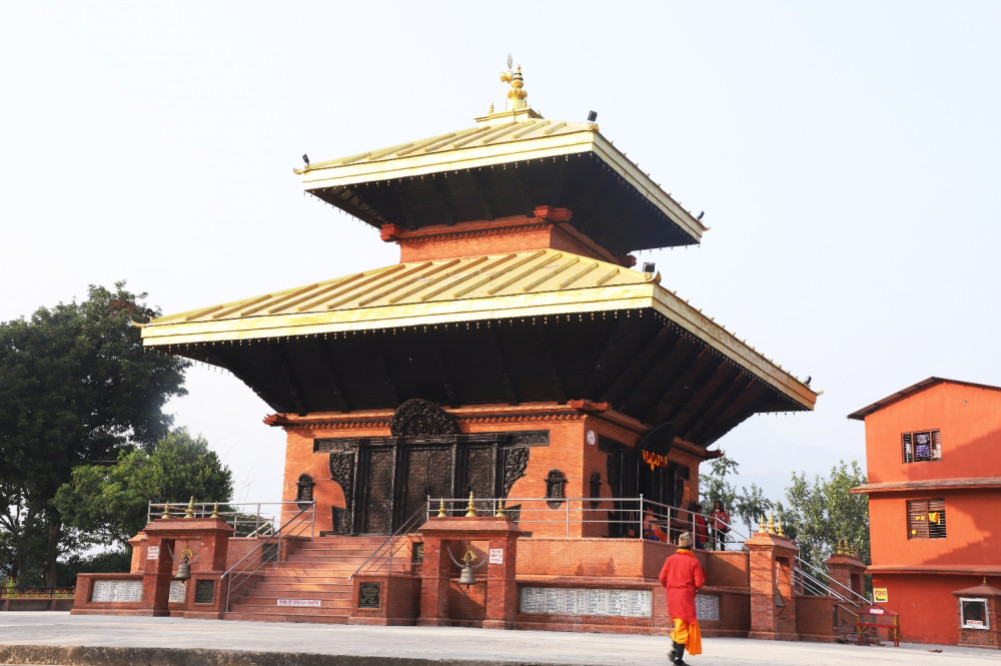
The importance of ancient sacred religious places in Chitwan, Nepal's best destination for pilgrimage, is noteworthy
We use Google Cloud Translation Services. Google requires we provide the following disclaimer relating to use of this service:
This service may contain translations powered by Google. Google disclaims all warranties related to the translations, expressed or implied, including any warranties of accuracy, reliability, and any implied warranties of merchantability, fitness for a particular purpose, and noninfringement.
Rich in historical, religious, natural and cultural heritage, Chitwan has enough religious places. Here there are 3 types of land, namely Chure-Bhawar Province, Terai Province and Mahabharata Lake, in an area of 2238 square kilometers at a height of 141 meters to 1947 meters above sea level.
About two-thirds of the area is covered by forests, mountains and wetlands, including Chitwan National Park, which is listed in the World Heritage List. The importance of ancient sacred religious places in Chitwan, Nepal's best destination for pilgrimage, is remarkable.
When tourists come to visit holy places of historical, archeological, and religious significance, the destination is widely publicized. Stakeholders insist on the protection of religious heritage. Chitwan can be promoted as an evergreen destination through the development of religious tourism, which is considered important after wildlife tourism in the tourism sector of Chitwan.
By protecting and promoting art, culture, tradition, etc., infrastructure is developed even in backward places and local people benefit from tourism development. But day by day, there is an equal challenge to stop the theft and export of the valuable goods of the mythological idols and temples and to prevent the encroachment of the religious places. It is also a challenge to develop infrastructure in sacred religious places which are often located in remote places and study and prove them from archaeological centers. Locally there are many monasteries in Chitwan. But some major religious heritages are discussed here—
Devghatdham
6 km north of Bharatpur, the confluence of Trishuli and Kaligandaki, Devghatdham is a sacred place with religious glory. Located at a height of 200 meters to 575 meters above sea level, this Dham is considered to be the best area for peace and spiritual upliftment.
There are religious places like Galeshwar Ashram, Chakreshwar Shila, Sita Cave, Vashishta Cave, Harihar Temple, Mahesh Sannyas Ashram, Ram Temple, Yagyasala, Sidghi Ganesha, Gopidham, Suryakunda, Pashupatinath towards Chitwan and Tanahun. It is mentioned in Himavatkhand Nepal Mahatmya that Mahadev Shankar lived in this area with his followers.
Spread over an area of about 5434 hectares in the three districts of Chitwan, Tanahun and Nawalpur, Devghat is also known as Harihar area, Shaalgram area, Chakratirtha, Barah area, Kadambatirtha, Gajendratirtha, Tapovan, Prayag, Siddashram Yajnabhumi etc. It is customary for pilgrims from India to come to the Maghe Sankranti fair. And, even in July, lakhs of devotees come to Devghatdham to bathe. Not only Maghe Sankranti is here, but because of the sanctity and religious significance of Saun, there is a rush of pilgrims.
As the Vishnumulak (Har) Kaligandaki flowing from Damodarkund and the Trishuli flowing from Gosaikund meet at Devghatdham, the sacred religious site, the Harihar Circuit has been built to promote religious heritage by including the heritage of this Harihar area. Kaligandaki has many civilizations and cultural settlements on both its banks. Historical places like Lomanthang, Ranimahal, Mukundasen Durbar, archaeological places like Tatopani, Thakkhola, Tribhuvantar, settlements of human civilization like Jomsom, Veni Ridi, Narayangadh, Golaghat are included in the Harihar Circuit.
The major religious places in the Harihar Circuit are Damodar Kund, Muktinath, Kagbeni, Galeshwardham, Panchkotdham, Kundule, Shaalgram Museum, Baglung Kalika, Pulah Ashram, Sahasradhara, Galeshwar Cave, Modiveni, Jamirghat, Purtighat, Setiveni, Rudraveni, Bhairavasthan, Ranighat, Ramdighat, Keladidham, Devghatdham, Shivaghat, Kalika, Brahmasthan, Bhojbaba, Gajendramokshadham, Valmiki Ashram Trivenidham etc.
Vagishwari
A historical and archaeological site near Devghatdham, Vagishwari is the abode of Yogi Narharinath . Devotees have built temples and established a cow conservation center at this site where there are ruins of ancient temples. Yogi Narharinath envisioned a cow conservation center in Wageshwari because cow urine, cow dung, milk products etc. are beneficial for the human race from a religious and health point of view. Be it natural treatment or Ayurveda method, it has started in Wageshwari.
Someshwar Kalika
Someshwar is mentioned as the abode of Shiva in the mythological texts Barah Purana and Gandaki Mahatmya. Thousands of devotees even from India come to visit the Kalika temple near pillar 45 of the Nepal-India border. This strategically important fort is listed among the 100 tourist destinations chosen by the Nepalese government.
The ancient Someshwar area here is mentioned in the Barahpuran and Shivpuran . At an altitude of 800 meters above the sea level, the ancient Peetha can be seen in the ruins of beautiful carved stones, old bricks, Someshwari Kalika, old swords, large stone boats, wells, boundary pillars, stone ponds, waterfalls, etc. historical and archaeological settlements.
Pandava Nagar
Pandava Nagar area in Madi Municipality-1 includes sacred religious places like Goddaknath, Panchapandava Temple and Parashuram Kund . As mentioned in various religious texts, the Panchapandava temple was built when the Pandavas lived in this area. Near the temple there is an ancient well made of stone with a diameter of 11 feet and a depth of 50 feet. After walking for about two hours from here, you will reach Parashuram Kund.
Parashuram Kund, which is at a height of 700 meters above sea level, has a waterfall made from the Devta River. It is said that this Parashuram Kund is one of the 108 Kunds in India built by Rishi Parashuram for atonement. A large number of devotees come from India to witness such religious heritages that delight all kinds of tourists. Draupadi Kund, Yudhishthira's Umbrella, Virat King's Goth etc. are historical heritages here.
Valmiki Ashram
At Valmiki Ashram, a historical religious center located 2 km east of Trivenidham, every ruin provides curiosity to pilgrims. Here are temples of Valmiki, Lava, Kush, Sita, Hariharnath, Shivlinga, Baraha Avatar, Navagraha, Vishnu, Laxminarayan, Vaman Avatar, Hanuman etc. are decorated on the inner wall of the temple. Also, the ruins of different forms of Agnikunda, Sitavatika, Lavakush Pathshala, Yagyashala, Gaushala, Dharamshala etc. are the religious heritages here . Tourists can enjoy adventure walks, trekking, wildlife, bird watching, etc. in this area where sage Valmiki meditated. Valmiki area with Dharamshala and small hotel facilities in Gajendramokshadham is a religious destination that is the main choice of Indian tourists as well.
Trivenidham
Trivenidham on the border of Nepal and India is the confluence of Narayani, Sona and Tamosa rivers . A holy place of pilgrimage for Hindus, this dhama is close to the Chure snow range, a unique gift of natural beauty. Especially on Maghe Aunsi and Chaite Dasain, thousands of devotees from India and Bhutan participate in the Triveni Dham Mela.
Thus, Ram Janmabhoomi Ayodhya Dham is among the major Dhams of India. If the Harihar circuit is coordinated with the Ramayana circuit built in this holy place near Nepal, more than 50 million pilgrims can be brought annually.
Kashi Vishwanath, Tirupati Balaji, Shri Saibaba Temple, Vishno Devi Temple, Rishikesh, Dwarka, Harihar, Mathura, Prayagraj, Ujjain, Chardham etc. hundreds of pilgrims visit hundreds of religious places. Based on various religious texts, it is believed that salvation cannot be attained without bathing in Devghat Dham even after visiting all the Dhams. Therefore, if the topic that Devghat Dham is the Dham of all Dhams can be propagated, it can play a big role in Nepal's tourism.