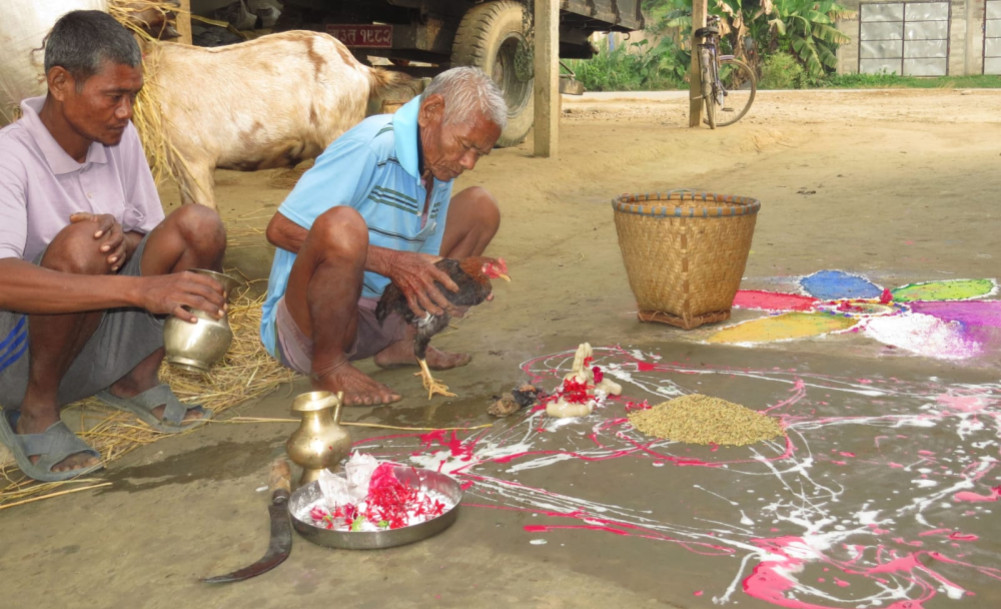
Tharu culture, dress and food are the main attractions of tourists visiting Chitwan, while other communities are interested in the lifestyle and festivals of the Tharu community.
We use Google Cloud Translation Services. Google requires we provide the following disclaimer relating to use of this service:
This service may contain translations powered by Google. Google disclaims all warranties related to the translations, expressed or implied, including any warranties of accuracy, reliability, and any implied warranties of merchantability, fitness for a particular purpose, and noninfringement.
Chitwan is called the 78th district of the country due to the attraction of people migrating from different parts of the country. This is not only because of the number of immigrants. The diversity seen in the ethnic and cultural traditions of those who come here is also making the district a common flower garden.
The population of the district is increasing rapidly due to migration for various reasons. The debate has not yet started that it will cause various problems and challenges in the future. Although many castes have settled over time, Chitwan is known for its indigenous people including the Tharu.
There are different castes living in different parts of the district. They have their own characteristics. But the importance of the Tharu community is different among the tribes associated with water, forest and land. The living and eating habits of the Tharu community, priests of nature and culture, are helping to boost tourism in the district, while on the other hand, the community has been playing a major role in protecting the precious biological diversity.
When talking about tribals in Chitwan, it is not enough to describe a single community. Looking at the presence of tribal communities, Chitwan is a 'tribal museum'. Before the elimination of malaria and malaria in the Terai region of Nepal, 90 percent of the territory of the Terai region was covered by forests. Even in unfavorable conditions, 90 percent of the population in Chitwan were Tharu and the remaining 10 percent were the marginalized communities of Bote, Musahar, Kumal, Sonahar, Darai and Chepang communities in the hills. The indigenous Tharu and other castes have their customs, costumes, and nature, which have been inhabited since ancient times. They have been protecting and using wildlife since tradition. The main occupation of the Tharu caste is agriculture. So they had a lot of knowledge about agriculture.
Before the eradication of malaria and malaria, modern agricultural systems were not practiced. The population in Chitwan was very low. As the land was sufficient for agricultural work, the Tharus used to shift the land for cultivation every five years. Being dependent on agriculture, to make this task easier, every household kept 2/300 cows and cattle. Which used to get fertilizer for agriculture. Farming was easy. The tribal Tharu, Bote, Musahar, Kumal and Darai were the only castes in Nepal that could digest the dreaded disease like malaria and still are. Before 1952, i.e. during the malaria outbreak, there were zero other castes living in the Terai for twelve months.
Chitwan was divided into 5 regions by tribal Tharus to make it easier to work politically, geographically and administratively. Which was called Prangana in Tharu language. Accordingly, East Chitwan was called Chitaun Pargana, Madi region was called Madi Praganna, Kasara region was Belod, Meghauli region was Tar and Divyanagar region was Kalabanjara Praganna. Before the migration from the hills started, all the mentioned areas of Chitwan were dominated by Tharu. Before 2012, there were about 150 to 175 mauzas (small villages) in Chitwan. Eastern Chitwan i.e. Chitaun Praganna and Madi Praganna had a large number of Tharu communities. There were 8 Kumal community villages in Belod Praganna (from Gauriganj to Patihani), Tar Praganna (from Chanauli to Golaghat) and Jitpur area under this Praganna in the present Bharatpur Metropolitan Municipality.
Tar Praganna's area was only in Gitanagar and Divyanagar gavis. The Chepangs lived in the hilly area of Chitwan. In Chitwan, tribal communities used to speak different languages. From the point of view of language, the tribal communities of Chitwan speak different languages from those of other districts. Therefore, the language of the Tharu of Chitwan can be an important form of study in terms of linguistics. The main occupation of the Tharus is agriculture. Along with agriculture, Tharu's lifestyle was different from that of other tribes because they had to live with the forest and the environment. For example, Tharus had ghongi, chichar, black duck meat, fish and forest vegetables as special food and they had special knowledge about it. The major festivals in Tharu Masuday are Jitia, Yamosa (Pitru Aunsi), Sohrai (Tehar), Khichra (Maghi), Phaguwa (Holi). The style of making every festival is also different. The dances performed during these festivals like Jhamta, Lathi Naach and Sardhari Naach have recently helped to promote tourism in Chitwan.
Tharu culture, costumes and food are the main attractions of tourists visiting Chitwan. The traditional culture celebrated by the Tharus has become the main choice of tourists today. The language, dress, lifestyle, dances and festivals of the Tharu community are different from other communities. The Tharus are considered to be a caste that wears a lot of jewellery. Connecting with this culture, there are 7/7 male and female jhamta and lathi dance groups in Sauraha of Chitwan, the third tourist area of Nepal. Similarly, there are 2/3 dance groups in Kasara region, 3/3 in Meghauli region and 1/1 in Madi region.