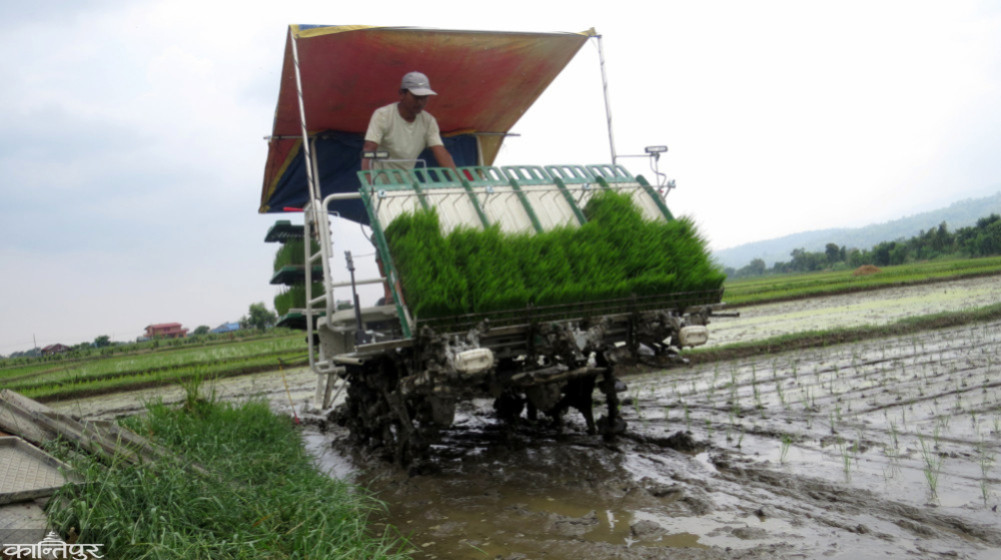
The irony in Chitwan's agriculture is the shrinking of the land at a rapid rate, the political patronage of the fertile arable land and the political protection of the plotting business will make the Chitwan of the future not a farm, but a 'Kausi Khet'.
We use Google Cloud Translation Services. Google requires we provide the following disclaimer relating to use of this service:
This service may contain translations powered by Google. Google disclaims all warranties related to the translations, expressed or implied, including any warranties of accuracy, reliability, and any implied warranties of merchantability, fitness for a particular purpose, and noninfringement.
Chitwan is mainly the homeland of the Tharu, Bote and Chepang communities. Before the land management according to the government's will, the Tharu community used to live in villages and villages, doing shifting cultivation. The Bote community used to survive on fish and forest products along the river banks. It is understood that the Chepang community living in the hills has been surviving on the cultivation of wild fruits, tuberous roots and pakhobari till the last decade.
The Tharu community was relatively ahead in economic productivity activities with farming and animal husbandry in the plains. The other two communities were left behind. In the context of the economic productivity of agriculture in Chitwan, the period before and after 2013 should be understood. Chitwan is geopolitically and economically made up of five 'clusters' - Pahad, East Chitwan, Bharatpur, West Chitwan and Madi. This division is somewhat like a hierarchy of 'intelligibility'.
The four 'clusters' of the plains became rapidly affected after the expansion of the effect of the resettlement plan established by the Raptidun Development Department Office in 2013 under the provincial development plan at the then Bharatpur Mauza. Almost a decade later, the agricultural economy here seems to have picked up significantly. The hill section has been lagging behind in the flow of 'economic development' since the beginning. Farmers made it a 'mustard district', a 'paddy storehouse'. After that, they created the 'Capital of Poultry', now they are going to make vegetables and 'Hub of Agro Tourism' as well. Among all these, which class and region have taken or are taking the most benefits in the politics of Chitwan, who is leaving and where? Why did you leave? If agriculture is going to be the mainstay of the economy here, how to attract the left out groups and communities to the flow of economic production? This debate has yet to be resolved.
History of agriculture in Chitwan
Till a decade after 2007, the winter headquarters of Upardangarhi and Barkhe sub-districts of Zhuwani, which were the then headquarters, were used to pay taxes on the produced crops. The Ranas appointed Chowdhury, Amali at leisure to raise Tiro. There were also the Ranas who signed with the Tharu zamindars to fulfill their implicit objectives. But there was no state presence in the village. Interestingly, as in other districts of Madhesh, the land was not seized by the nobles of Kathmandu by giving them 'jagir-khanki', and Chitwan survived the misfortune of falling into the long vicious cycle of 'Pahadia-Zimdari'. But some of the good produce was sent to the Rana's palace.
There was no market for selling crops in Chitwan. It seems that till the 20s, thori route was used to export agricultural products across the border. Old people are still alive who reminisce about riding horses from across the border to Chitwan including Madi and going from village to village in winter, carrying collected rice and returning through thori forest. After the Narayangadh market was organized and the local galla traders expanded the market, the market for rice and mustard produced mainly in West Chitwan and Madi was established in the Narayangadh center. Tandi and Parsa markets in East Chitwan became buzzing due to agricultural produce.
In the year 2011, a large population became involved in agricultural work after rehabilitating the victims of the large flood and landslides that occurred in the hilly districts of central Nepal and allowing them to expand the arable land. In 2013, the economic rejuvenation of Chitwan was going to happen after the hill communities who were able to live almost for free under the rehabilitation plan and bought land from Madhesh to "eat their stomachs full of rice" were included. The loss of democracy in 2017, the establishment of Bharatpur headquarters in 2018, political leaders organizing farmers and farmers' movement in various places of Chitwan to bring about social upheaval were important events of this phase.
Diversification of agriculture
The hard work and courage of the hill community mixed with the honest and straightforward Tharu community towards their land. As the new society was being built, the economy took a big leap. The old farms and settlements built by the Tharus were being destroyed. After the resettlement, new cultivation fields were being built. The sale with the Galla traders, who received a lump sum of cash in the season by farming enough for themselves, was established as an 'agricultural utility'. It is only after the political change of 2047 that animal husbandry and poultry became commercialized.
Although big announcements were made as 'pro-economic freedom' to coordinate with the world order after 1990, there was no reliable 'channel' of encouragement from the state. Instead, inspired by the spontaneous facilitation of the open environment and diversification practices in the agricultural sector in neighboring India, private 'projects' of animal husbandry, poultry, bananas and fish expanded in Chitwan as farmers began to search for new sources of livelihood and income. This changed the 'metaphors' of Chitwan's agriculture. But unfortunately, with those changes, Chitwan also became a big market for pesticides and chemical fertilizers. We are not going to discuss the irony here.
New Mode : Journey to Solution
Agronomist Bhaneshwar Pokharel, who is also operating a farm stay targeting farmers who come to Chitwan for training in agricultural production and research, says, 'Chitwan's agriculture is becoming solution-oriented. As the production cost is low and the 'volume' of production is high, the products of Chitwan are now cheap all over the country, which has become a trend of cheapening of vegetables in the market after Chitwan's vegetables are produced. But even though it is cheap, since the amount of productivity is high, the profit for Chitwan farmers is better than elsewhere.'
Agriculture in Chitwan has not long taken the path of diversification on a large scale. Farmers seem to be interested in multi-agriculture from vegetables to fruits to milk, fish and even livestock in the same farm. But at the private level, they are mostly involved in 'monoculture' like vegetable, poultry, animal husbandry, fish farming and banana farming. Even at the community level, they are engaged in farming only vegetables or different types of fruits by renting large areas of land.
Even in the hilly areas of Chitwan, the number of farmers active in vegetable and fruit farming with attractive products is increasing. Traditional agriculture as well as commercial cultivation of seasonal vegetables is growing at a significant level in the wards which are mainly inhabited by the Chepang community. Thousands of orange and kiwi plants have been planted here. Another interesting character who came up with the success story of collective farming in Chitwan is Santosh Bote and his group. In 2076, he formed a group of 18 people from the Bote community and got involved in commercial vegetable farming. Those involved in organic farming are also encouraged to give tips to those who come to buy vegetables from the garden. Santoshi Majhi is the president of this women-run group and Rachna Mahato is the secretary.
What should be done now?
About 70 percent of the country's total consumption of chicken meat is being met by Chitwan alone. Although this is a matter of pride, Chitwan's agriculture is not only poultry. It should be seen how many 'hygienic' products have been produced in poultry. The state should also pay equal attention to the potential of other areas of production. Professional security should be enhanced in all types of agricultural enterprises. The scope of agricultural insurance should be defined and broadened.
Land easement is a special 'moderator' of Chitwan's agriculture, which has created an environment where production costs are low and profits are high. It is Chitwan's 'privilege' to be at the center of the geographical and road network of the country. Chitwan should be able to take full advantage of this. Another 'moderator' here is the agricultural policy of local and state governments. However, it needs a lot of improvements and modifications. If it is not possible to stop the misuse of subsidies, the 'cheating' that is not seen in the field, it will definitely lead to the destruction of the state and the loss of credibility of the agricultural enterprise. The most ironic aspect of agriculture in Chitwan is the rapid rate of land shrinkage. There is a situation where political patronage of fertile arable land and plotting business will make the Chitwan of the future not a farm but only a 'Kausi Khet'.
Another important thing, the state does not yet have an Agriculture Act. This is a shame. Wagmati Province has made the 'Agribusiness Promotion Act', the study and monitoring of the implementation of the Act is zero. There are no comprehensive programs to attract women into commercial agriculture, who contribute the most to agriculture. Even now, the wages of women and men in agricultural labor are different. Out of the five 'clusters' of Chitwan mentioned above, it is necessary to formulate community-oriented and women-farmer-oriented programs on the basis of priority. Agricultural enterprises including Tharu-Bote communities in the plains and Chepang originality in the hills should be promoted along with tourism.