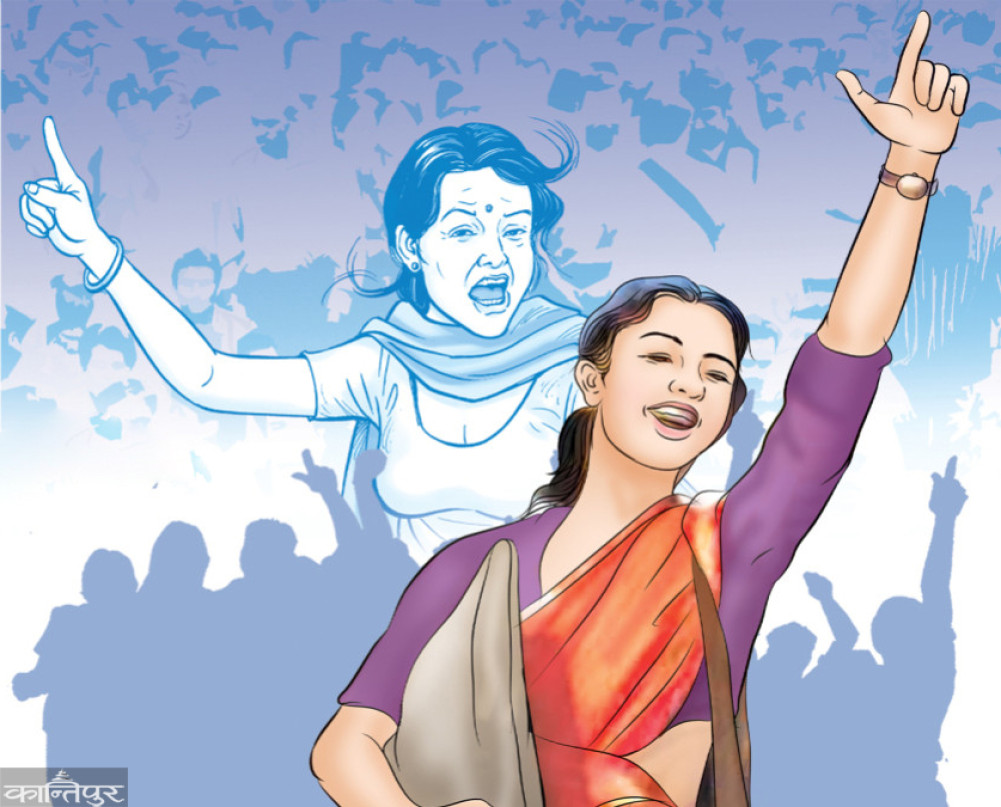
Malnutrition is a major problem for women in Lumbini region. According to the Health and Demographic Survey, Lumbini is the second most anemic state among women aged 15 to 49 years.
We use Google Cloud Translation Services. Google requires we provide the following disclaimer relating to use of this service:
This service may contain translations powered by Google. Google disclaims all warranties related to the translations, expressed or implied, including any warranties of accuracy, reliability, and any implied warranties of merchantability, fitness for a particular purpose, and noninfringement.
According to census 2078, Lumbini has a population of 51 lakh 22 thousand 78. Out of which 24 lakh 54 thousand 408 men are there and 26 lakh 67 thousand 670 women. That is, there are 213,262 more women than men. In terms of percentage, men are 48 percent and women 52 percent.
When it comes to rights, women are far behind. Like: Only 29 thousand 641 or 2.6 percent of women in Lumbini own houses. Women who own land are slightly higher at 9.3 percent. 74.8 percent of women do not own any real estate. Only 35.5 percent of women have become housewives. This confirms that women's rights and their implementation are weak in Lumbini province.
Lumbini Province is located in the center of the country. Consisting of 12 districts of Himalayas, Hills and Terai, Lumbini Province is a province full of potential from the point of view of development. Lumbini is also making leaps in infrastructure development. However, Lumbini province is weak in terms of women's rights, gender equality, diversity and social inclusion. There is gender and social discrimination in education, health, marriage, traditional culture, patriarchy, politics, employment, wages, reproduction, workplace responsibilities, budgets and programs. Because of those differences, violence is born. There are many women here who are forced to commit suicide because they cannot tolerate violence.
According to the situation report 2076 published by the Lumbini state government, 22.6 percent of women here have been victims of physical violence, 14.8 percent of mental violence and 8.3 percent of women. 70.4 percent of the victims of violence stated that they would not tell anyone about the violence they experienced. There are 14 lakh 9 thousand 965 single women in the state. Both figures are more than other provinces. Single women are also the victims of violence. Class discrimination, lack of equal access to development for all, lack of gender and inclusive development, and omission of target groups in the budget are the main reasons for this. This is also due to the tendency to spend in unproductive areas for cheap popularity.
The complaints of physical, mental, marital, child marriage, polygamous sexual violence and abuse, corruption and bad culture-related violence are increasing every year. Trafficking and trafficking, violence in public places, deprivation of economic and property use, violence caused by misuse of social networks, political sphere, citizenship and identity and employment related violence are significant. It has been seen that violence has been committed because many believe in conservative culture, do not give women the status of human beings and do not understand gender sensitivity. Addressing diversity and not paying attention to social inclusion has not been able to resolve conflicts socially and guarantee women's human rights.
Let's talk about women's health, Census 2078 showed that the maternal mortality rate has decreased across the country. However, it increased in Lumbini. 151 deaths per 100,000 women become mothers across the country. 207 out of 100,000 women mothers died in Lumbini. There are many reasons for maternal mortality. Most of all, anemia and malnutrition in women have pushed them to the face of death. On top of this, many mothers have lost their lives due to not having regular pregnancy tests, giving birth at home or not going to a specialist hospital. The Constitution of Nepal has given women the right to safe maternity and reproductive health. The Safe Maternity and Reproductive Rights Act, 2075 has been implemented to make the services safe, quality, accessible and accessible. Only 13 out of 199 municipalities in Lumbini province have reduced the rate of home births to zero. It is a challenge to increase.
Malnutrition is a major problem for women in Lumbini region. According to the Health and Demographic Survey, Lumbini is the second most anemic province among women aged 15 to 49 years. In Madhesh, 52 percent of women are malnourished, while in Lumbini, 44 percent are malnourished. Among women aged 15 to 49 years, Madhesh has the highest number of 29 percent, followed by Karnali and Lumbini respectively. 22 percent of women in Karnali and 19 percent of women in Lumbini are homeless. Many women and children in Lumbini are malnourished due to early marriage, childbearing, inability to eat nutritious food, and inconsistent eating and feeding practices, according to a Lumbini Health Directorate study report. Therefore, more investment in the health of women and children is necessary to eliminate malnutrition.
Lumbini is one of the 87 state assembly members and the only directly elected woman MP in 26 constituencies of the union. Out of 119 local levels, only 2 have female leadership. So far, women have not been able to become Chief Ministers, Heads of States and Speakers of Parliament. Nor are there women in the leadership of the parties themselves. It also does not implement the right of women to make political decisions. Women are limited to workers rather than leaders. There are many who do not rule, but only clap in speeches.
As in Nepal, Lumbini has a large share of economically active women. However, their access to financial resources is low. 75 percent of women are involved in unpaid service household responsibilities. A greater proportion of women than men are active in work such as agriculture and household management. However, the lack of formal employment or alternative livelihood opportunities has limited women's participation in economic growth. Women have to get involved in service work.
Lumbini province has made a gender policy this year. However, there was not enough discussion from the formulation of the policy to the time of its adoption. There are many laws to be made by the state assembly regarding women and sexuality. However, the state government has spent 6 years in creating policies, laws and programs to run the administration and increase facilities rather than the needs of the citizens. The civil law was enacted during the second term of the state assembly. We discussed it enough. Better than anywhere else. We provided leave facility to female employees during menstruation. It is linked to women's health and reducing maternal mortality. However, the work of discussing many bills in the subject committees of the provincial assembly and taking suggestions from external stakeholders is almost zero. The practical implementation of the law made by it is also weak.
Women's empowerment is not only about training women but also about transferring resources and power to them. It is important for women to come into politics and lead. No woman belongs in the party kitchen cabinet. In the name of keeping women, party leaders should stop keeping daughters, wives and daughters-in-law. The state has said 33 percent women in every field. However, in the name of inclusion in the government, barely one woman is included in the cabinet. All girls and women should have access to education. Women should be involved in entrepreneurship. As soon as we think of entrepreneurship, we are only thinking of things like sewing, dolls, pickles. The biggest thing is that the state should create an opportunity for women to implement what is given by the constitution and laws.
(Giri is a member of Lumbini State Assembly from Nepali Congress.)