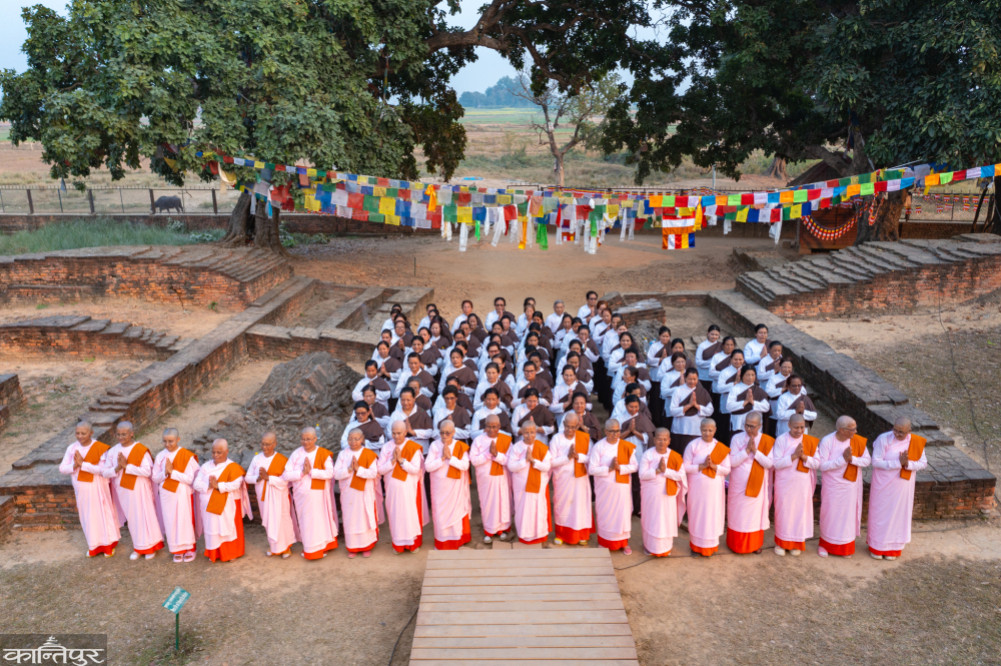
Gautama Buddha is regarded as the pioneer of peace. Therefore, it is important to convey the message that Lumbini is the source of world peace at a time when unrest, conflict and war are increasing in the world. Lumbini can also be made a place for peace talks by branding it
We use Google Cloud Translation Services. Google requires we provide the following disclaimer relating to use of this service:
This service may contain translations powered by Google. Google disclaims all warranties related to the translations, expressed or implied, including any warranties of accuracy, reliability, and any implied warranties of merchantability, fitness for a particular purpose, and noninfringement.
Where was Buddha's birthplace Lumbini one and a half hundred years ago? What was the condition? No one knew. The facts were under the soil. Therefore, according to the mention of Lumbini in the Buddhist scriptures, the rulers and archaeologists of that time were giving their own interpretations. Chinese travelers who came in ancient times mentioned about Buddha's birthplace in their travelogues.
Those itineraries are the basis of the Lumbini search. Chinese travelers who came at different times mention the place where Buddha was born and the environment there. Their description mentions the presence of an Ashoka pillar at Lumbini. Mention is made of Puskarani Pond. He has clearly written about the presence of Bodhi trees and the surrounding natural conditions. However, the said fact of Lumbini was overshadowed for a long time.
There was not much interest in the search for Lumbini in our country. The Rana ruler of that time restricted foreigners from entering Nepal. The state of research in the country was zero. Therefore, it was only assumed that Buddha's birthplace was around Uttar Pradesh, India. Archaeologists under the then East India Company were searching for the birthplace of Buddha. Lumbini was rediscovered on December 1, 1896, following the accounts of Chinese travelers. Then the world came to know about Buddha's birth place.
When Lumbini was discovered, then one or two pilgrims started coming. In the beginning, they started coming to see Lumbini with their own food, clothes and blankets. Traffic was not easy at that time. He spent a long time searching. Gradually, the number of pilgrims started to increase as the word spread about Buddha's birth place. From 1955/60 they started coming in groups of two/four people. For a long time there was no accommodation in Lumbini. Even if tourists came, they had to find accommodation themselves.
Hotel lodges were not opened in Lumbini until 1982. In the year 1985, Buddha Hotel was opened in Padaria with 4 rooms and two dormitories. That was the first guest house. It was also built for the residence of dignitaries. Currently, 72 hotels and restaurants are operating in Lumbini, including 4 star level hotels. Seeing the tourism potential of Lumbini, many hotels and restaurants have opened in this way. Many pilgrims and tourists come here. They stay in a hotel. They pay money. Due to the pilgrims, not only Lumbini but the whole district business has flourished. A lot of investors have started focusing on Lumbini because of earning.
The branding of Lumbini started 40 years ago. Lumbini has taken an economic leap when comparing the initial and current situation. 3 to 5 star hotels are operating here. There are two Japanese named star hotels in the Lumbini complex. Other hotels are also open. are still opening. From the point of view of pilgrim arrivals, the condition of Lumbini has increased.
Lumbini is an established and important Buddhist pilgrimage site. However, many people have not been aware of what causes problems when pilgrims come here. Foreign pilgrims are facing a lot of problems on the border between Nepal and India. For the pilgrims coming to the country, the paperwork to be completed at the Indian immigration has been made more complicated. A long form must be filled. There is no need to fill in many details for people leaving any country. However, at Indian immigration, you have to queue for hours and fill out a complicated form. As soon as the guest enters India, he/she has submitted detailed information about himself/herself. Why do you think you have to fill the same details again?
After completing the process in India and entering Nepal, the pilgrims have to suffer even more. The situation in Nepal is also different. Now you have to fill the digital form at the border. After reaching the Nepali immigration and connecting to the internet, the digital form will appear on the mobile. That form should be filled by the guest. All details of the firm are in English. Among the pilgrims who come to Lumbini are those who do not speak English. How to fill such a person? is a matter of concern. Not all pilgrims are rich and literate. Some even come from the village. Some don't even have mobile phones with them. The form comes only after WiFi login on the mobile. It should be filled. How to fill the form without a mobile phone? Those who do not know how to fill the form seem to be having the same difficulty. There are many who come to Lumbini in groups. In that case it takes all day to fill the group form. After spending a day at the border, how can one travel around Lumbini? What information can be found about Lumbini in a short period of time?
used to be a written form in Naka. Others would also help fill it by bringing it out. Now you have to present yourself to fill the digital form. I have seen with my own eyes that a group had to stay at the border for 6/6 hours to complete the process. This makes the pilgrim sad. Both the countries should work together to make the pilgrims comfortable. 97 percent of foreign pilgrims coming to Lumbini come through India. Even the Indian travel agent was baffled by the border problem. Even if a group of pilgrims want to go to Lumbini, Indian travel agents say that it is more difficult to go to Nepal. It takes around 4/5 hours. They used to ask when they will arrive and how long they will visit. How to brand
?
The fact that Lumbini is the birthplace of Buddha is doing its global branding. On top of that, Lumbini's popularity increased after it was listed as a World Heritage Site. Then there was more publicity. So much publicity is no longer enough. A lot of investment has been made targeting tourists coming to Lumbini. Not only Rupandehi, but also the Buddhist sites of Kapilvastu and West Nawalparasi, there has been an increase in investment targeted at tourists. So the current propaganda is no longer enough.
Lumbini branding has many aspects. We have not been able to identify it. Basically Lumbini should be branded as the Fountain of World Peace. The original slogan was coined in 1998 as 'Lumbini World Peace Fountain'. However, just by creating a slogan, branding could not be as much as it should have been. Therefore, it is time to make the message of Gautama Buddha, who gives the message of world peace and Buddhists should reach Lumbini once, widen and widen the branding. At a time when unrest, conflict and war are on the rise in the world, the message should be conveyed that Lumbini is the source of world peace. Gautama Buddha can be considered as the pioneer of peace. Lumbini can be made a place for peace talks by branding it.
Buddha preached brotherhood, compassion, love, kindness. Although this is the case in other religions, the Buddha explained it in a more practical way. Which can be easily used in the life of ordinary people. To realize these things, to make life good and positive and also to say that the energy of peace comes from Lumbini, it is necessary to spread the message that Lumbini is the fountain of world peace.
What Buddha said to his devotees/followers in his last moments of life can be used as the basis of Lumbini's branding. Before the Mahaparinirvana at Kushinagar, the Buddha reminded his followers to set foot in Lumbini as the first of the four important places in their lives. What we have not been able to preach. Let's say that the important speech of the Buddha has become secondary. In this way, Buddha himself has already promoted his birth place. Before his death, Buddha told his followers that they must reach four places. He said that he must reach Lumbini, the place where he was born, Gaya where he gained knowledge, Sarnath where he preached for the first time and Kushinagar where Mahaparinirvana met.
None of the contemporaneous gurus, teachers and followers of Buddha said to go to Lumbini after his death. Leaders and founders of other religions are also unable to give messages. However, Buddha had already 'branded' Lumbini at that time. In the Mahaparinirvana Sutra of the Buddhist Digganikaya, it is mentioned that the Buddha told his followers to reach these four places when he was on his deathbed. Buddha said to go there with reverence, devotion and consciousness. That place is a place that inspires you. Buddha must have left his spiritual energy in such places. That is why it is believed that devotees will get a golden feeling here. If one comes to such a place with devotion and reverence, it touches the thing. Vairagya means not to be close to perishable things. Therefore, in Buddhism, these 4 places are the place to realize impermanence.
Buddha's message to reach Lumbini is not marketed by meditating on it. Rattan is said to be the birthplace of Buddha. Marketing is not based on writing 'Buddha was born in Nepal' on a truck or vehicle. Branding should be done by creating slogans that are religious and touch everyone. Even Indians have not marketed like this. There are 7 places associated with Buddha in India. Anyone who can sell a haircut to a hairless person is good branding. He is a good merchant who can sell kaiyo to those who have no hair. Indians have it this way. But, we are wrong in many places.
India is far ahead in the development, protection and promotion of the intelligent sector. They are far ahead in roads, airlines and hotels. The connectivity of Buddhasthal has been improved. They create such an atmosphere about Piparhawa in the Indian land of the border that they cannot think about the real Kapilvastu (palace of King Suddhodan) in Nepal. They wear rattan saying that Piparhawa is the Rajprasad of Suddhodan.
In Nepal, historical, archaeological and cultural sites related to Buddha, including Buddha's birthplace, should be well promoted. The attractions of these areas should be recorded on audio and video and stored on pen drives and SD cards and given to foreign tourists. A brochure should also be made. Foreign tourists who come to visit Himal-Pahad will be curious to see what they have if pen dive and SD card can be given at the place where visas are issued. Then they are forced to change the itinerary. Even if it is for a day or two, they will be attracted to go to the Buddha place. Those who do not know about Lumbini are found going abroad for propaganda. One wonders who sends them there. Nepal Tourism Board is not effective in promoting Lumbini. How many brochures of Lumbini, Kapilvastu and Ramgram have been printed by the board? Now is the time to ask. The book I wrote to promote Lumbini has been published in 10 languages including Nepali, English, Japanese, Sri Lankan, Burmese, Thai, Chinese, Hindi, Tibetan and Newari. Foreign pilgrims are very happy to read about Lumbini in their own language. The government neither encourages nor thanks for doing such work.
After getting a book in his own language, a Japanese man bought 900 copies of the book in 2010. After reading the book, he was surprised that Lumbini is in Nepal. In Japan, it is taught that the birthplace of Buddha is in India. "Now I will take this book and give it to the school, I will also ask the government to correct the textbook," he returned to Japan. Many people do not know that Lumbini is in Nepal. This book has also worked to break it.
Everyone is equally responsible for the promotion of Lumbini. The job of hotels is not only to feed and sleep. They also have responsibilities. The hotel can also keep attractive brochures of the Buddhasthal, provide good hospitality and add attraction by showing documentaries of the Buddhasthal on television. If you can show the charm of Kapilvastu and Ramgram by booking a room in the hotel until you get the key, the length of stay can also increase in them.
There is a problem due to lack of good road and air route. Bhairahawa and Pokhara airports are not operational. If it could not run, it would not have been built. Another irony is that a one-way ticket for Kathmandu-Bangkok offers a double ticket for Bangkok-Calcutta. That's why many tourist pilgrims find it easy to go there. After going there, their transport connectivity is good. After wandering around, they finally come here with money left over, otherwise they return from there. On the other hand, the air fare for foreigners in Nepal is doubled. And how are they excited to come to Nepal? It costs about 14/15 thousand for foreigners to come to Bhairahawa from Kathmandu. It takes 8/10 hours to come by bus. India has well understood Buddhist tourism. That's why it has invested.
Only if Lumbini can be freed from politics, it will help in its wider development. Otherwise there is no option to spoil. Japanese architect Kenze Tange is one of the best master plan makers in the world. He also made the master plan of Lumbini. Singapore City was designed by him in two years. Which is now one of the most organized, developed and best cities in the world. Lumbini master plan was designed by him after 6 years. The whole philosophy of Buddha was reflected in one page of paper. However, the current leadership of the fund has proved that the master plan is false.
(Vidari is head of the Department of Archeology at Lumbini Buddhist University.)