Teej Geet and Bhaka have entered the city from the village, the words and styles have changed. Women's stories and travails are no longer found in new Teej songs. Now Teej songs are focused on market and business.
We use Google Cloud Translation Services. Google requires we provide the following disclaimer relating to use of this service:
This service may contain translations powered by Google. Google disclaims all warranties related to the translations, expressed or implied, including any warranties of accuracy, reliability, and any implied warranties of merchantability, fitness for a particular purpose, and noninfringement.
They used to be the stories of Teej songs of mothers and grandmothers - discrimination, inequality, desire for freedom by the society... In particular, it was the original language of gender resistance. Teej song has also changed its definition in the changing Nepali society.
The earlier songs were the real voices of women's lives, which explained and discussed about the mother-in-law, the behavior of the family, the pain they were going through. The women who could/didn't get to die would sit in the house-courtyard-floor, on the floor and sing their sorrows and tears . And, Teej was a song - a means of conveying public awareness message . Those songs were limited to courtyards.
But, now Teej Geet has entered the city, his words, words and style have changed . The old stories of women are no longer found in the new Teej songs. Now Teej songs are focused on market-business.
It is natural with the change of time - the pain, the environment also changes . A long time ago, women used to hum the songs of singer Haridevi Koirala on the chautari. His song was very famous, which was played a lot on radio-TV -
Udi Ayo Rani Chari Basyo Seto Himalama,
Dowry is dearer than daughter-in-law now in Nepal
Mouth says, everyone doesn't want dowry,
If you don't take dowry, no one will get it...
Haridevi's time was different . At that time, this Teej song challenged the stigma of dowry, the song made many people aware. That song played a big role in social change by presenting the distress and inequality of the society . With the change of time, experts say that the style of Teej song has changed due to women becoming independent, being educated, not suffering, being able to raise their voice, and fighting for their rights.
Teej songs come in the market every year, before Teej enters the house. As they have come this year . Singer Elina Chauhan's song, which was recently released on YouTube, tells the story of the change in Nepali society and the courage of women -
is not there, there is no fear of anyone, it is not possible to be a cheerleader for everyone,
Two days of living, eating, enjoying
It's not your habit, to earn a foot....!
The message of the women of today is not to live in fear of anyone, but to live without fear. This kind of message is also found in other songs. But, what do most of the current Teej songs indicate? Why are his words changed? Why is the use of 'slang' increasing in Teej songs along with stories of women's pain or complaints, gender equality/inequality?
Although it is natural for the theme of Teej song to change according to the time, experts say that the addition of confusion in the name of the festival is a matter of concern. Lately, various singers have been criticized for spreading distortions in the name of Teej song. Last June 26, the Home Minister Ramesh Akhtar also instructed to appoint a 'focal person' to look into cyber crime in the art sector. The use of indigestible words and videos in the Teej song has been accused by organizations related to folk repetition.
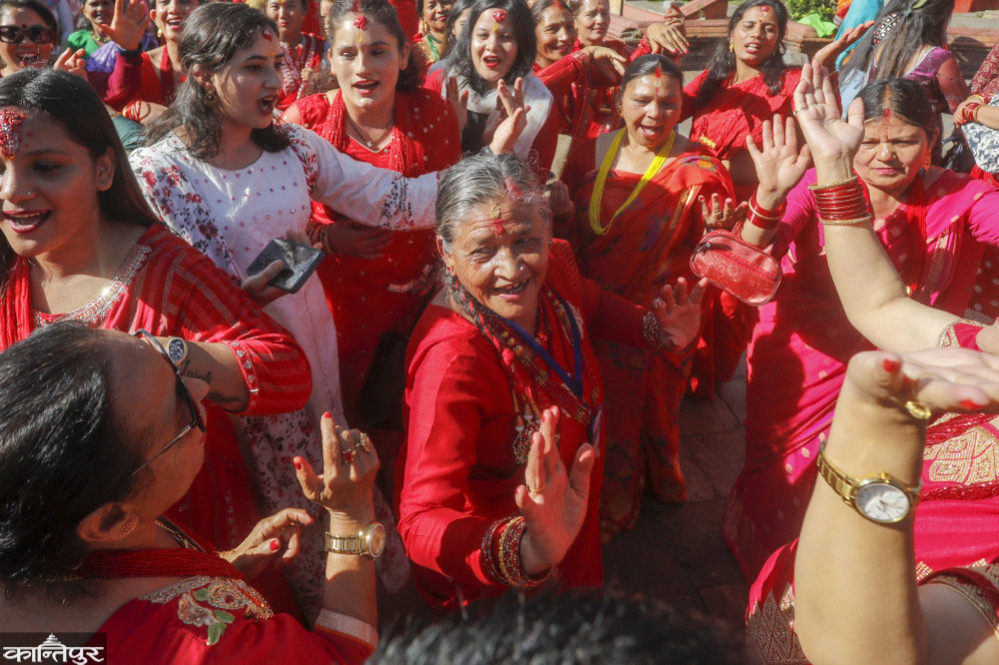
Singer Haridevi Koirala is worried about the indigestible and obscene words in the current Teej song . During his time, there were hardly any people who did not hum songs after listening to his voice . The girls used to express their feelings or feelings through the words of the song . Haridevi says, "The first Teej songs were so polite, civilized and refined!" She enjoys remembering the old days when brothers sat in rows listening to songs hummed by girls. That song tells a mythological story, raised his voice against violence, questioned the political agenda . "Those who have sung such indigestible songs, they themselves will not be able to watch and sing with their family." These kinds of songs have also come in the market," she says, "Those songs have come to earn money and temporary fame. If you think about what to teach the next generation, what they will learn tomorrow by listening to and watching obscene songs, what kind of message they are getting, everyone has to hold their heads. Haridevi argues that technology cannot be blamed after the
song is obscene. Rather than blaming the technology, it is necessary to blame the mindset. Technology has taught us many good things, how we use it, where is our state of mind and mentality. A question arises there . In fact, the audience and the source have not liked the songs that convey such a negative message,' Haridevi argues, 'They are watching with curiosity to see what is going on, that's why there are more views. I don't feel like listening to the heart . Such themes, which are sung and brought by misusing technology, do not benefit anyone.'
As soon as the Teej song was mentioned, the name of singer Purushottam Neupane did not escape. Purushottam feels that there has been a big change in the style of Teej song and celebration before and now. "In the first context, the woman suffered a lot," he says, "It was not the custom to teach the daughter, the son eats the share, there was a time when the daughter went to someone else's house and why should she be taught." Like Kapikalam Kindini to my younger brother, Doko Bundini to my sad daughter . It was customary for married girls to be harassed by their mother-in-law, beaten by their husbands to prevent them from bringing dowry, and subjected to various kinds of torture.' He is fed up and sad to see that unnecessary, looser themes and words than women's lives have been given place in the current Teej songs. She is reminded of the earlier song -
'Teej ayo jau na babu didi lin lai,
khuttaima dhogare hai veta veda vena la veena, mother sister zaju jaan te,
koseli po ke lani ho lan ta lan te.... He remembers the days .
As Purushottam said, at that time, organizers used to sing songs to spread public awareness about natural calamities, theft-robbery, violence and torture of girls for not bringing dowry. ``In Barkha yam, one had to walk the path of the forest, the path of the river, Teej song has been made in that context as well . Like, Lali Jovan Kali wore a shawl....'
It is remembered that Purushottam did not forget the originality, tradition and culture when men and women sing songs together. "However, now a different theme than the theme of Teej has started repeating itself in the songs," he says, "We have not forgotten the originality, tradition and culture". Today's songs are not sung to preserve culture, but to be momentarily viral. With the advancement of technology, in the name of collecting views, making money and playing on the stage, the trend of bringing the song to the market with the name of Teej song has increased . Everyone should think about what we are going to hand over to the next generation.'
Rita Thapamgar, the president of the Rashtriya Folk and Dohori Geet Pratishthan, also feels that the Teej song has started to become popular. "Singing an original song or producing a good song does nothing, everyone has started thinking that they can do anything to get recognized and earn money these days," she says. Artists have also brought good songs to the market, but the society is such that it is more oriented towards the negative. Rita believes that because there are no laws related to
songs/music, loose and disorderly songs are coming. That's why they are forced to go through the legal process, Rita says, 'After the song was released, they even went to the Cyber Bureau to take legal action with the government. It is fatal to our culture. Now we all have to move towards improvement,' she says, 'After going through the legal process, the artists also understood for sure that this should not be done. Songs and videos with indigestible and obscene words do not lead the society in the right direction.'
The new generation is always change-oriented. He creates a culture according to the changed society. "However, originality must be maintained in creation," she says, "modification must also be done, but our cultural characteristics must not be forgotten." According to
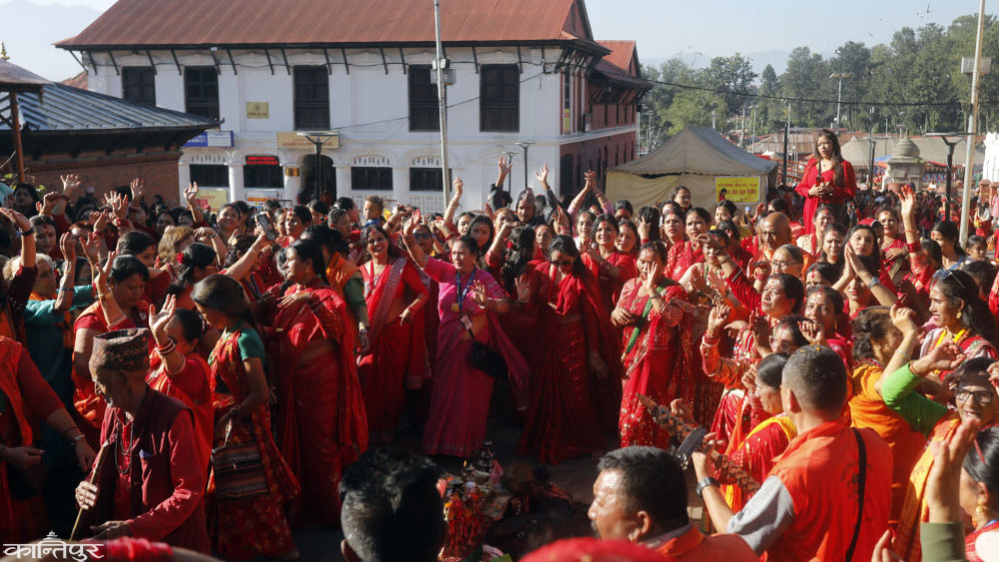
singer Badri Pangeni, this kind of song is being created to go viral. It was seen that the viewers encouraged and danced to obscene songs on social media, mainly Tik Tok, and with the support of the audience, bad and obscene songs got a place in the market . Such songs are being made to go viral. Spreading distortion in Teej song is a matter of concern, he said.
Singer Radhika Hamal says that since women are educated and capable, the tunes of freedom, rights and equality have started to resonate in Teej songs without pain. "The themes of earlier Teej songs used to focus on the torture suffered by women, the pain given by mother-in-law-Nand-Amaju, their expressions-style-stories were full of pain," she says, "but now women are aimed at fulfilling their wishes and dreams." After being educated and empowered, women will become stronger, now there is equality between men and women. Women have also started to think that they should raise their voice and not suffer torture. So now, more than pain, the songs of freedom and equality are sung and played. This is a positive issue of the society.'
'There is a fear that culture will be spoiled by the bad content of songs,' says Hamal, 'Songs and music are the mirror of society, artists should take care of their dignity and be responsible.' Even in the society, we don't hear much respect for creators/artists who compose good songs . However, there is a widespread practice of encouraging those who sing bad songs.
He feels that due to the change of time and the rapid development of technology, there has been a difference in songs and music. Earlier only common sarangi-madal-flute was used in the song . Now, with the leap forward in technology, easy access to other goods has also been reached and the market has also expanded. It's a pleasure . However, it is necessary to discuss how to make music strong and decent.'
Every creation is a product of society and also a reflection, in which it is seen - the mirror of society. Now not only the society has changed, the way of life of people has also changed . It is not strange that the song changes with this change, but there must be a debate on its social impact. According to
singer Khuman Adhikari, there has been a change in Teej songs before and now. "Earlier, there was a lot of violence and pain in the songs, and tears were mixed in". But, with the change in society, awareness was developing,' says Khuman, 'Similar themes have started to enter Teej song too.'
Sociologist Nirmala Dhakal also feels that there has been a massive change in the Teej song. She says, "Teez song used to be against injustice and discrimination". They used to be about family matters - the behavior of husband, mother-in-law, father-in-law, etc. Dhapedi used to have stories of happiness and sadness. Until 2/4 years ago, women's freedom and rights were sung, but now the song is focused on what words attract the audience and sources rather than freedom-equality. Now songs like 'Samu' are reaching the audience. It's sad .' She is very worried that the importance of Teej is decreasing by mixing loose words in the
song . "Now the song is seen only as a commodity to be sold in the market". Bad words were also introduced during the holy festival, which sent a negative message to the society. If I can't sit with my family and watch and listen to that song and dance, then it's not a Teej song . It did not understand the essence of the Teej song, nor the women,' she says.
Dhakal says that stories of women's progress are sung through the Teej song, which will help in social development. "Development of technology, freedom, empowerment of women can be sung in songs". It gives encouragement to women.'
Anthropologist Dumbar Chemjong thinks that due to social change, the style and song of celebrating Teej has also changed . Teej is full of excitement. There is a different way of celebrating Teej in the village, different in the city. Old traditions still exist in the village. Political-economic changes, migration, and changes in production have not only changed the tradition of celebrating Teej and singing songs, but everything has changed," he says.
"Teez is a topic related to women's freedom and rights and it is wrong to say that men can digest whatever they do and women can't digest it," he said. It is also necessary to change the society's perception that satire through songs is digested by men and not by women, and it is gradually changing. The subject of what the society digests and what it does not digest is also a bit prejudiced,' he says.
Dumbar says that the negative message spread in the society because of Teej song is wrong. He says, "Earlier, when there was no equal rights, only songs of sorrow and pain were sung, but now you can sing about every subject". All this is a reflection of political, social and economic changes.'
Every creation is a product of society and also a reflection, in which it is seen - the mirror of society. Now not only the society has changed, the way of life of people has also changed . It is not strange that the song changes with this change, but there must be a debate on its social impact.

