We use Google Cloud Translation Services. Google requires we provide the following disclaimer relating to use of this service:
This service may contain translations powered by Google. Google disclaims all warranties related to the translations, expressed or implied, including any warranties of accuracy, reliability, and any implied warranties of merchantability, fitness for a particular purpose, and noninfringement.
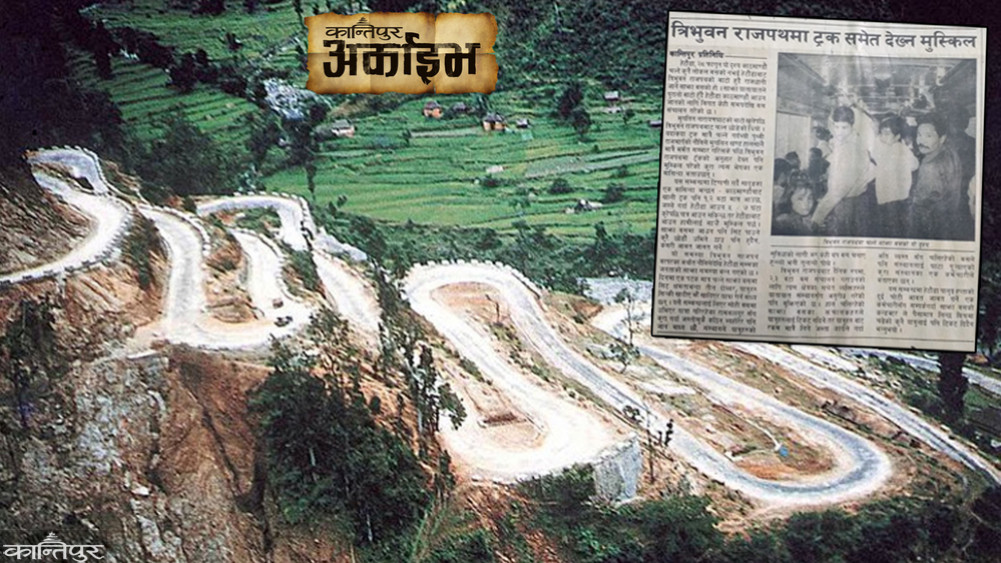
The lyrics of this song, sung by folk singers Hiranya Bhojpure and Pandav Sunuwar, are still very catchy even now. This song was composed in the name of the country's first highway Tribhuvan Rajpath i.e. 'Byroad' road.
Byroad is the country's first road connecting the capital Kathmandu with Terai. Some people also discuss that India has made this road according to its strategic strategy . It is said that by using the English word 'byroad' instead of saying 'go through the road', common people have come to understand it as 'byroad'. Even now some people identify the road with the name of Byroad rather than Tribhuvan Rajpath.
Common people also started to use the word Byroad gradually. It is understood that the name of the road is also 'Byroad' as the same word continues to be used in the public tongue. Even now, instead of Tribhuvan Rajpath, 'Byroad' is heard.
The Tribhuvan Rajpath was the main transport route connecting India until the Muglin-Narayanghat road, whose construction began in the thirties, came into operation. The use of byroads has been decreasing since the 40s as the road network has become overcrowded. Tribhuvan Rajpath, which was inaugurated in 2010 after a survey in 2008 with Indian assistance, has been running passenger buses for the general public since 2015.
The construction of Tribhuvan Rajpath, which was started from Chandragiri area in 2009, was the only way around Kathmandu at that time. Not only Indians, Nepali Army also participated in making Rajpath. This was the main road for importing merchandise from India. After the change in 2007, the byroad was built during the implementation of the promise made by the Indian Prime Minister Pandit Jawaharlal Nehru on his visit to Nepal on June 2, 2008.
From June 2016, a regular bus service was operated from Kathmandu to Amlekhganj under the name of Nepal Transport Service. After Muglin-Narayanghat road came into operation, the importance of Tribhuvan Rajpath decreased .
After the highway, which was always busy with vehicles, started to become deserted, in the 2040s, Common Transport started bus operations for the common people on that Rajpath. Earlier, there were more means of transportation than passenger buses. Byroad had only shared buses as passenger transport . The means of transportation (trucks) were running very little . After the Muglin road was built, the means of transportation started to move.
After the road was shortened to get around Tarai, it was narrow and curvy and not suitable for vehicles carrying goods . The daily limited number of shared buses to and from Kathmandu were not convenient for local passengers. Seats were filled by people from Kathmandu. The shared bus did not want to take the locals. Since trucks and passenger buses were not operating, it was very difficult for the locals to move around.
There was a lot of trouble for the common people especially from Nauvise to Tistung Palung, Daman, Bhainse to Hetounda. Let alone getting a seat in the daily common bus, there was no place to stand. When the truck was in operation, some passengers used to travel between Hetaunda and Kathmandu.
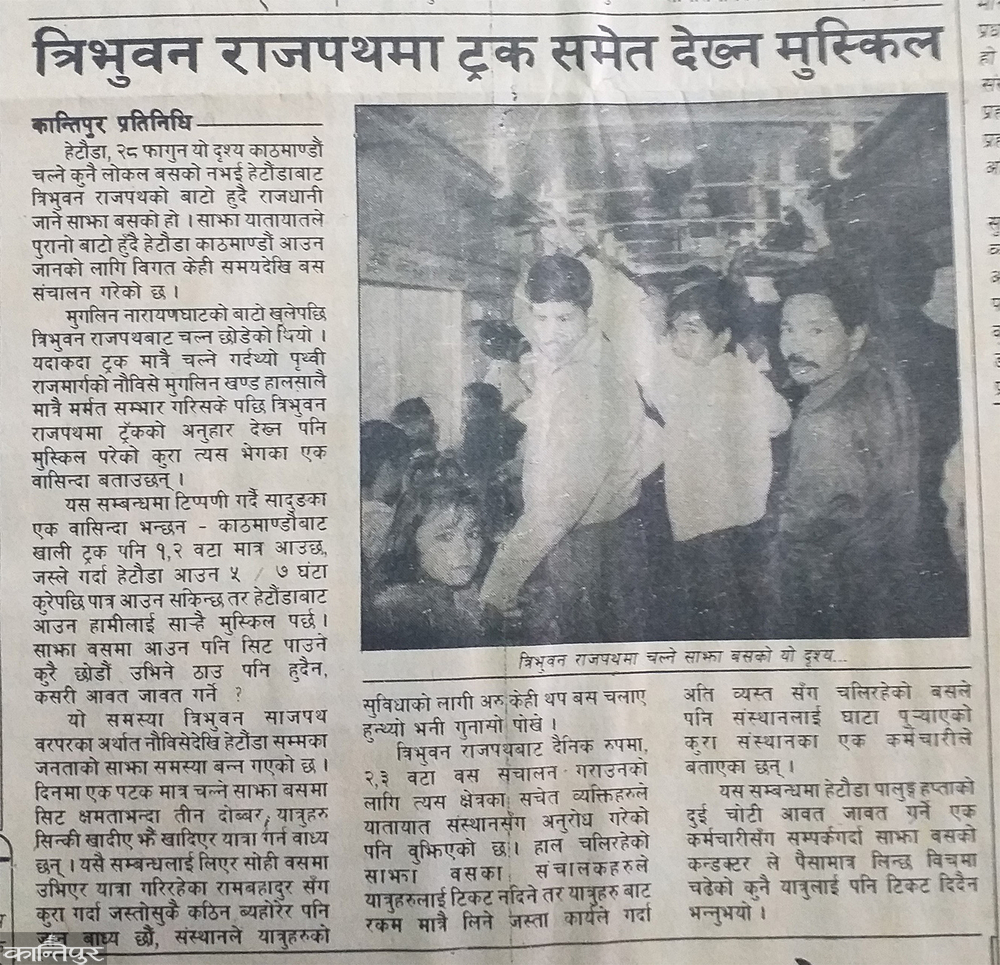
It was so difficult to travel with many passengers in one vehicle on the winding 'Byroad' road. Kantipur Daily published this news on February 29, 2049 under the title 'Hard to see even a truck on the Tribhuvan Rajpath' covering the sufferings of the passengers of the 50's.
Presentation : Rishiram Paudyal