We use Google Cloud Translation Services. Google requires we provide the following disclaimer relating to use of this service:
This service may contain translations powered by Google. Google disclaims all warranties related to the translations, expressed or implied, including any warranties of accuracy, reliability, and any implied warranties of merchantability, fitness for a particular purpose, and noninfringement.
Nepal's politics had been shaken for a long time by the agreement with India regarding the Tanakpur project. That was the time, 2049 February. Prime Minister Girija Prasad Koirala was explaining the agreement he made with India. But the main opposition party UML was against it.
The UML was agitating both on the streets and in the House. This matter had also entered the court . In November 2049, the Supreme Court ruled that the agreement regarding the Tanakpur project was a treaty.
The court had instructed to evaluate the treaty as Tanakpur is not only a constitutional issue but also an economic, diplomatic and technical issue. After that, the government formed an 11-member evaluation committee under the leadership of Lokraj Baral on 15th January 2049.
Shailendra Kumar Upadhyay, Surya Bahadur Shakya, Ramananda Prasad Singh, Mahadev Yadav, Vanwarilal Mittal, Deepak Gyawali, Dr. Kamal Rizal, Badri Bahadur Karki, Govinda Prasad Lohani and others were there. Jit Bahadur Karki was assigned as the member secretary of the said committee.
This committee submitted a report to Prime Minister Koirala on February 3. In the report, it was mentioned that the Tanakpur project will not have long-term impact. The report was made available to the parliamentarians of both houses. The report suggested that it mainly focus on three issues. In the report, it was mentioned that the Tanakpur Agreement was of a simple nature that did not have long-term impact on the nation. In the
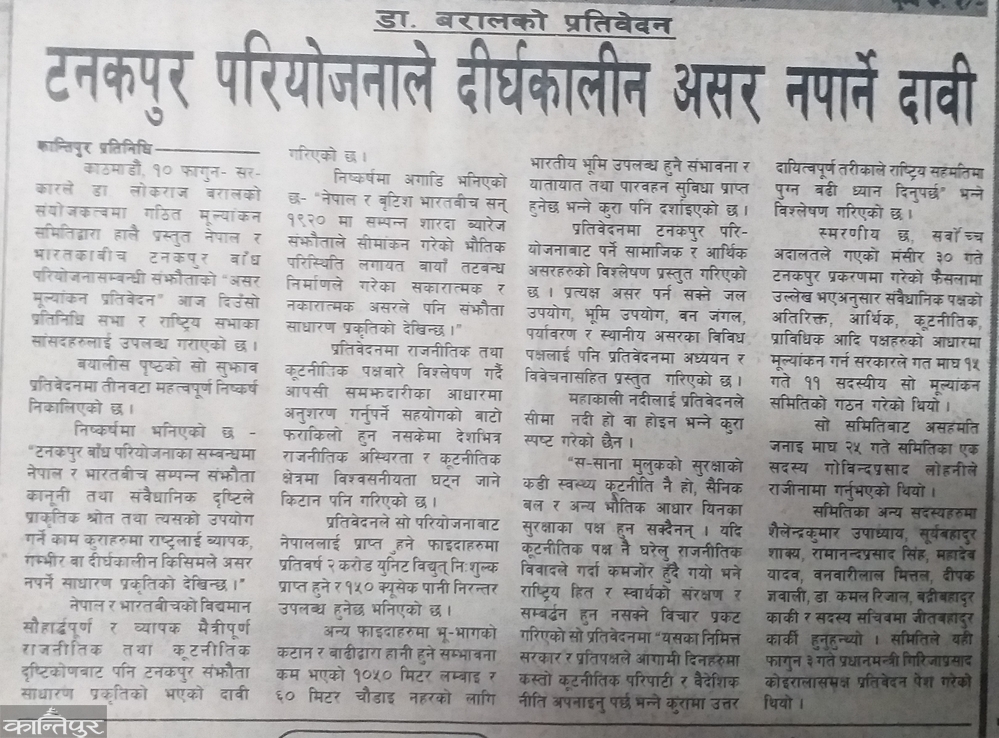
report, it was mentioned that Nepal will receive 20 million units of electricity per year for free and 150 cusecs of water will be continuously available from the project. It was mentioned that issues such as flood control, transportation, transportation facilities will be used as benefits. Whether the Mahakali river is a boundary river or not, it was not clear in the report . It was said in the
report, "Healthy diplomacy is the key to the security of small countries, military force and other material bases cannot be part of their security." It was mentioned in the report that if the path of cooperation to be followed on the basis of mutual understanding with foreigners cannot be widened, there will be political instability in the country and credibility in the diplomatic field will decrease.
At that time, the main opposition UML was strongly opposing the Tanakpur agreement by linking both the then Prime Minister Koirala and India . In this situation, a diplomatic issue was raised in the report pointing to the propaganda made by the main opposition party against India.
This topic was published with priority by the media of the time . And Kantipur daily also printed a news on the first page under the title that Tanakpur project will not have long-term impact.
presentation: Rishiram Paudyal

