”There is no agreement that there should be a movement for change, and that this should be according to the constitution. If the characters who have been displaced continue after 6 months, who will take responsibility?” -Associate Professor Apoorva Khatiwada
We use Google Cloud Translation Services. Google requires we provide the following disclaimer relating to use of this service:
This service may contain translations powered by Google. Google disclaims all warranties related to the translations, expressed or implied, including any warranties of accuracy, reliability, and any implied warranties of merchantability, fitness for a particular purpose, and noninfringement.
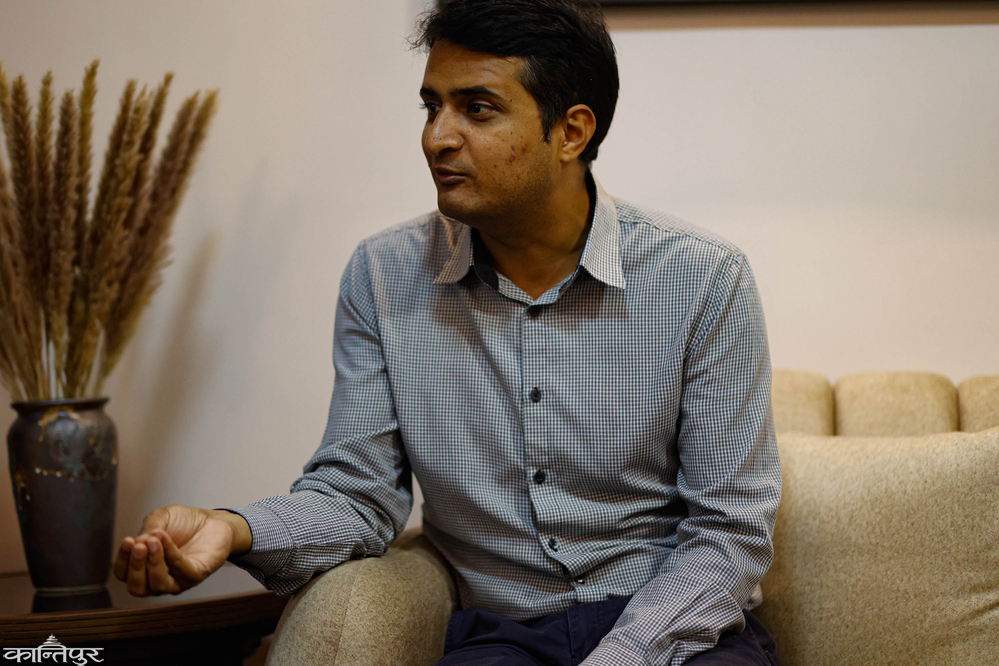
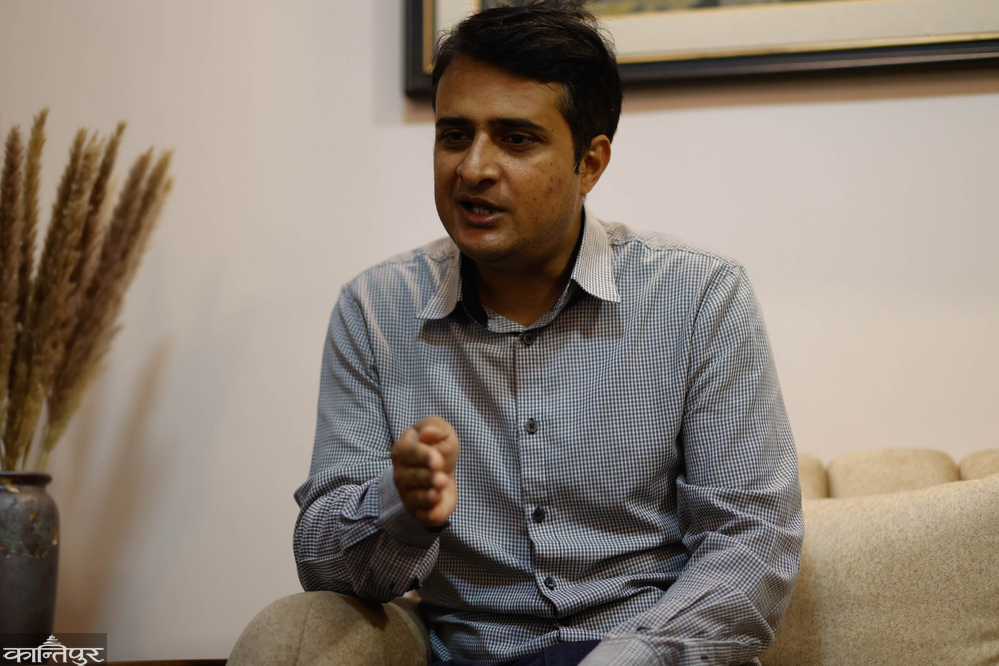
Advocate Apoorva Khatiwada is the Associate Professor of Tribhuvan University Faculty of Law. He is well-versed in jurisprudence including constitutional law and is known as an eloquent speaker. He argues that addressing the language of the street and sacrifices is not always under the constitution and sometimes it should go outside the constitution.
Excerpts from Apoorva Khatiwada with Durga Dulal and Daya Dudraj for Kantipur about Gen-G movement, transitional government, new elections and constitutional amendment There are those who argue that there is no more constitution after the Gen-G movement. It is also heard that the government is alive because it is formed according to the constitution. What is the state of the constitution now? How do you explain this situation?
This is transition. There is a transition in the constitution, and there is also a transition in politics. In a way, there is a transition in the society as well. We are on the brink of a change. Whether you want it or not, change was bound to happen, so it happened. That's why the constitution also has some effect during this transition and is being affected. Now the former Chief Justice is the head of the government. That is the effect of the transition to a kind of constitution.
Just as it was decided that we will decide on the monarchy from the first meeting of the Constituent Assembly, in the same way, from the first meeting of the House of Representatives, we should start the process of reconsidering these provisions of the constitution. The provision of government formation is in Article 76 of the Constitution. It should be accordingly. If it were to go according to 76, it would have been a different process. Therefore, the transition had an effect on that constitution as well. People started shouting that political parties have started raising their heads when they release the press. Why was there such a comment about the majority party with an open political identity? They don't even have the confidence to move forward now. While they used to claim that we have a government with two-thirds of votes.
Thus, there is a situation of infection everywhere now. This is the transition brought about by Gen-G's sacrifice for change. This is what I prefer to call a positive transition. It is a sign that something positive is changing in us. A sense has developed that this is a transition for that. This is its strong point. In the constitution/law there is a term called 'post-conflict constitutional transformation'. We can understand it as post-conflict constitutional change. The conflict is the situation since 23 August. There has been a major political change. It must be accepted. After this, we are in the midst of constitutionalism and transformation in the 'basic structures' of the constitution. Some say that there is no constitution after this change. Gen-jis have come to the streets against Bethiti. They demanded change. They have said that if they are going to accept the current situation, why should they protest? But the President has said that the appointment of the Prime Minister is under the Constitution. That didn't change it, did it? What is this situation?
This situation is not clear now. It seems that a settlement has been reached after a kind of political discussion. We don't know if there is anything else out there. We don't know. But from what we can see, there has been an 'extra-constitutional' exercise in the matter of government formation. This transition to constitutionalism is under the heading 'Outside the Constitution'. Forming the government, dissolving the parliament, but after that, it seems that there is a 'settlement' rather than a management and regulation procedure. We don't know if it went beyond this. Looking at the events so far and the facts that have come out, it seems that there has been a 'settlement' but the procedure to end the transition has not been made.
The government formed in the 'Extra-Constitutional' periphery. It did not show the way to address the change. Now comes the question, how does it proceed?
To ensure this change and to manage the transition, it was agreed to protect the constitution as a whole rather than the letter of the constitution. Now everyone has to accept it. There is a feeling in this 'settlement' that after ensuring the demands made by this change, the subsequent behavior is to conform to the constitution.
But as you said, after listening to the unofficial demands of the protesting party, it seems that in the next election, the executive prime minister should be elected directly. It is said that the provincial government should not be formed from the next election. Gen-ji believes that the next election should be only at the central and local levels. There is a big gap in this understanding. On the other hand, if what Jen-Ji says is to be believed, then the constitution should have been amended. In this way, both sides can be seen as correct.
But does the movement mean to keep the old things as they are and only make the government new? Of course not. And how to agree with the arguments of the old situation? It is not seen in the present agreement whether the constitutional expectations of both of them will be fulfilled or how to manage them. Even in the constitutional system, if this situation occurs, there is no way to manage it. So the new government will hold elections after 6 months and parliament will come. And there begins the game of making a government.
And the one who brings the majority in the parliament, now works to amend the constitution. That would make arrangements for direct election of the Prime Minister by amending the constitution. Whether the provincial government will be abolished or not, it will say. Is this what Jen-ji's demands and sacrifices are for? If it's a
, then it's okay. If not, there is no possibility that the government that will be formed after the election will amend the constitution as per the demand of Jen-G. Because, the National Assembly will remain for some time to come. When Jen-G has a majority in the House of Representatives, they will move forward with their demands, but can they accept the National Assembly, which is under the control of the old parties? What will happen if he does not accept the directly elected executive, will he protest again?
You are also like a representative of Zen-ji. More than 70 people have died in the Zen-ji movement. But won't Sushila Karki be limited to being the prime minister?
than in a word, no. A week ago it would have been very bad. Surely he would have been targeted. Until Tuesday-Wednesday, there was no doubt that we should not proceed without making a plan or ensuring the possibility of some concrete change. But within a week of this change, some doubts are being created.
Now we are in a quandary, there is still a dilemma whether to transfer power to another person after the election or to prepare the basis for constitutional change even after the election. Now, if we want to prepare the basis for constitutional changes after the election, there will be a way. There is another way if the power is handed over to another person only through elections. But there seems to be a lot of confusion about what this path is. It has also started to have its own interpretation. This was not a problem till Tuesday-Wednesday of last week. There was no doubt that it was a radical change, but looking at the current situation, it has progressed to the point that it is not. There was a bit of confusion about that. In my opinion, the purpose of the movement was not simply to change the cabinet of one government to another.
The demand for constitutional change arose in the movement. In a way, the movement approved. Yatra people also offered sacrifices. Now how can it be institutionalized or scripted? There are two processes for
. The basis of any change is twofold. One is to manage this transition and the other is to institutionalize change based on it. Movement creates a new system. That system changes as a prerequisite. Or you have to take this change to the people. The people have the right to approve or disapprove as part of their decision-making power. By keeping preconditions, going to the elections and managing the current transition period, power is transferred to the new power that comes from the elections.
The second is creating constitutional foundations. The constitutional standard should be the basis for ensuring change from the constitutional basis. No matter how you look at it, during the 062/63 movement, the House of Representatives announced it or the House repeatedly passed this resolution, these are some of the bases for future changes, and it was said that we cannot compromise on them. The current changes have also brought such foundations. It may not seem scripted, but it certainly is. If so, it should be approved in the next referendum.
If we do not 'compromise' the achievements achieved at that time in 062/63, if it was accepted when the constitution was made, it should be accepted even now. But what happened in the last one week and the discussion shows that? The principle of change is the 'underlying principal'. Shouldn't it be ambiguous? The political and constitutional basis, which will not be raised tomorrow, should be decided now.
Another thing is that you should make an urgent decision on some issues right now. And what happened? why not Who will decide now? Does it look a little incomplete? If we look for change within this constitution, we will not find it. I was saying earlier that the 2047 constitution was terminated for the changes after 062/63. Even now, if it has changed, what happened and what are its points? That transition was managed for some time by restoring the parliament at that time. Then the transition was managed by promulgating an interim constitution. Even the interim constitution is unable to manage the transition and the obstacle
The transition was managed through elections by forming a cabinet under the leadership of Khilraj Regmi. This transition period ended after the promulgation of the constitution in October 2072. What arrangements have been made regarding the current transition period?
Now if the new elections were to be held within this constitution, then after KP Sharma Oli resigned as the Prime Minister, shouldn't the President call for the formation of a new government? It would have been necessary to go through clauses 1 and 2 of Article 76 in order to form the government with the majority. The alliance would have said that Oli should be replaced by so-and-so. That would be constitutional, wouldn't it? But we cannot imagine that now. Ramchandra Paudel could have declared Sher Bahadur Deuba as the Prime Minister according to the calculations of the big party. But why didn't it happen because of the sacrifice and change movement of Jen-ji? And how will that change proceed and what are the demands of the change, how will it be fulfilled?
We are ready to believe that we will form a people's government to ensure this change and form a cabinet under the chairmanship of the former chief justice. But to manage the transition of such things and to ensure this change, it became contradictory why we could not make some such constitutional provisions and arrangements to ensure the expected change. Now let's talk about the constitution. Now everything is going to be according to the constitution.
If the desired change does not happen tomorrow, who will take responsibility for it? Tomorrow's discontent will come again, who will take responsibility for it? Why did people wake up like this? It was said that after 062/63 the king will go, all will be well. It didn't happen. Otherwise, Jen-G would have come to the street. If tomorrow what they say doesn't change, if there is a rebellion again, who is responsible for it? After 6 months, the same character, the same person, the same system, the same corruption, who has already been displaced, who will take responsibility if it continues. What if the
 change fails? It was not said that by showing the constitution, one should follow the provisions of the constitution that are favorable to them, and when they are not, this is what happens in the movement. This is honestly the blueprint for change. This change is what we expected. This should be done to ensure this change. That by engaging everyone politically, as after 062/63, a common document should be arrived at through a kind of political discussion among all political parties. Otherwise, it should be said that the government will proceed in this way and these things of change will be ensured in this way.
You took out the 062/63 thing. At that time, the agreement with the Maoists and with the King was the basis. Is it the same situation now? Yes,
, that's what I'm talking about. At that time, a guiding principle was made by politically agreeing on what should be included in the interim constitution, but now it is nothing. Any change requires this. But what has happened now has not come to public knowledge. Is this constitution the basis for addressing change? The purpose is to go according to this constitution? Is this the purpose of saving the constitution itself? If it is, I'm not saying it's wrong. The only thing is to protest for change because the current system does not exist and to go under this constitution or to say that it should be according to the constitution.
How this government came. which came to the base. Whatever came from the cause. This does not seem to be consistent. In the past, the basis for political change was ready, but in the current change, that political and constitutional basis has not been decided. This is a bit of a concern for me. The basis of future change like
is neither political nor constitutional. What is it? Is it operating in a 'vacuum'? What has changed to manage the current constitution? There was a technical issue before the elections were held. As in the case of Khilraj Regmi, it was a technical responsibility to conduct the election itself. But has the current government only been entrusted with such technical work? If so, what is the meaning of the sacrifice of change? If not, the mandate of transition? It is important to be very clear whether only elections are to be held or not.
The responsibility given by the president is not the mandate of the movement. If so, how should that mandate be addressed?
does not seem to be technically just about making elections. When I see/understand the society in this way, when I listen to the people who are on the streets and lose their lives, it cannot be a mandate to conduct elections only technically. A political basis for ensuring this constitutional change after tomorrow's elections had to be established by creating an environment of political consensus.
or the constitutional basis of constitutional change tomorrow, it should be ensured that we will make constitutional changes in this matter now or at least we will take this matter to the public. Like say, a referendum. To do this, the House of Representatives may be needed, but if we accept the current changes, let's hold a referendum on some issues during the election. Let's have a plebiscite on the matter requested by Gen-ji and based on its strength, let's have a mandate that the next government must amend the constitution. It will also lead to elections, and change will be institutionalized and the transition period will end.
Are you trying to say that we should hold a referendum on whether to keep a direct executive head or not, to keep a proportional election system or not, to keep a province or not?
yes, let's do it. Why, if the election is to be held only technically, then this election and the next parliament would not be necessary. Isn't that the change we need? Elections are held tomorrow. A new parliament comes. For some years, the upper house of the federal parliament, the National Assembly, consisted of all the people of the old party. They also have their own people in the state assembly.
And then the constitution will not be amended until those who demand change come? If we want to amend the constitution after six/seven years, then it is fine. Whatever is written in the constitution is what happens in practice. In my personal opinion, without being a directly elected prime minister, it would be good if a regular prime minister, like the current one, has good ideas and works with good intentions. But now, if there is a question tomorrow about what has changed, there will be no answer.
As far as I understand, the desire for change is expressed from the street. It does not seem to be the only desire to hold elections technically. I don't think the Gen-G groups, who they are, agree with the current system, that the next transfer of power will happen through elections. But then who will take charge of the discontent that has not changed? If the law is not changed, technically the election is done, then who will be the ultimate responsibility? Will it be the government, will it be the president, will it be the army? Whose will it be?
 A possibility or guess or suspicion, 6 months later the election took place. The old party won the majority and again they ran the government. What is the meaning of the death of so many people if the distortion, corruption and familyism that we have been talking about starts again?
is what I'm saying. Something had to be guaranteed now to ensure that change. It should be constitutionally and politically. I don't see the possibility if power is transferred technically through elections. Because the Home Minister has already said. We cannot stop anyone. We cannot ban any party. Tomorrow the UML-Congress-Maoist party won the election by forming an alliance and if these changes are not accepted then what is the meaning and justification of this movement?
So what we fear is how to ensure that change? The premise is simple. There are two things in this. Either now politically all parties agree and say that we will reconsider these provisions of the constitution after this election. Otherwise, we should take this issue to the people after 6 months. If these two things do not exist, there is a danger that the current change may not be institutionalized.
First, it was decided from the first meeting of the Constituent Assembly that we will decide on the monarchy. It was a kind of political consensus. The first meeting also decided about the monarchy. Similarly, from the first meeting of the House of Representatives, we must start the process of reconsidering these provisions of the constitution or call for a referendum. If not, a political consensus is needed.
But whether there is a situation where such a political agreement can be reached. If not, a constitutional basis should be made along with the political basis on the basis of the movement for change. For example, a referendum can be held without calling the House of Representatives. It cannot be said that the constitution does not provide for it. This is not according to the constitution, but it came in the foundation of the movement. The 'mandate' of the movement should not be found in the constitution. A special kind of legal or constitutional arrangement has to be made now. And change is guaranteed. Who watches the rules during a war like
? The side that needs to win has nothing to do with winning. The same is said in the movement. Is the fight for change based on constitutionalism or the constitution only? Should we rise above the constitution or not?
The principles of the constitution have basic assumptions. In a country where the rule of law is democratic, minimum appreciation of democratic spirit is done even during protests. Even in times of change, it is said that constitutionalism and the 'basic' idea of the constitution should not be 'compromised'. But there is no change within the limits set by the constitution and it is not possible. So it has to be balanced.
Some writers and scholars say that there may be a 'democracy deficit' in the transition. During the transition, there may be some reduction in democracy. This is the situation even now. In power was a government elected by the people. But why Sushila Karki was made Prime Minister. This is a kind of 'democracy deficit'. But it does not mean that you can do whatever you want. In a transparent manner, the basis given to you by the people will be considered as the standard. The court can warn you not to go beyond the norms, undemocratic or beyond the mandate given to you by the constitution, but everyone has to accept the change.
If we talk about compliance with the constitution, then the Election Commission cannot be complete. If it is said that only three of us cannot conduct elections, we need a Chief Election Commissioner under which constitution? The constitution does not allow for appointment. It is certainly not acceptable to remain silent because the constitution does not allow it. Not only to transfer power by conducting purely technical elections, but surely some way should be opened? Since the parties should also be elected through the elections, the country should be settled by deciding on a kind of common opinion on the occasion of the Constitution Day. And we have to accept the change and move on.
What you mean is, you want a bare minimum that says we'll do this after the election?
is needed, otherwise this government will be a technical government that will hold elections. A referendum could be the basis for ensuring change. A referendum can be held on some issues on February 21. The points raised in the movement can be carried forward. Fresh elections and forming a government from the 'mandate' that comes from that will lead to a long-term solution.
is no longer the election of the House of Representatives. Are you trying to say that there should be a decision whether or not to change the constitution according to the demands of this movement? is a
. Because if elections are held tomorrow only for the formation of a new government, there is a possibility that questions will arise. Nepalese people will say whether change is necessary or not. No, if it is not necessary, the people will reject it. If necessary, change the constitution, they say. And there is no room for questioning. Then there is no room for anyone to question. It is also a statutory procedure. The question of illegality is also resolved. But if it doesn't happen, dissatisfaction will remain. Perpetuating discontent means perpetuating the possibility of another rebellion.
still how much movement? How much to bear? Don't you have to leave now? Is it necessary to accept the change if it is to give an exit? Shouldn't justice be done with the blood of young people who lost their lives with the desire for change? Are we always protesting and destroying the streets? Those who were the leaders in the 2047 constitution should still rule only by them.
People want change and make sacrifices and do not accept the change because the constitution should not be used, but should go according to the constitution? If the changes were made according to the constitution, there would be no movement. Dissatisfaction came to the streets because the constitution did not cover it. Addressing the language of the street and the desire for sacrifice is not always under the constitution, sometimes it has to go outside the constitution.

