The preservation of customs and historical heritage is important for Nepal, because it is linked to Nepal's identity
We use Google Cloud Translation Services. Google requires we provide the following disclaimer relating to use of this service:
This service may contain translations powered by Google. Google disclaims all warranties related to the translations, expressed or implied, including any warranties of accuracy, reliability, and any implied warranties of merchantability, fitness for a particular purpose, and noninfringement.
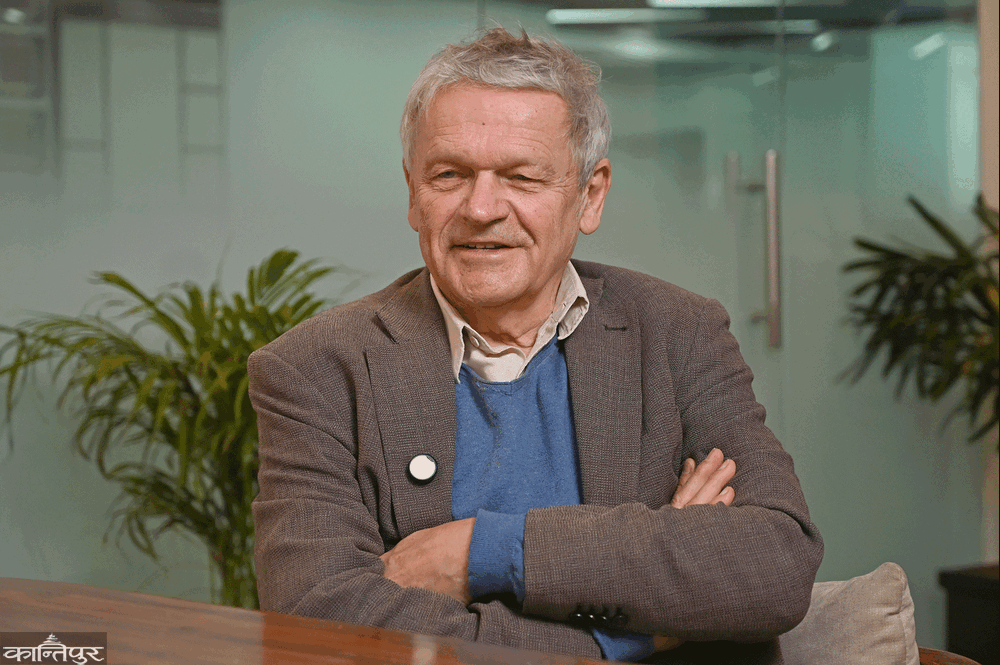
Axel Michaels is a German scholar who is researching about Nepali cultural heritage, tradition, festivals, Guthi-feast and history. He is a professor at Heidelberg, Germany's oldest university founded in 1386.
He is also the head of the project 'Documenta Nepali' to study and research the religious and legal documents of pre-modern Nepal and to digitize such records. He graduated from the University of Hamburg in 1978 in 'Shulvasutra', and for a long time he was the head of the South Asian Studies Institute (South Asia Institute) under the University of Heidelberg. While in the
department, he also taught Pura Vidya (Classical Indology). Even when he was an assistant professor at the University of Kiel in Germany, he played the role of director of the Nepal Research Center. Michaels has published dozens of books and research articles on Nepal. Recently, his book 'Nepal: A History from Earliest Time to the Present' has been published.
Similarly, his important works such as 'Nepalik Bhupavanshavali', 'The Making of a Statue: Last-Wax Casting in Nepal', and 'Hinduism: Past and Present' have also been published. Recently when he came to Kathmandu with book release and some project work, Professor Axel Michaels for Kantipur Janakraj Sapkota and Upendraraj Pandey Edited part of the conversation :
You came to Banaras in 1971 to study and understand Sanskrit language and Indian culture. At that time, after the start of India-Pakistan war, you came to Kathmandu via Raxaul with a car. How was your first trip to Kathmandu?
I had come to Kathmandu for the first time by road. When I came to Banaras, war started between India and Pakistan. And I drove a Volkswagen from Banaras and arrived in Kathmandu. At that time many other foreigners like me had also arrived in Kathmandu with cars. Many of them sold the vehicle in Kathmandu.
How many days did it take to drive from Banaras to Kathmandu?
took about four weeks like that.
What was Kathmandu like at that time? Do you remember anything?
At that time, Nepal was very isolated from modern society. Similarly, Kathmandu was a city with a population of 500,000. Now the population of Kathmandu has reached around 5 million. There were very few cars on the road at that time. Only a few cars, gifted by the Japanese government to King Birendra's coronation, could be seen in the city. Everything was very normal. The city was very nice.
What did you find different between Banaras and Kathmandu at that time?
Banaras was a bit of a modern style. It was also a bit busy and crowded. The temperature and other environment of Banaras was completely different from that of Kathmandu. It seemed that it would be difficult to live in Banaras even in summer.
How many days did you stay in Kathmandu?
I stayed in Banaras for 14 months to learn Sanskrit and Hindi. Then I came to Nepal and stayed for a few days. And after 10 years of returning from Nepal, I got a chance to come to Kathmandu again for the work of 'Nepal-German Manuscript Project'. We did microfilming of various archives, cataloging of Sanskrit texts. The project lasted more than 30 years. It was a very enjoyable and memorable job.
What did the manuscript project mainly contribute to?
This project worked on several areas of historic preservation. The work of preserving history, culture, poetry, philosophy, science and many other historical materials was done under this project. We used to microfilm historical documents. At that time, we also went outside Kathmandu for the documentation of historical materials.
At that time we had reached Gorkha for microfilm. But the task was not that easy. We even gave some money to the locals and took their help in documenting the 'documents' they had.
What documents were found there?
Various types of documents were found. From documents written on local culture and traditional laws, books like Mahabharata and Ramayana were also found. Not all were important to microfilm, but we microfilmed as many documents as we could find. It was not easy because there was no electricity. Our Kathmandu office had all the facilities for microfilming and archiving.
We had a special camera back then that could take 250 photos. Since there was no electricity, we assigned one such person, who used to go back and forth between Kathmandu and Gorkha to wash the photographs taken in Gorkha. We used to wash the photographs we took and give one copy to the National Archives and the other to an institution in Germany. The material is laid out in such a way that anyone can study and research it.
You are aware of the development and changes of Kathmandu in the last 5 decades. What is the difference between the Kathmandu you saw for the first time and the current Kathmandu?
The main difference in Kathmandu is the cars that can be seen on the roads here. And also population pressure. The politics here have also changed a lot. When I first came, it was a monarchy, now it is a republic. People have also changed a lot. I find that poverty and other social problems are also decreasing.
How do you see not only the physical changes in Nepali society but also other changes?
There has been a lot of openness in society. Caste system still exists in Nepali society. But when talking with people here, eating and sitting, they don't seem as fanatical about caste as before. The use of English language has also increased more than before.
Many things of modern style have entered the society. From telephone to social media, Nepali society has entered. At that time, it was not common to call Germany from Kathmandu. Reached the post office at 12 midnight and had to wait for an hour. It was barely possible to have a conversation, it feels strange to say that now. Many things have changed in Kathmandu.
Being a scholar of history and culture, do you see any changes in the culture and customs of Kathmandu?
The preservation of customs and historical heritage is important for Nepal. Because it is connected with the introduction of Nepal. People from different social backgrounds and castes join it. Whether it is Machhindranath Jatra or Indra Jatra or the reconstruction of temples and heritage sites after the earthquake of 2072, Nepali society is doing a very good job in its preservation. This means that not only the beauty of mountains and hills but also the cultural beauty is a great asset of Nepal.
Lately we also hear people worry that we have forgotten or lost culture. Interest is also heard that westernization has increased in Nepal. What do you think?
I don't think so. Westernization may also have increased. Faith in God may also be low. But cultural activities are still going on in Nepal. Death rites, marriage rites, vows etc. are all being done. Whether you believe in these things or not, you are still doing these cultural activities.
I have met very few Nepalis who flatly reject such cultural practices. Whether Nepalis believe or not, they express faith in God and temples. They participate in worship. They also go to the temple in the morning. And they are proud of such things. Even in western society, even if they don't believe in Christianity, they still celebrate Christmas and join in the festivities. Such a practice is also in Nepal. Despite secularism, culture is being protected.
You learned Nepali and Newari languages with Laxminath Shrestha after visiting Sanskrit and Kathmandu in Banaras. How difficult was this learning?
Lakshminath Shrestha is not only my teacher, but also my friend. He was a very dedicated teacher. He used to communicate with me only in Nepali. This is two weeks after the meeting. One day we met Balram Chitrakar, a photographer of the National Archives, at the Nepal-German Manuscript Preservation Center of the Nepal Research Center.
That whole evening we had only conversation in Nepali. Well my Nepali was not that good. As Lakshmi taught me Nepali, we became very good friends. I later invited him to the University of Heidelberg. We had a very memorable time there.
Did you find learning Nepali language difficult at first or did it become easy?
Nepali language is good for me but pure Nepali is not. I can read, but I find it difficult to speak. But I have learned a lot.
When you lived here, did you go to toll-toll and speak Nepali?
While in Nepal, I tried to speak as much Nepali as possible. Even in Germany, I sometimes speak a little Nepali with my team. I have been working with Rajan Khatiwada, Manik Vajracharya and others for a long time.
Are you considered as the person who introduced Nepal in Europe?
I just tried to do good on my part. But I am not the only one who introduces Nepal in Europe. The research I did and the book I wrote would not have been possible without the help of my Nepali friends. There is also support from many friends in the research on the civil law. I could not have done this work without the help of Rajan Khatiwada, Manik Vajracharya.
Many foreign researchers have researched the history, language and culture of Nepal, books have also been written based on this. It is said that the study of foreigners on Nepali culture reflects the western perspective! I don't think there is a West and East in
research. If the research is true and correct then the research is correct. I don't even want to nationalize it. The influence of western scholars is certain in Nepal. Nepal is also ahead in traditional science. He is also a notable scholar in Nepal. I have also discussed them in my book. They should not be forgotten because they are not written in English. They are honorable people. If you are writing about Nepal, you must pay attention to their findings.
You are also researching religious topics. Now there is a comment that festivals and festivals have faded compared to before. What do you think?
I am very interested in studying religion. Likewise, studying law is also my hobby. Administrative documentation is also my favorite subject. I am running a similar research project. For this, collaboration is being done with the National Archives of Nepal. We are working on a 19th century document. A lot of research should be done on religious matters. But some such complex documents and materials have been found that even because of that, many people have not been able to start research.
Our society is open. It is also accepting of different cultures. At the same time, Nepali culture is also being continued. What do you think, Nepalis are adopting a mixed culture?
culture is always mixed. What you call 'our culture' is already a mixed culture. Although it is called 'Nepali culture', it also has Indian and Islamic influences. Therefore, there is no such thing as 'pure culture'. Culture comes from defining yourself by looking at others. It means you have already assimilated another culture. So no one should talk about 'pure culture'. It is impossible. Certainly there is a national element or characteristic in culture.
When reading your latest book and other articles, you have said that it is necessary to study Newari language along with Sanskrit in the research of linguistics and religious culture. Make it more clear!
I have used documents written in different languages as sources during research. Sanskrit is very important for studying original works. Also Nepali is important in every way. Especially historical documents are also in Nepali. Newari: Knowledge of Newari language is essential for studying culture and heritage. Not only these, other languages also need to be studied.
If you want to study about Nepal, it is necessary to study all languages like Maithili, Bhojpuri, Tharu, Rai, Limbu etc. I don't even know all the languages. I have researched a lot about Kathmandu Valley itself. I have written about it here. Even if I write about the whole of Nepal, it is not detailed. Not so many resources are found in the hilly areas.
You have also discussed about Prithvi Narayan Shah in this book. You said that only after 1951, more talk about Prithvi Narayan started happening in Nepal.
He is also seen as a nation builder, in a sense that is also true. Because he extended the Gorkha kingdom to the Kathmandu Valley. This is something everyone knows. The name of Nepal became known as an independent country only in 1923. Before that, only Kathmandu Valley was called Nepal. In fact Prithvi Narayan Shah is the creator of the extended Gorkha kingdom. But the politicization of Prithvi Narayan happened only much later. After 1951 Shah Rajas discussed about Prithvinarayan.
Since Nepal has not been a colony of any country, is it possible that its art, culture and heritage have been protected?
Nepal has always remained independent despite being between two great powers. Despite this, it is a great success of Nepal to be able to save its sovereignty and independence. In 1791/92 Nepal-China war took place. War with British India in 1814/16. Despite that, it is a wonderful success that Nepal can keep itself independent.
When we talk about Nepal – Nepal is a diverse country in terms of language, culture, religion and ethnicity. It is a great asset of Nepal. There is no such thing as one culture in Nepal. In this way, Nepal can become a 'role model' for the world. It requires a lot of patience and independence. Happily, it is still maintained in Nepal. I hope this will continue in the future.
You said earlier that the earthquake of 2072 damaged Nepali cultural heritage. How did you find the reconstruction work now?
Even though the earthquake caused so much damage, Nepal is doing unprecedented work in the field of heritage reconstruction. Especially temples and palace squares are being reconstructed as historical heritage. There is still a lot of heritage reconstruction work to be done, but the awareness of the citizens is there. Citizens want to rebuild their heritage.
There was also a dispute about whether to use old lime and bricks in the reconstruction work. What is your opinion on this?
I know, this controversy is still going on. Some have said that traditionally heritage should be reconstructed. Arkathari's opinion is, rebuild but in an earthquake resistant manner. I am not an architect to say which method is correct, but I am a scientist that if earthquake resistant materials are not used, they will collapse in the next earthquake. So I think there should be some compromise on this. Iron forks are not used in traditional temples. At present, thorn has started to be used in temples. Don't be too fanatical about it.

There are also Nepali students at Heidelberg University where you teach. How do you get students who have obtained higher education from there?
They are very good. Few Nepali students come to study medicine and other sciences. In my department, Nepali students come to study about Nepal. Therefore, they don't have to learn German. What they should learn is how to read the history and culture of their own country? A few students have also graduated from Heidelberg. They are doing good work in their field. There is also a conversation with them from time to time.

