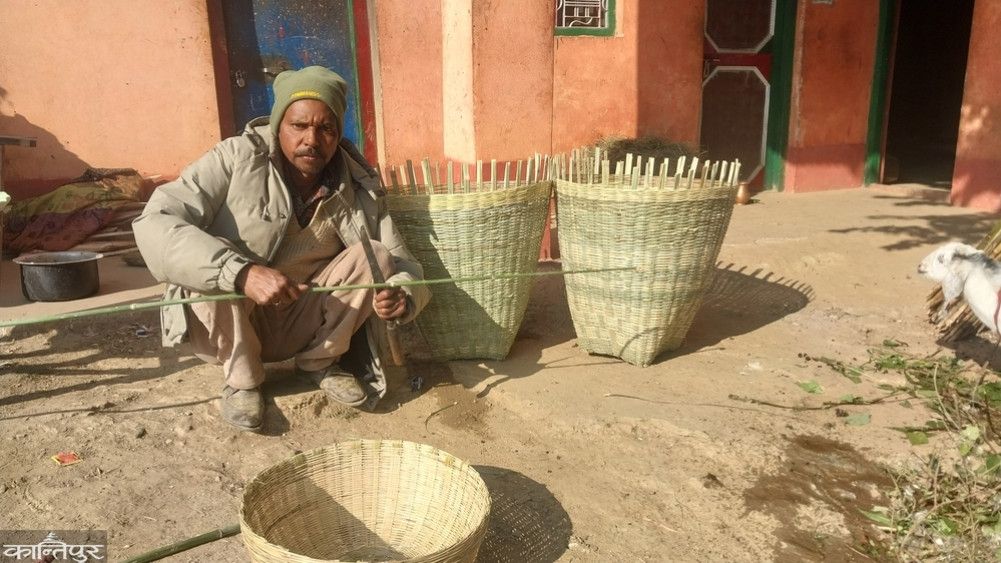
The younger generation is not attracted to this profession. My sons are also not interested in learning this job. I don't blame them. Because, if even after working all day, it is difficult to make ends meet in the evening and morning, how will the attraction towards this profession increase?
We use Google Cloud Translation Services. Google requires we provide the following disclaimer relating to use of this service:
This service may contain translations powered by Google. Google disclaims all warranties related to the translations, expressed or implied, including any warranties of accuracy, reliability, and any implied warranties of merchantability, fitness for a particular purpose, and noninfringement.
I live in Kaini Tole, Amargadhi-7, Pokhara. I am now 56 years old. I no longer have the same energy as before. My body is getting tired. I play with bamboo and reed stalks and think. I weave doko, suppo, and bhakari from bamboo and reed stalks and sell them. That is the skill of a novice.
We weave as many items as we can and sell them to earn money. We are making a living from this. This has been our family's profession for years. The skill has been passed down from our grandparents to me. I was 16 when I started this work. My father taught me how to make doko, supo, basket, nanglo, chhapra, and bhakari from cotton. At that time, this work did not seem like such a big or special thing. Many people in the village used to make such items. At that time, the use of such materials was essential for everything from household work to farming. Times have changed, the market has changed, but the situation of people like us has not changed. This skill, learned since childhood, has never received a good market price. It only takes a lot of hard work. The income is not much. But I learned to live wherever life took me.
I have reached here by weaving baskets and baskets up and down. That was about 40 years ago. At that time, reeds and bamboo were easily available. Reeds were cut and brought from the ‘Tele Lake’ in the Mahabharata region. The forest was open, there was no shortage of raw materials. How easy would the work have been!
If I had only looked at income, I would have left this work long ago.
I need 15 to 20 reeds to make a basket. I can weave a maximum of two baskets in a day. But it is still difficult to meet household expenses. Even though the work seems easy, it requires patience. My hands hurt, my eyes get tired, but I do not stop working.
The next generation is not attracted to this profession. My sons are not interested in learning this job either. I don't blame them. Because, I don't see a future in this job either. If you work all day long and it is difficult to make ends meet in the evening and morning, how can you be attracted to this profession? I take it to the Pokhara market here and sell it for three hundred rupees per basket. If I go from village to village, I can get up to five hundred. Sometimes I carry 10-15 heads on my back, but not all of them are sold. I never had the income that I earned from my hard work. If the money I earn after working all day is enough to cover my basic expenses, that is a big deal. My family is big. I have a family of 7, including my wife, three daughters, and two sons. I am not doing this job based on income. If I had only looked at income, I would have left this job long ago. I have studied up to 10th grade in the name of education. I was hoping to get a good job after completing my studies, but I could not complete my studies. Amargadhi Municipality once tried to promote skills. I myself was a trainer in a program brought for skill transfer. I was also happy that I was able to teach what I knew to the new generation. However, that happiness did not last long. There was no attraction for those coming for training. That is why the reality that this skill is on the verge of extinction has become even clearer.
Today's market is not about doko and supo. Plastic, iron and modern materials have taken over. It seems that if you can make materials like pots, chairs, tables, and mudas, it can be sold to some extent. But for that, new designs, new training and investment are needed. Even though that possibility is seen, it has not been put into practice.
It is very difficult to make ends meet in the evening and morning. I have been borrowing wheat and rice from the market and earning money from somewhere in two to three months to pay off the shop loan. However, since the shop belongs to the villagers, it is not much of a problem to borrow. I have no idea of my daily income. It is not that I make doko-supo every day.