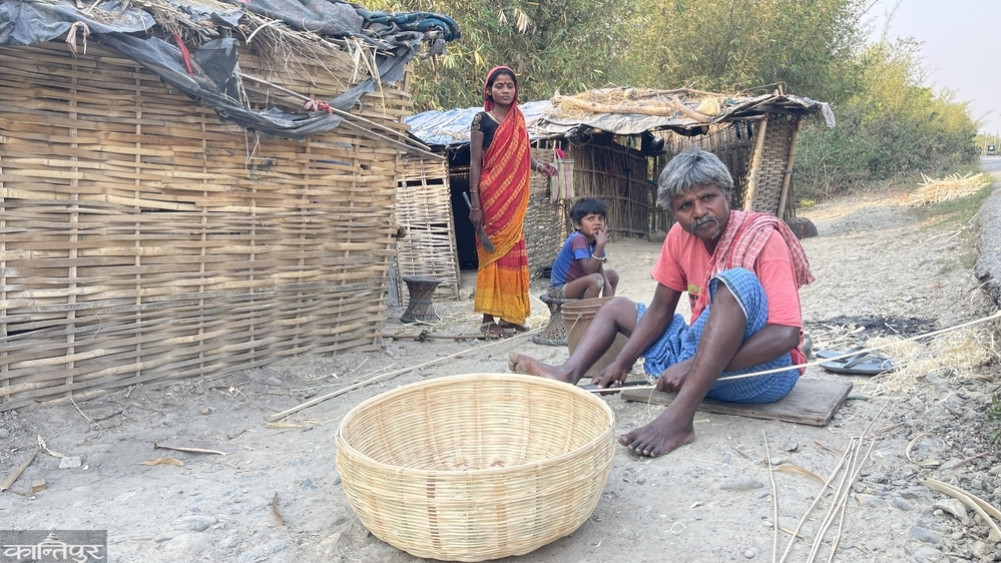
”When the body needs rest, we old people have become each other's support”
We use Google Cloud Translation Services. Google requires we provide the following disclaimer relating to use of this service:
This service may contain translations powered by Google. Google disclaims all warranties related to the translations, expressed or implied, including any warranties of accuracy, reliability, and any implied warranties of merchantability, fitness for a particular purpose, and noninfringement.
I live on the west bank of Koshi river at Hanumannagar Kankalini-14, Rampura Malhaniyan. I am now 54 years old. Saptari has not seen the world except this village. So far, many sorrows have been cut. When the body needs a little rest, we old people have become a support to each other. Poverty never let him slow down.
In the morning, the sun does not rise, and the worry of going to bed starts to bother you . That's why I start going from village to village in search of bamboo. It is not sad because it is found everywhere . However, I look for the cheapest bamboo and buy it . Bamboo can be used for work from one and a half to two hundred. After returning home and having dinner, I take out the bamboo tea . A day passes by preparing choya. Sometimes it takes two days .
After the choya is ready, the process of making chiti, dhaki and pankha starts . I have been weaving three/four sticks, dhaki and up to two fans from one bamboo . After starting knitting in the morning, I prepare two pieces of yarn till 2/3 in the afternoon . After I finish weaving, my wife carries it and goes to the village to sell it.
Now Chiti, Dhaki is not selling like before . After visiting many places, barely one piece is sold and you can get up to 200 rupees . If you sell two a day, it will be 400 . With that income, we used to buy a kilo of rice for 70 rupees, half a kilo of potatoes for 15 rupees, cooking oil for 35 rupees, and spices for 30 rupees.
Now half a kilo of onion comes for 15 rupees . Spices are also needed. Buying the same 20 rupees of turmeric and 30 rupees of green vegetables will cost 215 rupees. Two hundred rupees must be saved to buy bamboo every day. One time purchase of food saves three/four meals.
Nowadays, it is difficult to get rid of bamboo products because they are not sold. Sometimes we have no money to buy pulses and rice and we sleep hungry . It is not possible to count the days of such shortages. Our property is nothing except the tower built on Ailani land .
The daughters are already married. Now they have two sons, Sanjay and Deepen, aged 25 and 23. Sons have also not found employment. Being jobless, they were finding it difficult to take care of their daughter-in-law and grandchildren. Since there is a shortage here, they are living in their in-laws' house in Kanepokhari in Morang. To break the story, our son and daughter-in-law also have a problem sleeping in our bedroom. Staying at the in-laws house, both of them are washing dishes and cleaning in the hotel . They do not touch their in-laws . Who doesn't want to spend time with their grandchildren in their old age? But the sinful stomach did not allow it to be fulfilled. Daughters sometimes help in the work when the mother-in-law comes. It is not possible to always come and help.
Even the people's representative who came back asking for votes never came to inquire . But where do they have the leisure to inquire about people from the Dalit community? They have not been able to get the services from the government.
I heard that the government will give a concrete house to the Dom family under the Janata Awas program. Even though they tried repeatedly to ask for that house, they refused to give it because they didn't have their land. They say to buy land but we are not able to eat and from where can we buy land? The dream of living in a concrete house will remain a dream.
Earlier our ancestors lived in Rampura Malhaniyan village. But after the annual floods started there, they moved here . We have lived here for three generations. We are on the west side of the embankment and on the east side is the house of Badri, Ram Vriksha, Shyam, Rama and Shivnarayan Marik. They too have not been able to get a fixed house under the Janata Awas program . Like us, they have been living a poor daily life in Tahara.
presentation: Vidyananda Ram