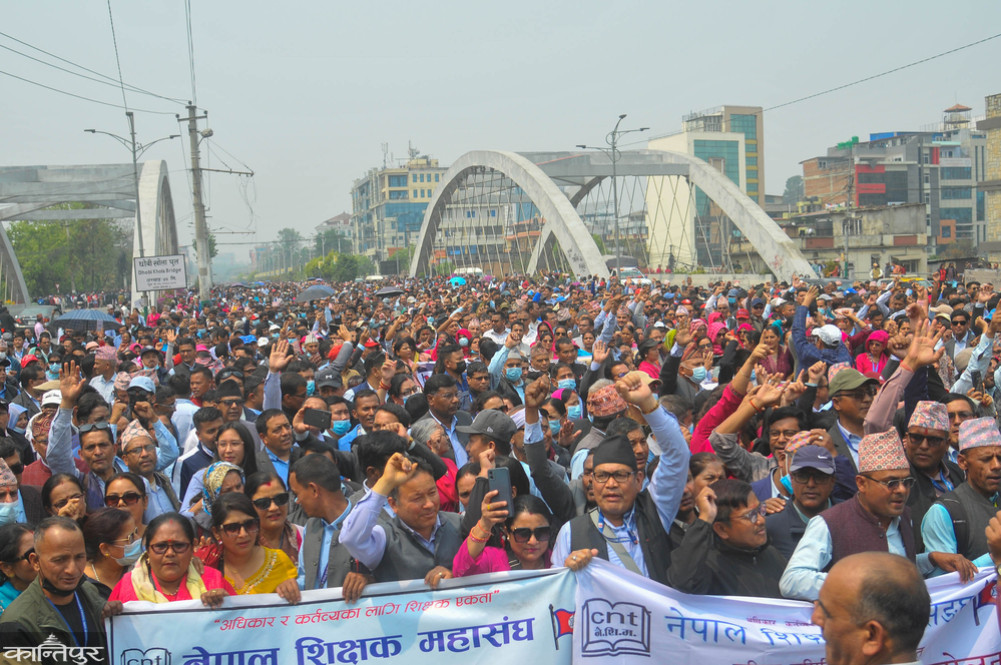
The teachers' federation submitted a letter of attention, discussion with the team led by Education Minister Vidya Bhattarai
We use Google Cloud Translation Services. Google requires we provide the following disclaimer relating to use of this service:
This service may contain translations powered by Google. Google disclaims all warranties related to the translations, expressed or implied, including any warranties of accuracy, reliability, and any implied warranties of merchantability, fitness for a particular purpose, and noninfringement.
A dialogue has started between the protesting teachers and the Ministry of Education for nine days. A team led by Education Minister Vidya Bhattarai and representatives of the Nepal Teachers' Federation held a discussion at the Ministry of Education on Thursday.
The delegation of the federation led by co-president Nanumaya Parajuli has submitted a letter of attention to Education Minister Bhattarai. "We went to the ministry to express our views rather than negotiating and agreeing. "We came back saying that the Ministry of Education had to play the role of a mediator to issue the School Education Act," said Parajuli, who is also the coordinator of the Kathmandu-centric movement. She said that even though the ministry asked to stop the protest, the programs including the educational strike will continue.
The spokesperson and joint secretary of the ministry, Shivkumar Sapkota, also said that the dialogue with the teachers has started but no decision has been taken. "There has been an internal discussion and a meeting," he said. After Education Secretary Deepak Kafle called for discussion, the teachers are ready to communicate. Earlier, when the Ministry of Education invited them to dialogue, they refused. The teachers have been in Kathmandu-centered agitation since March 20. An academic strike has been announced from Monday.
According to Federation President Laxmikishore Subedi, an attention letter with a 24-point list of the main issues to be addressed by the school education bill has been submitted to the government on Thursday. "We have not only gone to explain the confederation's agenda," said Subedi, "we have also drawn the government's attention to the fact that the government should have a clear view on the implementation of the previous agreements." The school education bill is in the stage of quarterly discussion in the sub-committee under the committee. Stating that the winter session of the Parliament has ended before the estimated date, the Federation has accused the government of not being serious about bringing the School Education Act. It is said in the attention letter, "Nowadays, Nepali teachers-employees have come to the protest in search of the School Education Act, which will address all their previous agreements." In the current situation, the school education act can be issued through one of the options of starting the annual session of the parliament immediately, calling a special session or issuing an ordinance.'
The Federation demands that the government should have a clear opinion on the issue of the new Education Act. Why has there been a delay in taking necessary decisions regarding the implementation of past agreements that can be addressed by the decision of the Council of Ministers? The Federation is looking for a concrete answer to this," the attention letter said.
The co-chairperson of the federation, Parajuli, said that the government is not serious about bringing the law quickly even when the teachers and staff are living on the streets. "There is nothing that needs to be agreed upon through negotiations now. According to the agreement reached with the teachers in 2075, 2080 and 2080, the Education Act is needed, she said.