Since 2046, the main rein of politics has been in the face, the youth who turned 18 years old in 2046 is now 53 years old, but he has been seeing the same face of running the state since then, and how will it change?
We use Google Cloud Translation Services. Google requires we provide the following disclaimer relating to use of this service:
This service may contain translations powered by Google. Google disclaims all warranties related to the translations, expressed or implied, including any warranties of accuracy, reliability, and any implied warranties of merchantability, fitness for a particular purpose, and noninfringement.
I was only 29 years old when I entered Parliament for the first time. Growing up in a political family, he became interested in politics from an early age. Baje worked as Pradhanpanch at that time. Father (Romi Gauchan) has been active in politics for 30-40 years. Muma is active in social work.
For me, the first ideal center of social service and politics is the family. He was committed from a young age that social work and politics should be the main objective for the legacy we leave behind. It was my childhood thought that sooner or later I would enter politics.
After the parliament, it was realized that there is a big difference between the expectations of the common people and the reality. Since 10/12 years, I have been closely observing, understanding, knowing and becoming active myself in my father's active politics, so many things were already felt. Since my father had been a district party chairman and became a member of parliament and a minister, I had some knowledge of the role that an MLA should play in the parliamentary sector and the responsibilities of the executive sector as a minister. I was able to experience the reality of parliamentary constituencies and the role of parliamentarians without being there myself. I was very ignorant about the ground reality and the role of MPs and ministers. But after coming to the role of the legislature, he saw something different than expected.
As it seems, after people's issues and issues are raised in the parliament, the state agencies take them seriously and go into implementation. The time I have spent today as an MP has turned into more disappointment than hope. Looking at the institutional structure, their working style, capacity and systemic development, disappointment has increased now. In principle, the role of the legislature is focused as a policy maker. However, rather than creating policies and making laws, the voters consider MPs to be lovers of the development of their villages, places and regions. There is an understanding that the elected representatives will develop. In this there is a gap between the theory and the ground reality.
Therefore, we parliamentarians are not allowed to be limited to the role of policy making. For example, when I go to my election, when I meet with an average of ten people, eight of them say that there is no village, no road, no infrastructure. Not a single person told me that such an amendment had to be made in the Citizenship Bill which was passed in the Parliament recently to obtain citizenship through the name of the mother.
is that our traditional political practices, values and beliefs are the building blocks of development. The expectation of common citizens is in that. Commitment in elections is also made for development. Elections are not won by making such laws, such policies and rules. What is needed is a commitment to build village problems and development. This is reality. MPs are not allowed to deviate from this. If the confessions made during the election are not taken into consideration, the next election will not be held.
If systems and institutions like those in Europe and America were to work, the legislative role could have been focused. However, in a country like ours, the reality is different. There is nothing that can happen just by submitting a petition, saying that it has to be done. Either we should be able to change the existing laws and structures, or else we have to act to give results to the people's confession that it is like this, it is like that. I think a lot can be done if you want to do it with a little effort and a little broad thinking. However, it is difficult to do with the existing organizational structure. As a
, the budget comes on June 15 every year. Prior to that, the parliament session is discussed twice. Till date, after experiencing two financial years, none of the suggestions and plans that we put in the Parliament have been incorporated when the budget comes on May 15. The discussion on the budget seems futile. National Planning Commission is the organization that formulates the plan by integrating all the three governments and stakeholders. Even the Planning Commission does not formulate the plan after discussing it with the people's representatives of the union, state and local levels and the relevant stakeholders. Therefore, many schemes do not cover the land requirement. Even if the working style and structure of the Planning Commission were to be reformed, MPs could spend most of their time focusing on the role of MLAs. To this day, Some ministers complain about the lack of plans in their own areas, some respond that billions of rupees have been budgeted. All this is the result of the national plan not deciding the plan after discussion on an objective basis.
Broadly speaking, the debates on various topics and issues in the Parliament seem to be mostly 'vibrant' except for a few. The issue of your constituency is being discussed, there is not much distance between the youth like us and the generation above us in the issue of Bharti and the national issue. The work style and methods are increasing dissatisfaction in the society. Nepali society complains that the state government has not been able to work as expected. It is inside and outside the parliament. Those in executive positions are not allowed to work on average. Even those who are in charge of legislators like us are not allowed to do average work. If we really want to transform the country and work accordingly, it does not seem that all generations will work in the current style. The working style must be changed. Right now, it is very necessary to change the thinking and working style from the leaders who run the state to other democratic bodies to perform smoothly and efficiently. If the older generation is not ready for this, it is necessary for young parliamentarians like us to do a creative rebellion.
There is such anger towards the leader on the streets and social media, the reason behind this is the style and way of working of those in power. Yes, our democratic parliamentary system, values, recognition and fundamental rights are among the best in the world. However, there is general dissatisfaction with the behavior, decision-making ability, working style and appointment process of the leaders of the state power and its 'stake' holders. The performance of the
state runs counter to our accepted principles. If this is not rectified in time, the common youth cannot be given hope. Millions of young people today are left with a bleak future due to the failure to capitalize on the opportunities that have been created. The tendency of youth to migrate outside is increasing.
It is a pity that the young people who have received good education in urban areas, who grew up from inheritance, have stopped seeing the future in Nepal. It is not only new to replace the old, it is seen that our structural weakness and working style have to be radically changed. Now the state power is around two/four people. Since 2046, the face has been the main rein of politics. The young man who turned 18 years old in 2046 is now 53 years old, but he has been seeing the same face of ruling the state since then, and how will it change? Give an example like
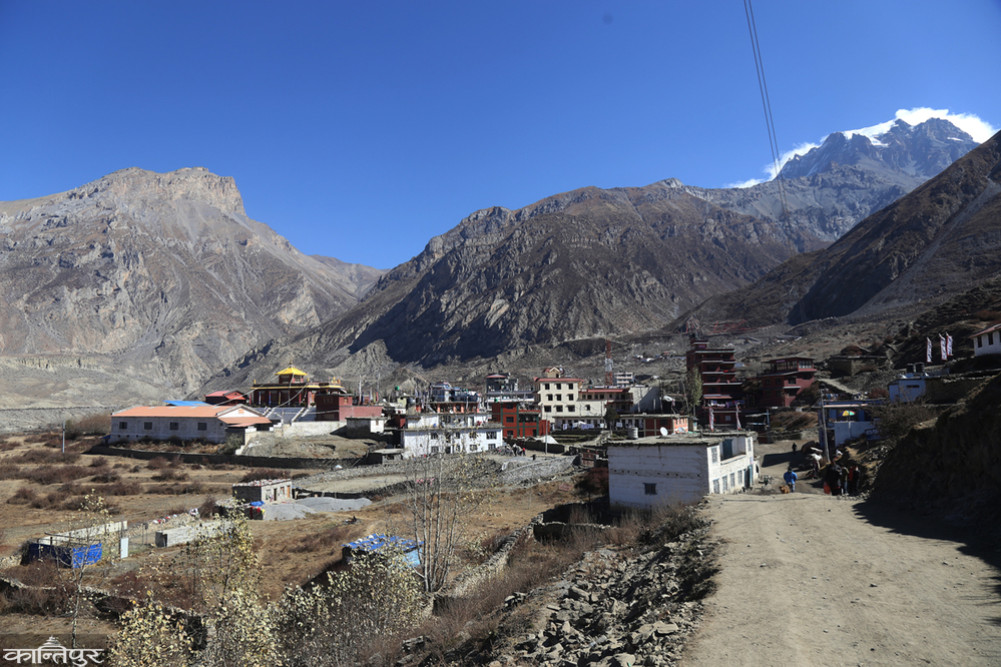
, now not only me in Mustang, but also two provincial MPs are young people below 40 years old. My father, Romi Gauchan, became a party chairman, MP and minister. Still active in politics. Having been active in politics for 30-40 years, he said that the generation after him should leave the way according to the society, the international environment and the wishes of the common citizens.
Our national sentiment was also the same. Not only the people of Mustang, but people all over the country want this change. Romi Gauchan says that he made his son the heir. However, it is not so. He has promoted me according to the wishes of the entire Mustang and General Congress. If it can be done in Mustang, why can't the mechanism be done? I don't tell other parties, the same question is frequently asked about the leadership of our own party, why can't our leader do it from his place when Mustang is handing over the leadership with generational transfer?