In the video conversation, Kumar spoke in detail about his background, from his journey as a research fellow at the University of Oxford to his study journey at the University of Cambridge, and the happiness of conservationists and his future plans.
We use Google Cloud Translation Services. Google requires we provide the following disclaimer relating to use of this service:
This service may contain translations powered by Google. Google disclaims all warranties related to the translations, expressed or implied, including any warranties of accuracy, reliability, and any implied warranties of merchantability, fitness for a particular purpose, and noninfringement.
When asked where the house is, conservationist Kumar Paudel says Sindhupalchok. If he had to say the name of the village, he said that it was a landslide, and that it was a village above that. One hundred and 45 people lost their lives in the Jure landslide on July 17, 2071. 153 houses were damaged. That's why when Kumar says Jure, many easily guess where he was born and brought up.
Kumar, who was born in the village above Jure, was recently selected from more than 300 international competitors and received a prestigious international award of 50,000 Euros from the 'Future for Nature' Foundation in the Netherlands. Despite naming the country that received the prestigious award of around 76 lakh rupees, Kumar has not yet received a formal inquiry about this from the government. Even though the state did not get the attention of Kumar, such a big international award has not only encouraged him, but also inspired him to continue his work quietly. He said, 'Well-wishers and those who have worked in this field have been inquiring and congratulating. I am happy about this .'
For almost two decades, Kumar Salak has been involved in research and campaigns against wildlife conservation and poaching. To learn about the salak, which lives only in the womb all day, has a tongue longer than the body's length, and lives by eating only ants and earthworms, What inspired you to find and preserve it? In a video conversation with Kantipur, he started talking about his background. said, "Being born in a border village in China, I have seen incidents like killing and taking people to be sold from an early age. Later on, we came to understand its importance, its value in its ecosystem . And while looking for this, new things kept me in the research.'
Understanding and searching for the salak that eats more than 70 million ants and wasps in a year, he has not reached anywhere. He has reached dozens of districts of Nepal to India, Sri Lanka and Indonesia to understand about Salak. There are not only local gangs in the smuggling and transportation of black and copper species found in more than 50 districts of Nepal, His research has shown that the international group of wildlife smuggling is connected. 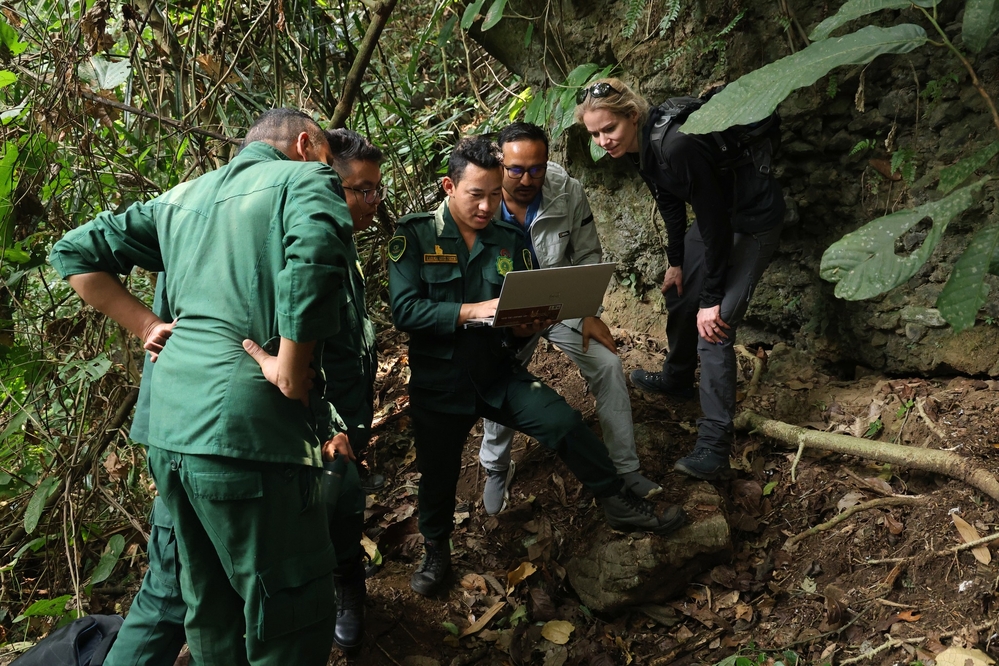
During the study of salak in Bhutan's Manas National Park / Picture:
from Kumar Paidel's Facebook
Kumar is also the vice-president of IUCN's salak expert group-Asia. He is involved in various campaigns for salak conservation in South Asia and Asia. After working as a research fellow at the University of Oxford, Kumar, who has an MPhil from the University of Cambridge, is currently contributing as a member of the UK Government's Biodiversity Advisory Group. Kumar, who is preparing to graduate from the University of Cambridge, says that he is still learning, understanding and searching. He said, 'Questions and hunger for knowledge felt like intoxication.'
Moving from an ordinary rural background to the University of Cambridge, Kumar has collected many bittersweet moments. Remembering the past, he said, 'After completing SLC, my studies are over. He thought that salvation had been achieved. But I am still studying and searching.' When he got his M.Sc from Pokhara University, he met and researched 162 prisoners who were jailed for wildlife crime. He wanted to know more about the traditional understanding that poverty drives people to commit wildlife crime. While narrating the gist of the investigation, he said, 'They are involved in crime because they can earn money more easily than because of poverty and they will be released from prison within a year. When only after being in prison, they know how much it costs in social life.'
According to Kumar, our understanding of wildlife conservation is limited and it seems that more studies and more work should be done on the conservation system. He said, "People from ordinary backgrounds are taking huge risks and are involved in poaching of wild animals. While someone else is taking a big financial benefit from it . It is also necessary to understand why common people are forced to join it.' Kumar's study was published in the journal 'Conservation Science and Practice' in 2020.
Paudel also established the Greenhood Nepal organization in 2012 for the protection of endangered wildlife and plants including tortoises, salaks, rhinoceroses and lions. Now he is studying and researching in the conservation of salak and other wild animals from this institution . Kumar, who has also written a book to educate children about conservation issues, is not only limited to research, study and writing, but he is equally involved in educating the new generation about this issue.
Kumar, who has also worked as an expert in the World Wildlife Crime Report published by the United Nations, is thinking of spending the money received from the 'Future for Nature' award on conservation and research. He said, 'There is still a lot of work to be done in the protection and promotion of Salak. I think this award will help further research and conservation campaigns.'
