The rocket, which was launched at 10:32 am Nepali time from the Satish Dhawan Space Center in Sriharikota, Andhra Pradesh, did not achieve its goal of reaching a 'sun-synchronous orbit', 512 kilometers above the Earth, within 20 minutes.
We use Google Cloud Translation Services. Google requires we provide the following disclaimer relating to use of this service:
This service may contain translations powered by Google. Google disclaims all warranties related to the translations, expressed or implied, including any warranties of accuracy, reliability, and any implied warranties of merchantability, fitness for a particular purpose, and noninfringement.
The 'Munal' satellite, built by secondary school students in Nepal over two years, has reached space, but it is not communicating due to technical problems. On Monday, the Indian Space Research Organization (ISRO) launched the 'Polar Satellite Launch Vehicle' (PSLV-C62) carrying 16 satellites from different countries, including Munal.
The rocket, which was launched from the Satish Dhawan Space Center in Sriharikota, Andhra Pradesh at 10:32 am Nepali time, was not able to reach the 'Sun-synchronous orbit', which is 512 km above the Earth, within 20 minutes.
The rocket reached space, but due to technical problems, communication with the satellites including Munal on board could not be established. Hariram Shrestha, the head of space science at the Nepal Academy of Science and Technology (NAST), who is currently in India for the same mission, said that some deviations (anomalies) were observed after reaching the third stage.
He said that after the rocket crossed an altitude of 460 km above the Earth, there was an obstacle on the way before reaching the final stage. 'The rocket reached space, but complete success (complete success) was not achieved.' Because in the current situation, we cannot communicate with our satellites,' Shrestha told Kantipur, 'The satellites including Munal are now stuck inside the rocket's carrier (pod). Not being able to reach the final stage means that the satellites have become like sitting inside a house, they could not come out of the pod.' According to Indian media including India Today, the satellites in this ISRO mission are now useless.
The Munal satellite was built by 9 students from Banepa, Dhulikhel and Panauti in Kavre with the help of an engineer. This 'One U' cube satellite, weighing about one kilogram, was equipped with two 1.3-megapixel cameras and artificial intelligence (AI) technology. It aimed to map the greenery of the Earth. Although this time it was not a complete success, NAST considers it an important achievement in terms of capacity development.
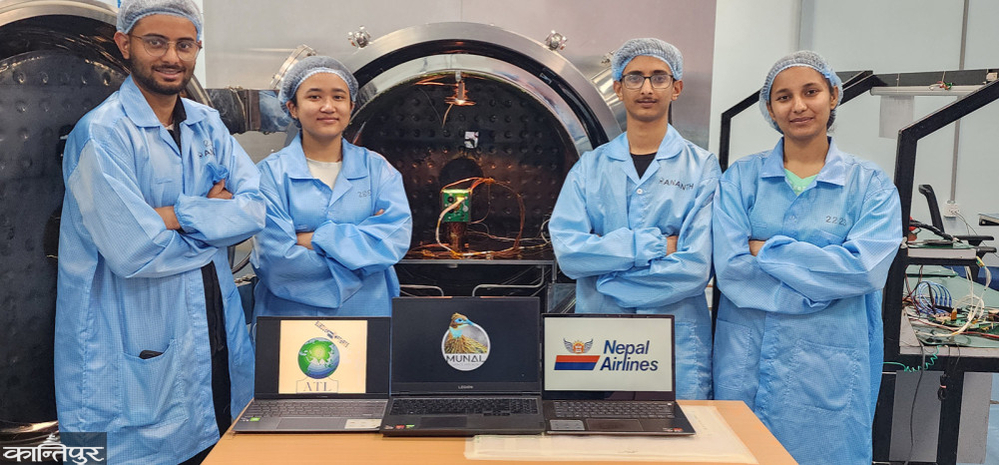
According to Shrestha, the experience gained from this mission will make it easier for the future. NAST has now planned to prepare for the construction of 'Munal-2' or 'Nepali Sat-2'. NAST has expressed gratitude to the Government of Nepal, Government of India, ISRO, NSIL, Indian Embassy in Nepal, students, and schools involved in this mission.
About two crore rupees were spent on this project. Due to the support of the Government of India, Nepal did not have to bear the cost of its launch. In the meeting of the Joint Commission of Nepal and India at the level of Foreign Ministers held in Kathmandu on 19 Pus 2080, it was agreed to launch the satellite built by Nepal with India's support. In Shrawan 2081, the Indian Ministry of External Affairs and New Space India Limited signed a memorandum of understanding to support the launch of Munal.
An MoU was signed between Joint Secretary Anurag Srivastava on behalf of the Ministry of External Affairs and Director of New Space India Limited Arunachalam A. The program was attended by NAST Secretary Dr. Rabindra Prasad Dhakal, then Acting Nepali Ambassador to India Surendra Thapa and Dr. Avas Maskey, founder of Space Foundation Nepal.
Earlier, Nepal had started its space journey through Nepali Sat-1. Munal satellite was developed by school students in the country. Along with Nepal’s Munal, satellites of various startup companies from Spain, Thailand, Brazil and India were also launched in this ISRO mission.
ISRO has launched 434 foreign satellites in 25 years, Orbital Today reports. The number of satellites launched on Monday, including eight foreign payloads, has reached 442.
Other payloads include KID, developed by Spanish space startup Orbital Paradigm, Orbital Temple, built by Brazil, and Thesis-2, built by the UK. According to the Times of India, Anvesh or EOS-N1, developed by India's Defence Research and Development Organisation (DRDO), has also reached space. This satellite, built for the Indian Army, is for surveillance purposes. Its hyperspectral imaging payload can identify the material of any object by analyzing light in a precise manner.
According to India Today, everything was going according to plan for 8 minutes after the rocket took off. ISRO's live broadcast showed the first and second stages of the rocket working properly, and the third stage of the rocket also ignited on time. The rockets are separated in stages and everything was normal when they reached the third stage. When the third stage was about to be completed, engineers detected unusual activity in the speed or direction of the rocket. This was the 62nd mission of the Polar Satellite Launch Vehicle (PSLV-C62).


