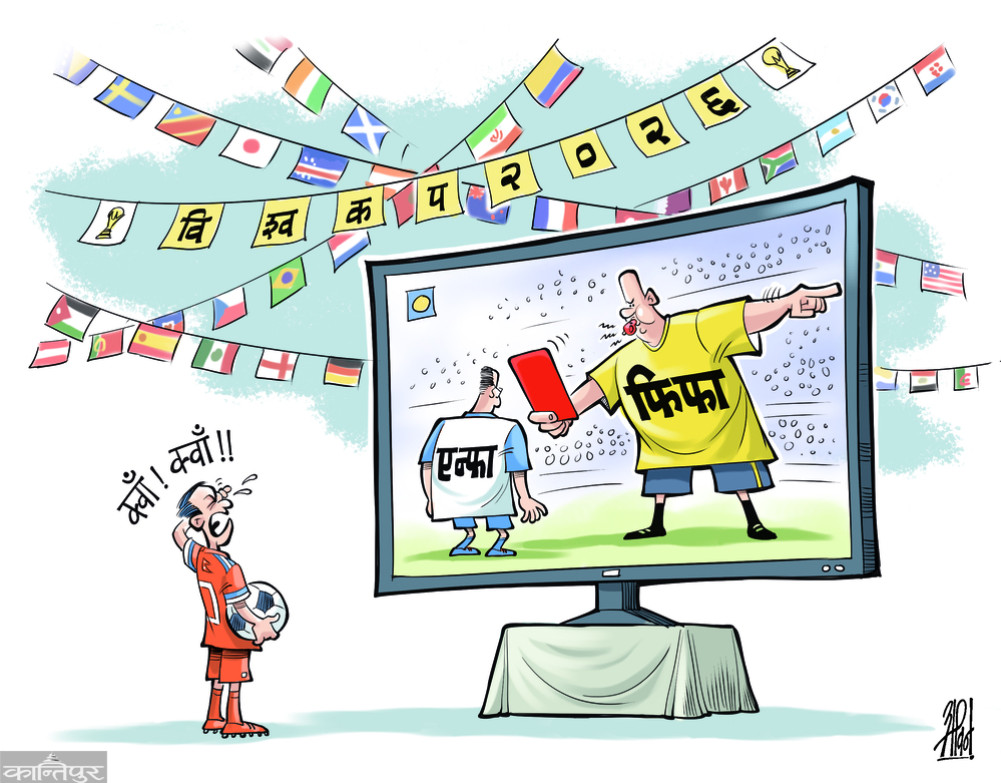
National team players are concerned that the government has not taken any initiative to resolve the issue even after a week of FIFA's ban.
We use Google Cloud Translation Services. Google requires we provide the following disclaimer relating to use of this service:
This service may contain translations powered by Google. Google disclaims all warranties related to the translations, expressed or implied, including any warranties of accuracy, reliability, and any implied warranties of merchantability, fitness for a particular purpose, and noninfringement.
The FIFA World Cup has a unique excitement and enthusiasm among Nepali football fans, but at this time, the dark cloud of the international ban is looming over Nepali football. This has not only disappointed Nepali football fans who are enjoying the joy of the World Cup, but there is a risk that a generation of players will flee if the ban is extended.
The International Federation of Football Associations (FIFA) has imposed an indefinite ban on Nepal after the controversy over the intervention of the government body, the National Sports Council (NSC), reached its peak. FIFA imposed the ban citing ‘third party interference’ as the reason. The future of Nepali football, which has been embroiled in controversy and internal conflict for a long time due to the ban, has fallen into a dark tunnel.
The FIFA ban has brought Nepali football activity to almost zero. Not only the well-wishers of Nepali football but also the players are disappointed. The lack of seriousness by the government and the Ministry of Education and Sports regarding the confusion seen in football, one of the most popular sports in Nepal, has further raised concerns.
Minister Sasmit Pokharel's comments on the situation after FIFA's ban are also not positive. Minister Pokharel has accused previous governments of repeatedly interfering in ANFA, but has not been able to put forward a clear blueprint on how to bring Nepali football out of the current ban. 'Nepali football is not in a position to go any lower than it is now,' Minister Pokharel had said at a press conference on Thursday. He said that correspondence has been sent to the International Football Federation (FIFA) and the Asian Football Confederation (AFC) to resolve the problem. Minister Pokharel also complains about the lack of a domestic league and claims that old players and contributors will be brought to ANFA to resolve the current problem. This shows that he is not aware of the international nature of sports.
Players and youth have been brought to the office bearers of the National Sports Council. That is not unnatural. However, it is not natural for the minister to say that he will select the ANFA leadership through the same process. The ANFA executive committee is selected by the clubs of various divisions and district associations affiliated to it. As sweet as it sounds to hear about taking former players and football lovers to the leadership of ANFA, it is equally difficult to implement it in practice. To lead ANFA, one has to go through this same structure. The players of the national team are worried that there has been no initiative to resolve the issue even after more than a week since FIFA imposed the ban, alleging third-party interference. They are not in a position to speak openly about this dispute. A member of the national team said, ‘Whatever dispute happened, it happened. Now it would have been better for Nepali football if everyone had left their own interests and gone towards resolving the dispute.’
This is the first time in the history of Nepali football that FIFA has imposed a ban. Due to this ban, all kinds of financial support provided by FIFA have been stopped. FIFA provides financial support of more than Rs 1.5 billion annually. Similarly, it also provides various projects for the development of Nepali football. But after the ban, all these have been stopped. This has brought Nepali football activities to a standstill.
According to ANFA itself, 324 people directly associated with Nepali football have become unemployed. According to statistics, 158 ANFA employees and coaches, 60 national players, both male and female, 92 licensed coaches and 14 FIFA referees will be affected. The number of those indirectly affected will be in the tens of thousands. According to statistics, there are more than 39,000 players in 1,700 schools in the age group. Similarly, there are 22,000 players in 49 districts.
The number of players playing in the selection from 'A' to 'D' divisions is also around a thousand. The number of licensed coaches is 600. On that basis, more than 80,000 have been affected by the ban. If the ban is prolonged, all of them are sure to choose an alternative path. Nepal has already lost three international tournaments due to the ban. The AFC Women's Champions League is the biggest of them. The other two are the Women's U-17 and Men's U-20 Asia Cup qualifiers.
The council and ANFA have claimed that they are making some efforts to lift the ban. The newly appointed vice-chairman of the council and former football player Vishal Shrestha says, ‘We are serious about the current situation. Therefore, the council is ready to solve the problem and we have also started the necessary process.’ Under his leadership, an investigation into the recent financial activities of ANFA is also underway. Shrestha himself is not in a position to say clearly what is happening regarding the FIFA ban. ANFA spokesperson Suresh Shah also claimed that efforts are being made to solve the problem. He said, ‘We are also open to all kinds of possibilities. Efforts are ongoing from our side.’
The claims that are being made now are limited to words. It is a situation where nothing concrete is being done. A player of the national team said, ‘No concrete work is being done to solve the problem now.’ His claim is that the current problem has affected only the players more, and those involved in politics within Nepali football have not been affected at all. Therefore, everyone is only saying that efforts are being made to solve the problem, but nothing concrete has been done. If something has happened, the process itself is wrong and it can exacerbate the problem instead of solving it. The player says, ‘It would have been better if everyone thought about the future of the players before making any decisions.’
Fear of losing a generation
If the ban on Nepal is extended further, a generation of players is certain to be lost. Not only that, it will also be equally difficult to find players to replace them. In the last four years, the ‘A’ Division Martyrs’ Memorial League has been held only once. Which was won by Church Boys United. If we were to make a list of all the players who played in that league, a quarter of them have migrated abroad. Another half have stopped playing football. Most of those who are left are not able to play.
The current captain of the men’s national football team is Kiran Limbu. Along with him, Rohit Chand has played more than a hundred games for Nepal. Most of their contemporaries have migrated abroad. Those who are left are also nearing the end of their playing careers. Of the new players in the national team, two-thirds have either gone abroad, and the rest are unknown.
The situation of the women's national team is even more worrying. The leadership of the women's team is on the shoulders of Angela Subba Tumbapo. The most experienced player of the women's team is Renuka Nagarkote. Two-thirds of the players in this team have been playing for the last decade. Most of the players in the team have won 50 'caps'. Most of them are moving towards retirement. Players to take their places in the women's national team are not ready yet. In that sense, it may be difficult to find good players in both national teams in the near future.
After the ANFA controversy and FIFA ban, former captain Upendraman Singh himself is in a position to say nothing about the future of Nepali football. 'My son plays football very well and dreams of becoming a player in the future. But am I not spoiling his future by playing football? There is only controversy in Nepali football, when will this end? I don't have the answers to any of these questions,' he said. Instead, he wants to ask, 'Who is doing what to bring Nepali football back on the right track?' Former goalkeeper Singh, who also runs a football training academy in Madhyapur, has another bitter experience, the number of people coming to learn football has decreased. What this means is that the Nepali youth generation is now more focused on other sports than football. Therefore, it will be difficult to form a national team with a hierarchical structure for both men and women in the future.
The lessons to be learned from the Olympic controversy
are not many, just a year ago, the same kind of problem that is now seen in Nepali football was in the Nepal Olympic Committee. The then government did not recognize the NOC election conducted by Jeevan Ram Shrestha. It was called illegal. Bank accounts were frozen. The NOC office was locked for months. Not only were the committee officials prevented from going abroad, the government also formed a new ad hoc committee.
The chairman of the ad hoc committee was Dhruv Bahadur Pradhan. This same group occupied the committee building in Satadobato and claimed that they were the real Olympic Committee. They also made big talk about participating in the upcoming Asian Games under their own leadership. But they could not do anything. The International Olympic Committee and the Olympic Council of Asia ignored it. On the contrary, they took action against some officials of various sports in that ad hoc committee.
After that, some changes also came. The Olympic Committee led by Jeevan Ram Shrestha has returned to its previous state. Even when the entire government was formed, it could not do anything. Now this same NOC is coordinating Nepali sports internationally. Here, ANFA is also involved in this Olympic dispute. This clearly shows what the trend of Nepali sports is. ANFA is also a member of the Nepal Olympic Committee. When the government was trying to remove the Shrestha-led committee, ANFA, whether under political pressure or not, decided to withdraw its membership in the Olympics at that time. What ANFA could not have imagined at that time was that it could also face similar government and political interference.
Controversy as old as Nepali football
It is said that the controversy within it is as old as Nepali football. ANFA came into existence only after 2032. Before that, the supreme body of Nepali football was the Nepal Football Association. Which everyone called 'NFA' at that time. It had obtained FIFA membership in the 1970s. Once Nepali football was associated with FIFA, it is said that the then royal family had its eye on it.
What was needed after that and the controversy not only started, but it is also believed that strong political pressure was put on the officials associated with NFA. Representatives of FIFA and AFC had to come to Nepal at that time to settle the dispute, although what really happened at that time is not clear. During the Panchayat period, both ANFA and Nepali football were used for their own benefit.
It is natural that after the 2008 movement, the controversy in ANFA once again persisted. In the meantime, when Ganesh Thapa was appointed president in 2009, FIFA and AFC did not initially accept him. At that time, the president was Rukma Shamsher Rana. Thapa led ANFA for more than two decades, never letting disputes and conflicts fester, and even more flourished.
In 2010, two parallel ANFAs came into existence at the same time, Thapa had international recognition, while Geeta Rana was at the head of the association formed with the support of the government. Even then, there were rumors that FIFA might ban ANFA. But the ban was not imposed, but FIFA never stopped supporting Thapa. Later, another ANFA disappeared.
Much later, the Nepal Football Association was formed, while ANFA was still there. Later, ANFA was embroiled in a match-fixing scandal and a corruption scandal involving Thapa. Thapa was banned by FIFA for 10 years. After that, ANFA was run by Lalit Krishna Shrestha (deceased) for some time. Then Narendra Shrestha became the president and then Karma Tshering Sherpa. Pankaj Nembang became the president after defeating Sherpa.
If we try to find out what the real controversy is in Nepali football, we cannot know its root cause. There have always been factions and sub-faction within ANFA. The process of moving from one faction to another for their own benefit also continued. Each kept accusing the other of being corrupt. The accusation that one could not do the work of the other never got old. But each faction took turns taking over the leadership of ANFA.
The root cause of the current dispute is the series of irregularities and irregularities within ANFA. When they were in the leadership of ANFA, there were always those who said that FIFA and AFC were right and when they were out of the leadership, there were those who said why FIFA and AFC were needed. But no country's football can run without the coordination of FIFA. For that, there was never unity in Nepali football. No one was innocent behind the current ban on Nepali football, everyone is guilty.
The conflict caused by the 'early election'
Having said all this, the root cause of the current sequence of events was the 'early election' announced by the current Nembang leadership. At that time, there were clearly three factions within ANFA. Therefore, the establishment side claimed that if this process was to be stopped, it was right to go to the elections, that too with three months left in its term. Perhaps many people did not object to the 'early election', but since there was no level-level election (district, province) for it, everyone disagreed with it. ANFA has claimed that it went for the 'early election' in accordance with the statute. Although it claims that level-level elections are not necessary for this, it was not a basic democratic practice. It was a normal process to have elections from the lower levels to select the leadership. This was the biggest mistake made by the Nembang leadership. It is natural that its impact will continue even after this.