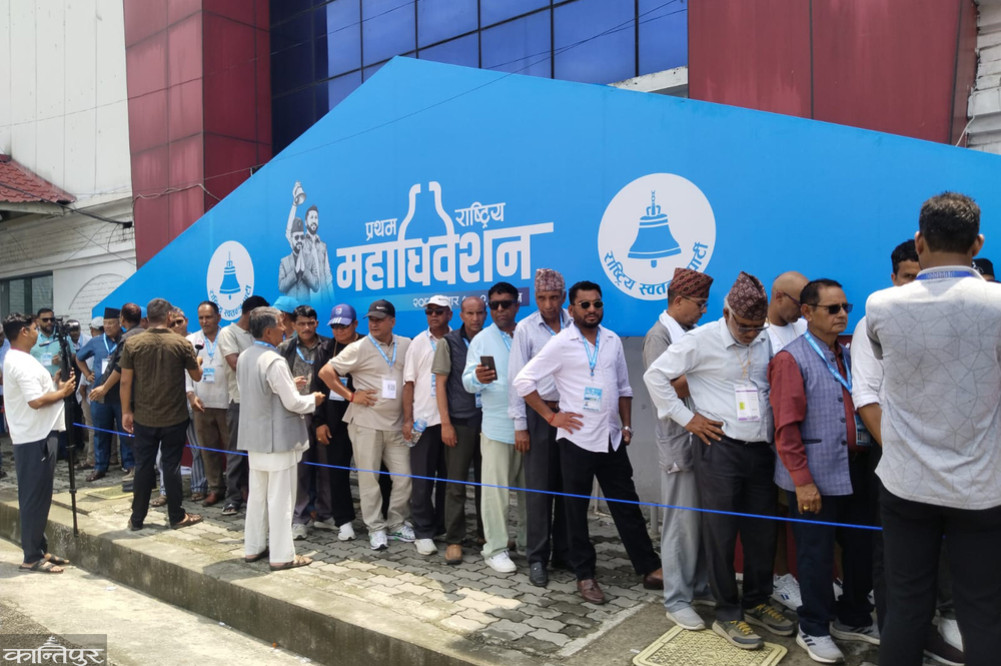
Even though the party leadership said there would be no group competition, discussions were held to ensure that the establishment side would be given a place in the election of the general secretary. The list of those who should vote in the election of central members was sent to representatives on WhatsApp.
We use Google Cloud Translation Services. Google requires we provide the following disclaimer relating to use of this service:
This service may contain translations powered by Google. Google disclaims all warranties related to the translations, expressed or implied, including any warranties of accuracy, reliability, and any implied warranties of merchantability, fitness for a particular purpose, and noninfringement.
Amidst chaotic management and undeclared group competition, a new leadership has been elected in the National Independent Party. Ravi Lamichhane has been elected unopposed as the party president and Swarnim Wagle as the vice president. Other office bearers and central members have been elected through voting.
Lamichhane is the founding president of the party. Wagle, who is also the finance minister, joined the Rashtriya Swayamsevak Sangh (RSS) after the 2079 general election. He was previously the vice president. Sobita Gautam has won the women's vice president position. Gautam was elected by getting 789 votes in the voting conducted online on Friday by electronic voting machines and representatives of the migration movement. Her competitor Toshima Karki got 572 votes. Gautam, who is also the law minister, was previously a central member.
Bipin Acharya has been elected as the general secretary. He got 673 votes for the post of general secretary, while his competitors Manish Jha got 346, Ganesh Karki got 169 and Sagar Dhakal got 139 votes. Acharya is a leader who has been working closely with the party leadership. He also headed the party's statute amendment committee. He was previously the joint general secretary in the party.
Asim Shah was elected as the open joint general secretary with 471 votes and Hari Dhakal with 410 votes. In the election for the two joint general secretaries, Ramesh Prasai, Yagyamani Neupane, Sulabh Kharel, Ashok Kumar Chaudhary, Milan Limbu, Pukar Bam, Rajiv Khatri, Vijay Jairu and Himesh Pant were also competitors. Nisha Dangi was elected as the women's joint general secretary with 737 votes. Her competitors for the joint general secretaries were Julie Yadav, Jamuna Sharma (Bidushi), Kamini Kumari Chaudhary and Rima Bishwakarma.
The election for office bearers was held only on Friday, the sixth day of the general convention, which was supposed to be held in three days. Only 1,289 delegates participated in the voting for the office bearers. Voting for the central members was held from 12 midnight on Wednesday to 12 noon on Thursday, in which 2,959 people participated. The total number of delegates to the general convention was 3,859.
Due to the repeated disruptions to the closed session and election process, most delegates returned home without voting for the office bearers due to increasing expenses and confusion. Some delegates even went home without voting for the central members. That is why the office bearers were selected by the vote of about one-third of the delegates.
The most exciting contest among the office bearers was for the post of general secretary. Initially, there were 10 competitors for the post of general secretary, including Kavindra Burlakoti, Pramod Neupane, Rajunath Pandey, Manish Jha, Jagdish Kharel (Lalitpur), Ranju Darshana, Ganesh Karki, Ganesh Parajuli, Sagar Dhakal and Bipin Kumar Acharya. After that, the top leaders including Chairman Lamichhane tried to reach a consensus. On Thursday evening, leader Shishir Khanal, who is also the Minister of Foreign Affairs, withdrew his claim, saying that he had paved the way for a consensus. When the rest could not reach an agreement, the establishment party of the RSP started discussions to come to a common ground. Meanwhile, on Friday afternoon, Burlakoti, Neupane, Parajuli and Kharel announced at a press conference on Friday afternoon that they would support Acharya by withdrawing their candidacies. Leader Khanal also expressed his support for him.
RSP President Lamichhane had initially said that there would be no group candidacy, and other top leaders had also repeated the same. However, at the press conference, leader Parajuli said that they had decided to support Acharya, saying that the representatives had demanded that ‘all the establishment parties should have stood in one place and voted in one place.’ He had said, ‘When all the general convention representatives were watching everything, the establishment party, everyone who would establish the party, should have stood in one place. Therefore, we discussed making a single candidate from the establishment side and have decided to support Acharya.'
Some even criticized Parajuli's statement. Leader Manish Jha remained in favor of competition. After the news of five people supporting Acharya came out, he spoke to reporters and said that the statement made was a group exercise and went against the spirit of the party leader. 'Ravi Dai had said that group political exercises should not be practiced, but the chairman is not aware that anyone is doing this in his shadow, we wonder if his name is being defamed,' he said, 'If this is a group exercise, it would not be to support or oppose any person.'
After being elected as the general secretary, Acharya has apologized 'for some friends raising the issue of establishment'. ‘All the friends associated with the first general convention are from the establishment party, while some of my friends were raising the issue of establishment, the essence of it would not have offended anyone,’ he said, ‘I apologize if it offended anyone.’
There was a commotion after the list of delegates who had to vote from unknown numbers was leaked during the election of central members. The list provided to Kantipur by a leader of the Rashtriya Swayamsevak Sangh (RSS) included 56 names, most of whom were those who had been integrated from the Balendra Shah party. A few hours after the voting for the selection of 99 central members of the RSSW had begun, such a list was sent to WhatsApp.
In the past, it was said that the UML and the Congress would not field joint candidates with the conclusion that they were spoiled due to the same factional politics, but an RSSW MP said that even worse practices have been seen in the RSSW. ‘The party should investigate what level of involvement there is in this,’ he told Kantipur. ‘This issue should not be left unsaid, even since it may have been done to defame someone.’
These developments revealed latent tension between groups that have been active since the establishment and those that have been integrated later. Candidates also expressed dissatisfaction with the serial number of electronic voting machines. In the election of central members and office bearers of the RSVP, there was a provision for representatives abroad to vote through a mobile app.
The RSVP had amended its statute and this time the number of office bearers has been increased to 19. The RSVP has a provision to have a president, a senior leader, three vice presidents (including one woman and one nominee), two general secretaries (one nominee), five joint general secretaries (one woman, two nominees), one spokesperson, three joint spokespersons (one woman), one treasurer and two joint treasurers (one woman). After the amendment, the number of nominees is more than the number of elected positions. Earlier, the number of office bearers was 12.
Leaders say that preparations are underway to nominate Sunil Lamsal, who came to the integration from the Balendra faction, as vice president and Bhupdev Shah as general secretary. Out of the 26 people who were integrated from the Balendra faction, 16 had not even filed their candidacies for central members. The party statute has given the president the right to nominate 51 people as central members.
After the agreement reached between Rashtriya Swayamsevak Sangh (RSS) President Lamichhane and the then mayor of Kathmandu Metropolitan City Balendra Shah in December, 26 members had become members from the Shah faction. Those who did not file their candidacies include Lamsal, Bhupdev Shah, Laxman Tharu, Ramesh Paudyal, Santosh Giri, Sarita Gyawali, James Karki, Laxmi Bardeva, Anantaraj Ghimire, Ramkumar Dhungana, Pradeep Gyawali, Madhusudhan Dhakal, among others. Home Minister Sudhan Gurung also did not file his candidacy.
The first general convention of the RSP appeared to be chaotic in terms of management. The party, which claimed to establish a different culture and style in politics through its first general convention, was criticized for the lack of internal democracy, the propaganda style that reflected the old party, and undeclared group exercises.
The inaugural ceremony of the general convention was scheduled to begin at 1 pm last Sunday. It was postponed to 2 pm. But the program began only after Chairman Lamichhane and Prime Minister Balendra Shah arrived at 3:30 pm. The venue for the event, which was held in 36-degree heat, did not have enough fans or coolers. The closed session was prolonged as the list of delegates could not be arranged. While some leaders who were subject to action appeared in the list of delegates, the names of some lawmakers were missing.
Although electronic voting machines were arranged, it took 7-8 hours to convert the forms into digital form as they were collected manually. The delegates themselves protested, saying that they had to queue for hours to fill out the forms in the election of a party that came to digitize the country. Prime Minister Balendra Shah himself returned to Kathmandu before voting.
After President Lamichhane presented the political report in the closed session, there was no discussion among the representatives, it was passed with applause in about seven seconds. There was criticism that internal democracy was stifled like in other parties. The leaders said that they could not discuss it due to lack of time. The party's political document included sensitive issues such as the abolition of the provincial assembly and the reduction of local levels, but representatives from the Far West, Madhesh and Karnali were not able to express their different opinions on these issues.
According to new generation political analyst Navin Tiwari, the Rashtriya Swayamsevak Sangh (RSS) had an opportunity to send a message of new political culture to other parties through this convention, but the RSS lost that opportunity. After taking the oath as the re-elected president, Lamichhane admitted that he had some weaknesses due to his first experience and committed to improving it in the upcoming general convention. "The RSS will move forward with more maturity," he said. Preparations are underway to swear in other office bearers in Kathmandu.