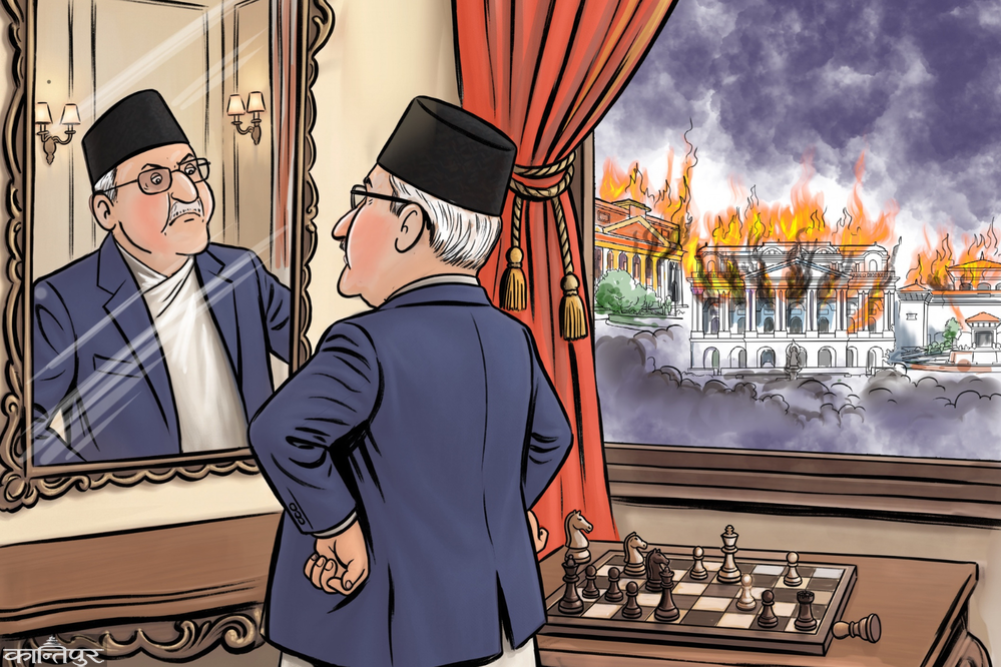
KP Sharma Oli's political journey not only reflects the contradictions of Nepal's democratic practice, but also the tension between revolutionary tendencies and institutional governance, and between populist and constitutionalist tendencies.
We use Google Cloud Translation Services. Google requires we provide the following disclaimer relating to use of this service:
This service may contain translations powered by Google. Google disclaims all warranties related to the translations, expressed or implied, including any warranties of accuracy, reliability, and any implied warranties of merchantability, fitness for a particular purpose, and noninfringement.
Eloquent, blunt, arrogant and self-centered. Some describe UML Chairman KP Sharma Oli in this way. Those close to him see him as a truly courageous leader – a nationalist leader who can speak clearly, who cares about the country.
The 74-year-old Oli is perhaps the most divisive figure in the country since the promulgation of the 2072 constitution. There are few leaders in modern Nepali politics whose lives have witnessed so many ups and downs, revivals and continued stubbornness.
Oli’s political journey has been full of rebellion, prison life, serious illness and stubbornness. Once marginalised within the party, he not only rose to the party leadership, but also became Prime Minister four times. He is a leader who rose from underground communist activities to the top of state power.
Oli’s political journey reflects not only the contradictions of Nepal’s democratic practice, but also the tension between revolutionary currents and institutional governance systems, and between populist and constitutional advocates.
Oli has for some years twisted both political ideology and the political system around his authority. He was the most powerful person in the country until Bhadra last year. When he was leading the government with the support of the then largest party in the House of Representatives, the Gen-G movement broke out. It toppled his government.
In the House of Representatives elections held six months later, Oli was not only defeated, his party was greatly reduced. He is still leading the UML, but pressure is increasing to reorganize the leadership.
To understand how Oli came to this situation, we must go back to the incident of Bhadra 24. At that time, protesters had already entered the Prime Minister's official residence in Baluwatar. A day earlier, 19 people had died in police firing in the Baneshwor area.
The then Prime Minister Oli was surrounded by security personnel, some party officials, and members of his own secretariat. Buildings including the Supreme Court, Parliament, Singha Durbar were on fire, and leaders' houses had started burning. Smoke and chaos had already covered Kathmandu city.
When the country was facing a complex situation due to the Gen-G movement of 23 Bhadra and the protests of 24 Bhadra, some officials had suggested that Oli resign. But he flatly rejected such suggestions. ‘What is the political solution to the current crisis after I resign?’ was his question.
The then Finance Minister Bishnu Poudel, his chief advisor Bishnu Rimal and party Deputy General Secretary Pradeep Gyawali were urging him to resign. ‘I am not going to bow down to wrongdoing. If they kill me, I will rather die here,’ was his stance.
When the situation got out of control due to the protests, he was ready to resign. He asked for the official letterhead of the Prime Minister’s Office, but it was not there. So he wrote his resignation on plain paper and let it be typed.
‘...I am resigning with effect from today to pave the way for a political solution through constitutional means,’ he had written in his resignation letter.
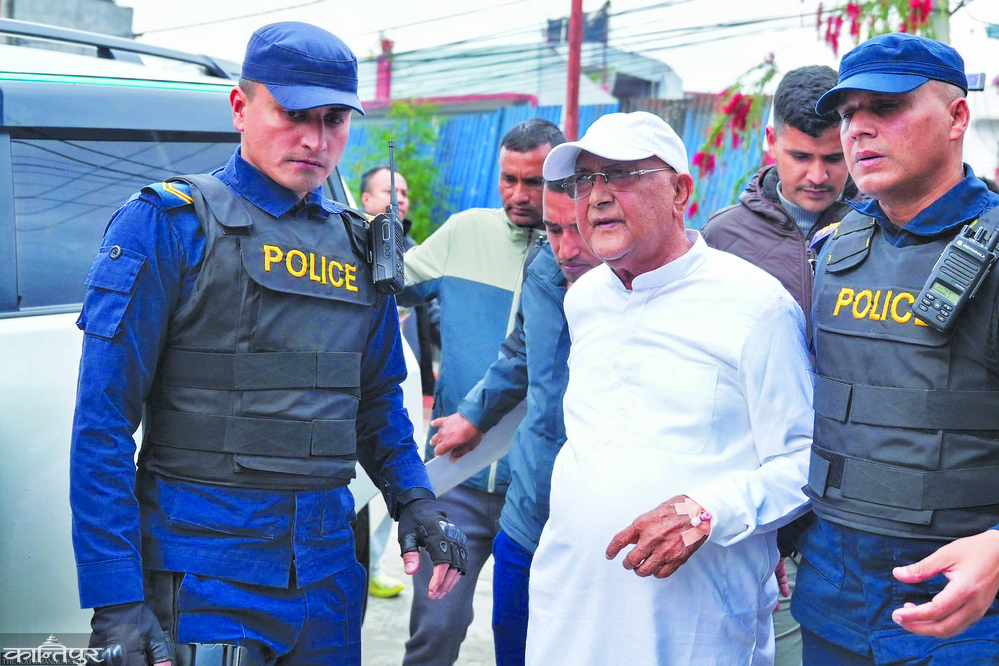 There were many rumors about Oli’s condition. Some said that the Nepal Army had taken him to the Shivpuri barracks. Others speculated that he had been taken to a military base. Later, it was confirmed that a Nepali Army helicopter had taken him and his wife Radhika Shakya to a barracks in Makawanpur.
Oli was not seen in public for 10 days. He did not give any statement, did not appear in newspapers and did not appear in the media even once. Such a long silence in his recent political life was not seen before. On 2 Asoj, Oli went public in Gundu, Bhaktapur. His house in Balakot was burnt to ashes during the 24 Bhadau protests. His loyal and sometimes aggressive UML leader (currently central secretary) Mahesh Basnet had arranged a residence for him in Gundu.
In the program that was made public after the Gen-G movement, he spoke little about his absence during this time, but did not seem to realize his weakness at all. He was stuck in the situation just before leaving Baluwatar. He said, ‘The Gen-G movement of 23 Bhadau was a conspiracy, the arson and vandalism on 24 Bhadau were a well-planned plan.’ Oli's statement shows that he has no remorse, no humility, and no admission of the mistakes he made during his tenure.
Oli did not accept that the lack of readiness to lift the ban on social media platforms was the cause of the Gen-G movement.
The seeds of the Gen-G movement were sown after the government banned 26 social media platforms, including Facebook, X and WhatsApp. The Gen-G people took to the streets demanding accountability, generational change and good governance. After the state suppressed the movement on the first day, incidents of vandalism, arson and looting took place the next day. 76 people lost their lives in two days. Material properties worth billions were damaged.
The political impact of the Gen-G movement was soon visible. After Oli’s resignation, a new government was formed under the leadership of former Chief Justice Sushila Karki. On the same day of his appointment, the House of Representatives was dissolved on Karki's recommendation, and elections were announced for February 21. Oli's party, UML, suffered a historic defeat in the elections. He himself lost to Balendra Shah of the Rashtriya Swayamsevak Sangh (RSS) from his home constituency, Jhapa-5, by nearly 50,000 votes.
In an interview with Kantipur shortly after the election, he directly blamed the defeat on the voters. 'The people have made a big mistake by not voting for UML,' he said.
Political analyst Jhalak Subedi says that Oli's statement reflects his growing nature while in power. 'Oli developed a kind of superiority complex (a tendency to consider himself superior) in both government and party matters. Whether he is a party leader or a government leader, he has become increasingly arrogant,' he said.
Oli's statement shows that he has neither remorse nor humility, nor does he admit the mistakes he made during his tenure. For anyone who has closely followed his political career, this was not surprising at all.
How did Oli develop such a stubborn and harsh style of thinking that he is right? To understand this, we need to understand the background in which Oli's political journey began.
Born on 11 Falgun 2008 in Eva (Athrai) of Tehrathum, Oli lost his mother at the age of four. He was raised under the care of his grandmother.
In an interview with Nepal Television, he recalled those early years as follows, 'There were no daughters in our family. When my grandmother used to sweep the floor, I also wanted to do the same. I learned that. Whatever my grandmother used to do, I did the same.'
He has been repeating this story over and over again for years. A person who grew up struggling himself, who learned discipline from his grandmother, not from the classroom. The image of this background has always been at the center of his political persona.
KP Oli: An alliance of unimaginable realities
In Naxalbari, a rural area of West Bengal, India, the peasant movement turned into an armed conflict around 2024. Eight women, two children and a youth were killed when the police opened fire on a crowd of mostly female protesters. The repercussions of this soon reached Jhapa across the border.
In Jhapa, Nepali communists were closely monitoring the Naxalbari movement. Historian Surendra KC writes, ‘At that time, a slogan was very popular in eastern Nepal – socialism cannot be brought through speeches alone unless the army is fought and the feudal lords are killed.’
A group including Oli, Mohan Chandra Adhikari and CP Mainali were deeply influenced by the Naxalbari movement. They resolved to start an uprising with the aim of eliminating the ‘class enemy’. After the ‘coup’ of 2017, the independent Panchayat era established by King Mahendra was at its peak.
In 2028 BS, the ‘Jhapa Rebellion’ took place, in which Oli also participated. The Panchayat government strongly opposed those involved in the Jhapa Rebellion. Oli was underground. On 23 Asoj 2030, he was arrested from Rautahat. He then spent 14 years in prison.
According to the memoir ‘Unwritten History’ by former UML leader Radhakrishna Mainali, Oli developed ulcers and tuberculosis in the central prison’s roundhouse. Mainali wrote, ‘His physical condition had become extremely weak. Due to ulcers, he would vomit blood. For such a patient, we had nothing but boiled rice and grated radish juice in the name of nutritious food. On top of that, Oli was a very picky person, he would not eat anything that was cooked. The illness brought him to a state where he could not get up. Only bones and ribs began to be visible in his body.’
Those harsh days left a permanent mark on his body. Over time, his kidneys failed. In August 2064, he underwent a kidney transplant in New Delhi. In Falgun 2076, when he was the Prime Minister, he underwent a second kidney transplant at the Tribhuvan University Teaching Hospital.
Many believe that 14 years in prison increased Oli’s self-confidence. That self-confidence has proven to be more durable than any political alliance he has formed. Former ambassador Nilambar Acharya describes Oli as a ‘person with willpower’. He has written in ‘KP Oli- Dreams, Struggles and Determination’, ‘The Panchayat system robbed him of 14 years of his youth by sending him to prison. But he never let his energy die. He never let his dreams die.’
In an article published in Kantipur in Falgun 079, Oli himself wrote, ‘I have lived through death many times. In fact, death always walks alongside life... I don’t think much about death. There is no need to make any plans for death.’
This self-confidence of Oli, who presented himself as an ‘invincible’ person who never considered himself weak, sustained him in every subsequent crisis. That self-confidence turned into stubbornness and he reached such a point that he could not even recognize that every ‘front’ had been defeated.
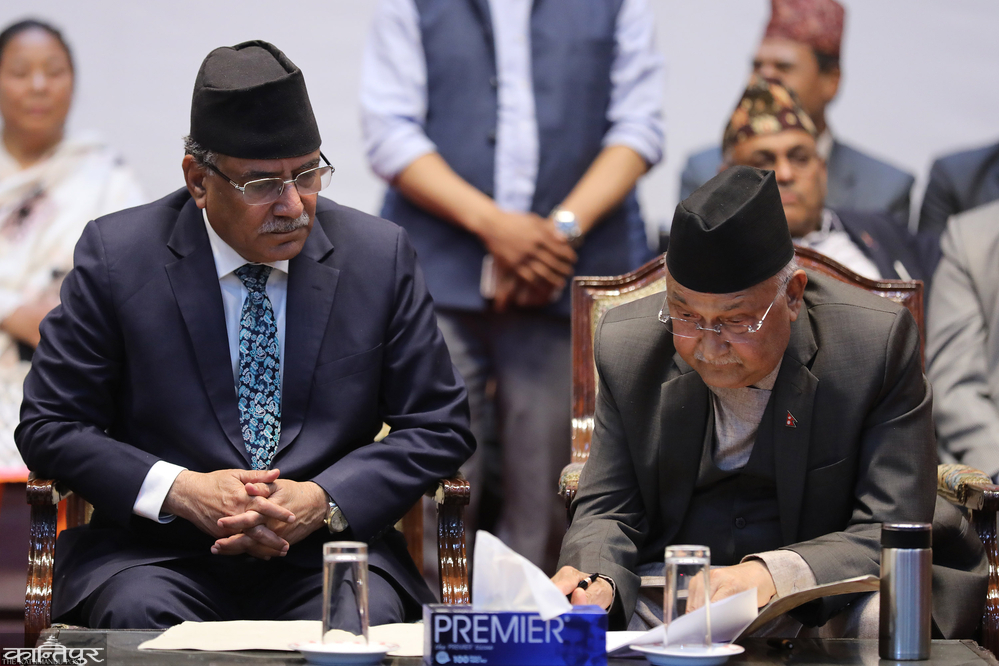 After the restoration of democracy in 2046, Oli’s rise accelerated. In 2051, he became the Home Minister. He is also remembered for his support and defense of the Mahakali Treaty with India in 2053 - for better or worse - which earned him the nickname 'Man of India'.
The main leadership of the UML was still beyond his reach. He developed the image of an opposition leader with different views within the party. He had to struggle a long time to reach the party leadership. He finally became the party president after defeating Madhav Kumar Nepal at the ninth general convention held in Shrawan 071.
This was a time when Nepal was going through one of the most important periods in its modern history. The first Constituent Assembly had failed. There was great pressure to promulgate a constitution from the second Constituent Assembly. At that time, the earthquake of Baisakh 072 claimed the lives of nearly 9,000 people. This put intense pressure on political parties to demonstrate unity.
Oli played a role in building maximum consensus to conclude the writing of the new constitution. His aspiration was to lead the country after the constitution was promulgated. Three weeks after the constitution was proclaimed, he took the oath of office as Prime Minister. That is, Oli, who had been on the sidelines for decades, reached the executive leadership of the state.
Oli was very lenient towards the demands of the Madhesi and Tharu during the constitution-making process. He did not play a significant role in making the constitution inclusive. He was accused of showing little interest in the marginalized communities and trying to preserve the dominance of the traditional power structure. Oli himself was responsible for implementing the constitution.
New Delhi was dissatisfied with some of the contents of the new constitution. Its dissatisfaction turned into a blockade, which caused extreme suffering to the common Nepali.
For Oli, the blockade turned out to be an unexpected political boon. Once known as the 'Man of India', he suddenly emerged as the country's most vocal nationalist leader.
Oli, who had been strongly opposed to the Maoists for years, joined hands with the same Maoists to contest the 2074 elections. He won the elections with a landslide victory. उनी र पुष्पकमल दाहालले एमाले र माओवादीलाई मिलाएर ३ जेठ २०७५ मा नेपाल कम्युनिस्ट पार्टी (नेकपा) बनाए, जुन मुलुककै शक्तिशाली राजनीतिक दल बन्न पुग्यो ।
त्यसबेला प्रश्न थियो, ‘ओलीले त्यो राजनीतिक शक्तिलाई कसरी प्रयोग गर्लान् ?’
राजनीतिशास्त्रका प्राध्यापक कृष्ण पोखरेलले स्पष्ट शब्दमा टिप्पणी गरेका छन् । ‘जब माधव नेपाल महासचिव थिए, ओलीले आन्तरिक लोकतन्त्रको वकालत गरे । तर जब ओली पार्टी नेतृत्वमा आए, एउटा सर्वसत्तावादी चरित्र उदायो,’ पोखरेलले कान्तिपुरसँग भने, ‘संसद्मा पार्टीको करिब दुईतिहाइ बहुमतको सदुपयोग गर्न ओली चुके ।’
तत्कालीन माओवादीसँग पार्टी एकता गर्दा ओली र दाहाललाई सहअध्यक्षको परिकल्पना गरिएको थियो । तर ओलीको अहंकारले त्यसलाई चाँडै खिया लगाइदियो ।
जेठ ०७७ मा कोभिड महामारीकै बेला ओली सरकारले कालापानी–लिपुलेक–लिम्पियाधुरा क्षेत्र समेटिएको मुलुकको नयाँ राजनीतिक तथा प्रशासनिक नक्सा जारी गर्यो । जसअनुसार संसद्ले संविधान (निसाना छाप) संशोधन गर्यो । ओलीले संसद्मा उभिएर भारतको राष्ट्रिय प्रतीकमाथि ‘खिल्ली’ उडाए । यी घटनाक्रमले भारतसँग नयाँ तनाव सिर्जना गर्यो ।
तत्कालीन नेकपामा अन्तरसंघर्ष चुलिएका बेला ओलीले ५ पुस ०७७ मा प्रतिनिधिसभा विघटन गरे । सर्वोच्च अदालतले ११ फागुनमा त्यसलाई पुनःस्थापना गरिदियो । यसैबीच पार्टी नामसम्बन्धी विवादमा निर्णय सुनाउँदै सर्वोच्चले नेकपालाई एकतापूर्वको अवस्थामा पुर्याइदियो । एमाले र माओवादी ब्युँतिए ।
ओलीले फेरि जेठ ०७८ मा प्रतिनिधिसभा विघटन गरे । सर्वोच्च अदालतले दोस्रो पटक पनि पुनःस्थापना गरिदियो र कांग्रेसका तत्कालीन सभापति शेरबहादुर देउवालाई प्रधानमन्त्री नियुक्ति गर्न परमादेश दियो । एमालेमा पनि विभाजन आयो । माधव नेपाल नेतृत्वको समूहले एमाले छाडेर एकीकृत समाजवादी पार्टी स्थापना गर्यो ।
०७४ को निर्वाचनमा एमाले र तत्कालीन माओवादीको गठबन्धनले पाएको शक्तिशाली संसदीय बहुमत छोटो समयमै छिन्नभिन्न बन्यो । तैपनि ओली शक्तिमै देखिए ।
०७९ को आमनिर्वाचनमा कांग्रेस–माओवादी गठबन्धन थियो । निर्वाचन परिणामलगत्तै प्रधानमन्त्री को बन्ने विषयमा देउवा र दाहालबीच विवाद भयो । त्यही मौका छोपेर ओली दाहाललाई प्रधानमन्त्री बनाउन अघि सरे । दाहाल सहजै राजी भए । दाहाल ‘जसरी पनि प्रधानमन्त्री बन्ने’ दाउमा थिए ।
त्यो गठबन्धन लामो समय टिकेन । दुई महिनामै एमाले–माओवादी गठबन्धन भत्कियो । तर २०८१ मा ओलीले देउवासँग हात मिलाएर दाहाललाई सत्ताबाट खसाले ।
ओलीको हरेक राजनीतिक चाल रणनीतिक रूपमा चतुर देखिन्थ्यो तर त्यसभित्रको उद्देश्य थियो- समय लम्ब्याउने, विश्वास भत्काउने र अन्ततः जनताको धीरताको बाँध तोड्ने वातावरण बनाउने । ओली आफूले पाएका अवसर गुमाउनै चाहँदैनथे ।
२०२८ र २०८२ को ओली–संयोग
ओली सरकारले सामाजिक सञ्जालमा प्रतिबन्ध लगाएपछि युवा सडकमा ओर्लिए । आन्दोलनले उग्ररूप लियो, जसको परिणामस्वरूप प्रहरीको गोली लागेर १९ जनाको मृत्यु भयो । भोलिपल्ट प्रदर्शनकारी नियन्त्रणबाहिर गए– सर्वोच्च अदालत, संसद्, राष्ट्रपति भवन, व्यापारिक प्रतिष्ठानहरू र राजनीतिज्ञहरूका घरहरूमा तोडफोड गरियो, आगो लगाइयो ।
तत्कालीन स्वास्थ्यमन्त्री तथा कांग्रेस नेता प्रदीप पौडेलले जेन–जी आन्दोलनको एक सातापछि कान्तिपुरसँग कुरा गर्दै २३ भदौको घटनापछि बसेको मन्त्रिपरिषद् बैठकमा ओलीले निकै कम संवेदनशीलता देखाएको बताएका थिए । ‘बरु, प्रधानमन्त्रीले झन् बढी अहंकार र दम्भ प्रदर्शन गर्नुभयो,’ उनले भनेका थिए । ओलीले त्यस घटनालाई आँखा अगाडि घटिरहेको त्रासदीका रूपमा नभई आफ्नाविरुद्ध रचिएको षड्यन्त्रका रूपमा हेरेका थिए ।
राष्ट्रिय सुरक्षा परिषद्को आपत्कालीन बैठक कहिल्यै बोलाइएन । सुरक्षा निकायहरूले आन्दोलनको रूपलाई कम आँकेका थिए । सरकारको शीर्षस्थानमा रहेका व्यक्तिले पनि त्यही गल्ती गरे ।
२१ फागुनको चुनावको पूर्वसन्ध्यामा ओलीले सार्वजनिक रूपमा अति आत्मविश्वास प्रदर्शन गरे । तर उनले आफ्नो चुनावी अभियान झापा–५ मै केन्द्रित गरे । तैपनि काठमाडौंबाट गएर उम्मेदवारी दिएका रास्वपाका वालेन्द्र शाहसँग पराजित भए । यसले ओलीको आत्मविश्वासमा धक्का दियो ।
२०४८ यता यो उनको दोस्रो ठूलो चुनावी हार थियो, यसअघि ०६४ मा उनले हार भोगेका थिए । तर यस पटकको हारको प्रकृति नयाँ थियो दलीय राजनीतिमा भर्खर प्रवेश गरेका व्यक्तिले उनलाई उनकै गढ मानिएको क्षेत्रमा करिब ५० हजार मतले हराएका थिए । राजनीतिक विश्लेषकहरूले यो मतान्तरलाई एउटा सामान्य संख्या मात्र नभई जनताको फैसलाका रूपमा हेरेका छन् ।
झन्डै दुईतिहाइ बहुमत सिट जितेर रास्वपाले १३ चैतमा सरकार गठन गर्यो, सरकारको नेतृत्वमा ओलीलाई चुनावमा हराएका वालेन्द्र शाह आए । भोलिपल्ट बिहानै ओली पक्राउ परे । २३ भदौको जेन–जी आन्दोलनमा भएको मानवीय क्षतिमा जिम्मेवार ठहर गर्दै अनुसन्धान र कारबाहीका लागि जाँचबुझ आयोगले गरेको सिफारिसका आधारमा उनी समातिएका थिए ।
स्वास्थ्य अवस्थाका कारण प्रहरी हिरासतका रूपमा त्रिवि शिक्षण अस्पतालमा बिताए । २६ चैतमा सर्वोच्च अदालतको आदेशबाट ओली रिहा भए । त्यसपछि उनको पत्थरीको शल्यक्रिया भयो । उनले स्वास्थ्य लाभ गरिरहेका बेला पार्टीभित्र नेतृत्व पुनर्गठनको माग उठ्न थाल्यो । जेठ पहिलो साता बसेको केन्द्रीय सचिवालयमा बहुमत पदाधिकारीले पार्टी नीति र नेतृत्व पुनर्गठन हुनुपर्ने धारणा राखे । त्यसबेला ओलीले अस्वीकार त गरेनन्, उपाध्यक्ष रामबहादुर थापाको संयोजकत्वमा निर्वाचनमा हार हुनुको कारण पहिल्याउन समिति बनाए ।
तर जेठ २० मा काठमाडौंमा भएको एक कार्यक्रममा ओलीले ‘बीचमै झोला फालेर नहिँड्ने’ भन्दै नेतृत्व नछाड्ने बताए । उनले पार्टी विधान नमान्नेलाई कारबाहीको चेतावनी दिए । यसको अर्थ हो, ओली स्वैच्छिक हिसाबले पार्टी नेतृत्व छाड्न पनि तयार छैनन् ।
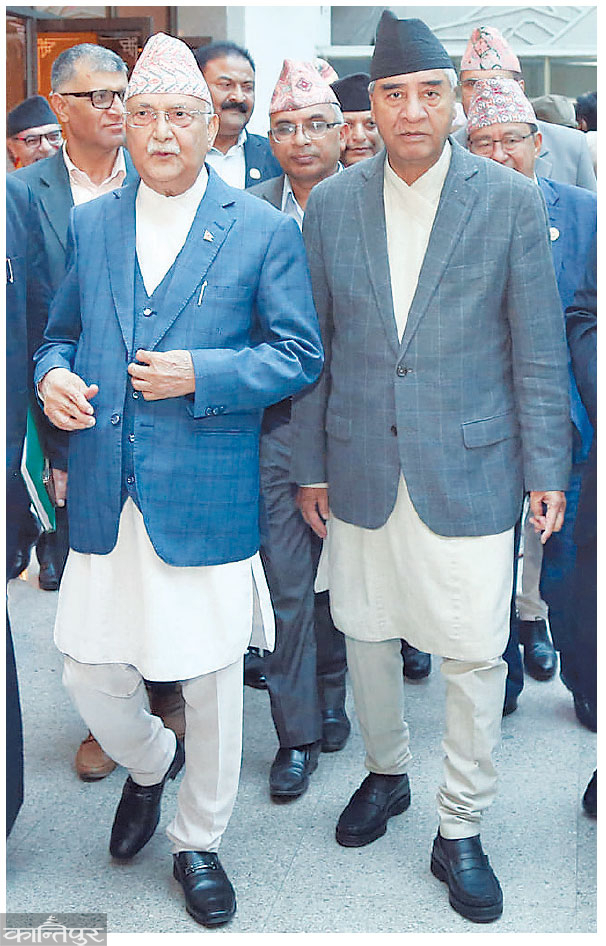
गत भदौको संकटका बेला पनि प्रधानमन्त्रीबाट राजीनामा दिन सुझाव दिइरहेका व्यक्तिसँग सुरुमा ओली भन्दै थिए, ‘म राजीनामा दिनेवाला छैन ।’ पछि सेनाको हेलिकोप्टर चढेर बालुवाटार छाड्नुपरेको थियो ।
पूर्वप्रधानमन्त्री तथा एमालेका पूर्वअध्यक्ष झलनाथ खनाल ओलीलाई राजनीतिक धैर्य बलियो भएको नेता भन्छन् । तर उनी ओलीबारे टिप्पणी गर्न कुनै कसर बाँकी राख्दैनन् । ‘०७४ को चुनावपछि दुईतिहाइ बहुमतको नेतृत्व गरेका बेला इतिहासले उनलाई अवसर दिएको थियो, तर उनले त्यो मौका गुमाए,’ खनालले कान्तिपुरसँग भने, ‘ओली अब असफल भइसके । उनी केवल तर्क र वितर्क गर्छन् । कुरा त्यत्ति हो ।’
ओलीका एक समयका निकै निकट सहयोगी एमाले नेता गोकुल बाँस्कोटा अहिले उनका सबैभन्दा प्रखर आलोचक बनेर उदाएका छन् । ‘ओलीको नेतृत्वमा एमाले अब अगाडि बढ्न सक्दैन,’ हिमालयन टेलिभिजनमा निभेष बञ्जाडेले लिएको अन्तर्वार्तामा केही दिनअघि उनले भनेका थिए, ‘उहाँले सामूहिक निर्णय प्रक्रियालाई लत्याउनुभयो । पार्टीमा कुनै अर्थपूर्ण छलफल नै हुँदैन ।’
ओलीका समर्थकका लागि उनी अझै त्यही राष्ट्रवादी नेता हुन्, अरूले घुँडा टेक्दा उनले भारतसामु डटेर उभिने साहस देखाए । आलोचकहरूका लागि उनी त्यो व्यक्ति हुन्, जसले मुलुकको समृद्धिका लागि प्राप्त सर्वोत्कृष्ट अवसरलाई खेर फाले । उनले आफूबाहेक अरू कसैले सत्ता सम्हाल्न सक्छ भन्ने कल्पनासमेत गर्न सकेनन् ।
इतिहासले उनको मूल्यांकन कसरी गर्छ भन्ने प्रश्न अझै अनुत्तरित छ । तर एउटा कुरा पक्का छ, ओलीका लागि समय र परिस्थिति फेरिएको छ ।