Similarly, reacting to the report of the Nepal-India Eminent Persons Group (EPG), he said that he did not have the authority to make it public.
We use Google Cloud Translation Services. Google requires we provide the following disclaimer relating to use of this service:
This service may contain translations powered by Google. Google disclaims all warranties related to the translations, expressed or implied, including any warranties of accuracy, reliability, and any implied warranties of merchantability, fitness for a particular purpose, and noninfringement.
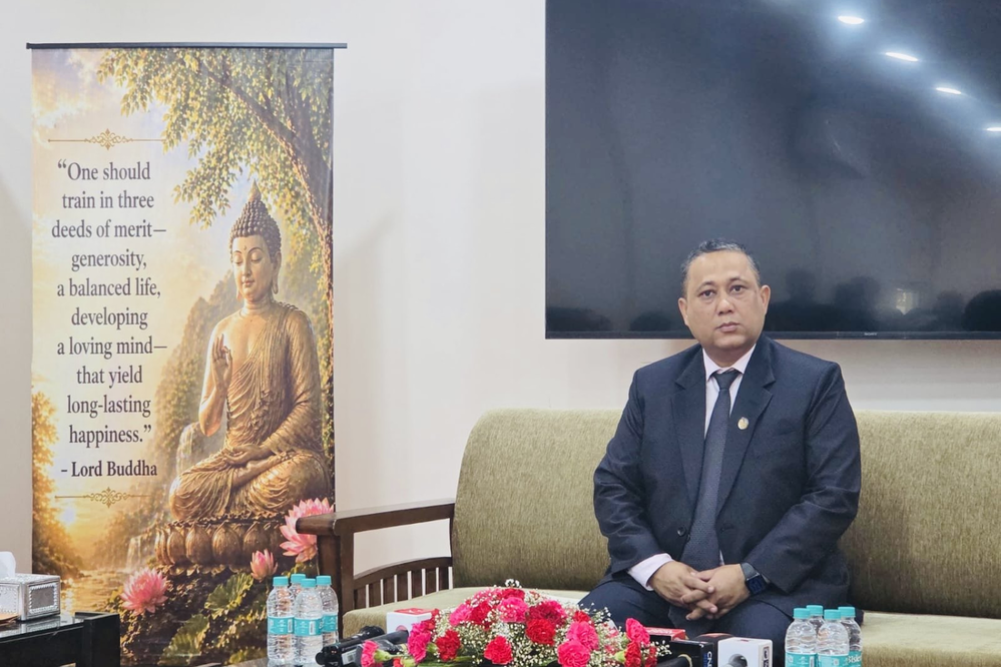
Foreign Minister Shishir Khanal has said that Nepal does not want a third country to mediate in the Nepal-India border dispute. Speaking at a press conference organized at the Nepali Embassy in New Delhi on Sunday, he, who is on a visit to India, clarified that he only wants documents related to the dispute from the United Kingdom (UK).
‘Many of these border disputes are part of a long historical legacy, especially those related to the Nepal-India border,’ Khanal said, ‘We want to resolve these disputes through diplomatic processes. We only want to see if we can get access to some documents that may be in the UK libraries or museums. Our position is not to seek mediation.’
Prime Minister Balendra Shah, while replying to the House of Representatives on Jestha 17, had revealed that he had also spoken to the UK government about Lipulekh and Limpiyadhura. However, India had said that it would reject the role of a third country in the Nepal-India border dispute.
Similarly, Khanal said that Limpiyadhura and Lipulekh are Nepal's territory and that he has made it clear to India and China through diplomatic notes. 'We have clearly expressed our views to both India and China through formal diplomatic notes,' he said, 'We have clearly told both countries that this land is ours. This is our historical claim.' Similarly, reacting to the report of the Nepal-India Eminent Persons Group (EPG), he said that he did not have the authority to make it public. 'The EPG was formed with the consent of the two prime ministers, and its report can only be submitted to the two prime ministers,' Khanal said, 'Therefore, I do not have the authority to make it public, accept it or take any decision.' Describing Nepal-India relations as a relationship that goes beyond geographical boundaries, he said, 'We are not just neighbors separated by political lines drawn on a map. We are the children of the same river, the same mountain and the same ancient knowledge.’ Expressing gratitude for the hospitality received during his visit to India, he said, ‘I would like to express my deep gratitude for the immense goodwill, warm hospitality and spirit of cooperation shown to me and my delegation.’ Foreign Minister Khanal described the political reality he represents as a ‘good governance-oriented system based on a new mandate’, saying, ‘Our rise has come from the historic mandate of the citizens, at the core of which are good governance, meritocracy and direct accountability.’
He expressed hope that the Janakpur-Ayodhya rail project under Nepal-India connectivity will be taken forward soon. He said, ‘We want to see the Janakpur-Ayodhya rail link operational soon.’
Regarding his visit to India, he expressed hope that the discussions have gone in a positive direction and that results will be seen in the coming months. He said, ‘I am returning with great optimism, I have great hope that these discussions will reach results within the next few months.’
He declined to comment on the Gen-G movement taking place in India. When asked about it, he said, 'I do not want to comment on what is happening in India. I only want to talk about Nepal and Nepal-India relations.'
Referring to the border dispute resolution process, he said that there was an agreement to activate the diplomatic mechanism, 'We have suggested reactivating other mechanisms, and both sides agree that there is no harm in sitting at the table and discussing.'
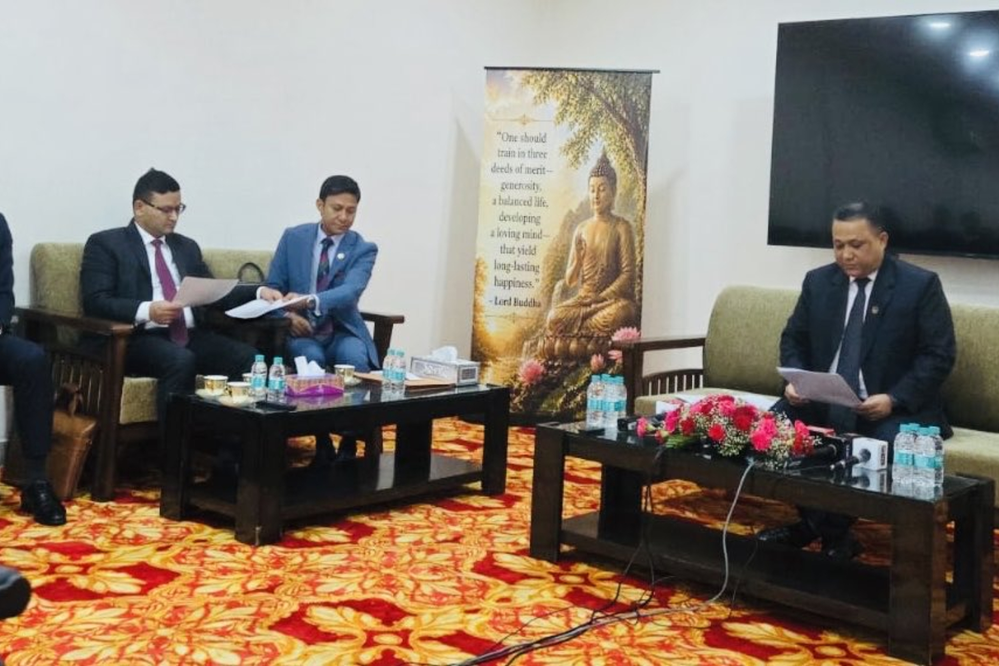 Similarly, citing the perspective of the Rashtriya Swayamsevak Sangh (RSS), he opined that Nepal-India relations should be transformed from geopolitical competition to development-focused cooperation. He said, 'We want to stay away from geopolitical confrontation and focus on development diplomacy.'
#WATCH
| Delhi: On US tariffs, Nepal's Foreign Minister Shisir Khanal says, "We are in constant dialogue with the Americans. They have expressed some concerns. However, you would have noticed that there have been three or four high-level visits since our government came to power.…
pic.twitter.com/1xcozuVmw8
— ANI (@ANI)
June 7, 2026