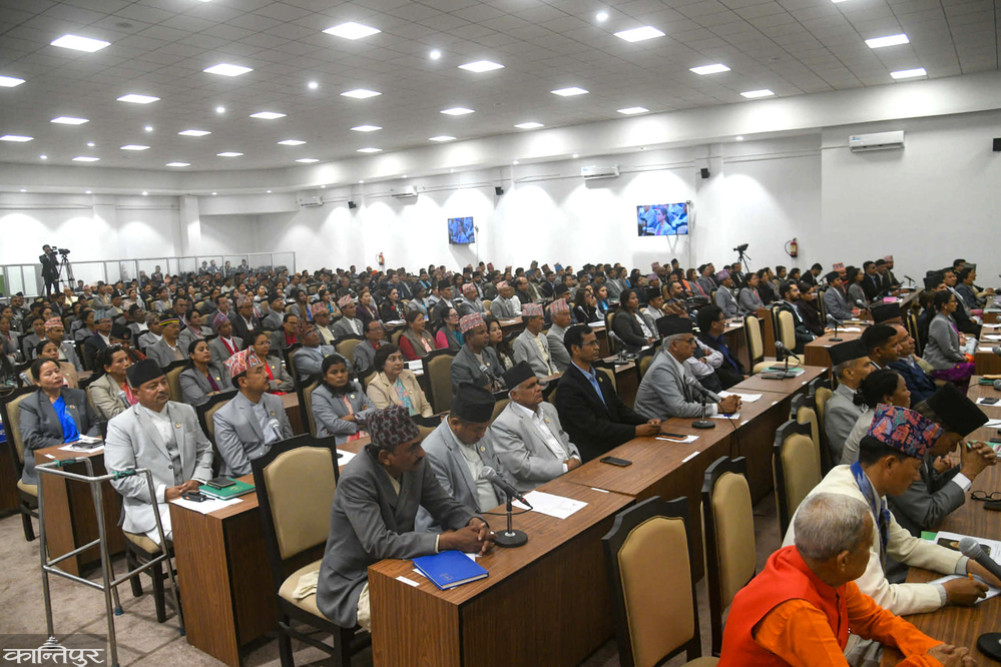
Rashtriya Swayamsevak Sangh (RSS) Joint General Secretary Bipin Acharya says: We should take the help of technology. But if MPs and ministers start formulating/getting the policies of this country based on ChatGPT, then it will be sad for the country.
We use Google Cloud Translation Services. Google requires we provide the following disclaimer relating to use of this service:
This service may contain translations powered by Google. Google disclaims all warranties related to the translations, expressed or implied, including any warranties of accuracy, reliability, and any implied warranties of merchantability, fitness for a particular purpose, and noninfringement.
The use of various AI chatbots, including ChatGPT, in the federal parliament and parliamentary committees is currently in the spotlight. The discussion has intensified after lawmakers started using AI to draft speeches, search for data, and strengthen their arguments during public interest and policy debates. Although AI chatbots have assisted in parliamentary activities, questions have been raised about the reliability of the information they provide and the originality of the lawmakers.
Last week, during a meeting of the Agriculture, Cooperatives, and Natural Resources Committee of the House of Representatives, MP KP Khanal's idea about 'green hydrogen' technology to overcome the shortage of chemical fertilizers in Nepal was discussed and criticized on social media, saying that it was borrowed from ChatGPT. In the meeting, he presented point-by-point arguments in the style of ChatGPT about the 'game changer model' that can extract hydrogen from water and electricity and make urea fertilizer.
‘How much easier it would be if we could make fertilizer domestically through green hydrogen instead of chemical fertilizers,’ he had said, ‘It could be a common process. This technology could become a game-changing model for Nepal. Now, in this process, natural gas is usually required to make chemical fertilizer urea, which is not available in Nepal. However, in green hydrogen technology, we use electricity extracted from water to split water and extract hydrogen, then the hydrogen is combined with nitrogen in the air and the hydrogen extracted from water is mixed to make ammonia. What happens to that ammonia is urea production.’
Another MP and founder of the National Innovation Center, Mahavir Pun, also mentioned in the House of Representatives meeting on 4th Jestha that he had asked ChatGPT on his mobile phone whether developed countries impose taxes on raw material imports or not and the answer was ‘no’. ‘I had recently asked ChatGPT while sitting here whether any developed country imposes taxes on the import of raw materials needed by its industries,’ he said, ‘They do, they don’t. In Nepal, there is a huge tax on the import of raw materials.’
The most controversial case of AI use is related to Deputy Speaker of the House of Representatives, Rubi Kumari Thakur. She had resorted to ChatGPT to defend herself from criticism after the Constitutional Council recommended Manoj Kumar Sharma as the Chief Justice.
She had posted content in Nepali and Maithili prepared by ChatGPT and posted a screenshot of the text ‘Judge Sapna Pradhan Malla is considered close to UML’. After receiving heavy criticism, she deleted the post. When Prime Minister and Council Chairman Balendra Shah proposed that Sharma be made the Chief Justice, the Deputy Speaker elected from the Shram Sanskriti Party agreed with silence.
RSP Parliamentary Party Whip urges not to use AI tools too much
After ruling RSP MPs resorted to AI tools like ChatGPT to prepare topics for parliamentary meetings and parliamentary committees, RSP Parliamentary Party Whip Krantishikha Dhital warned them not to rely on ChatGPT. According to an MP, she had asked them not to rely on AI to prepare topics for presentation in Parliament because of public criticism of MPs. ‘We have used ChatGPT a lot while participating in discussions, let’s not do this, if we don’t have something to say, don’t say it,’ Dhital told the MPs.
RSP Joint General Secretary Bipin Acharya says that technology can be used but should not be relied on completely. In an interview with Tikaram Yatri, he said, 'It matters a lot whether we use ChatGPT or ChatGPT uses us. If MPs and ministers decide to use ChatGPT to formulate the country's policies, it will be a tragedy for the country.' As the use of AI increases in Parliament, the issue of its regulation and accountability has also become a major issue. Ekram Giri, Joint Secretary and Spokesperson of the Parliament Secretariat, told Kantipur that the use of AI is not addressed in any law of Parliament, but AI is being used. 'There is no guideline in Parliament yet on whether to use AI or not,' he said, 'We are in the process of formulating the House of Representatives regulations.' However, there is no provision in the regulations regarding the use of AI. Now that the law on AI is made, some things will come up regarding its use. Giri mentioned that there is talk in the Parliament Secretariat about working on some things through AI.
The ‘National Artificial Intelligence (AI) Policy’ made public by the government last year has presented a roadmap for the development, use and regulation of AI in Nepal. The long-term vision of this policy is to ‘build a human-centered, ethical and prosperous Nepal through AI’. The policy has identified disinformation, deepfakes and personal bias that can occur through the use of AI as the main challenges. The policy includes the establishment of a National AI Center under the Ministry of Communications to manage and facilitate AI and the establishment of ‘AI Excellence Centers’ in federal and provincial level universities and AI-related research institutions for the study, research and development of AI.
At the international level, various exercises are being conducted on the use of AI in parliamentary processes. The UK appears to be the most organized in this regard. There, formal guidelines have been issued for members of parliament and staff on the use of AI. The guidelines state that confidential parliamentary information should not be entered into AI and that information provided by AI should not be made public without first verifying it. The guidelines suggest that information provided by AI should only be taken as a draft.
Last September, British media The Telegraph published news that ChatGPT has been used extensively in speeches in parliament since 2022. James Ticcombe of the Telegraph claims that words and phrases frequently used by ChatGPT can be heard in the expressions of MPs and that some speeches appear to have been written by AI. House of Commons MPs Wendy Morton, Shawkat Adam, and Mohammed Yassin, among others, spoke entirely about Ukrainian children, chronic diseases, and universities, according to an analysis published by the Pimlico Journal.
While there is no federal policy on how AI can be used in the US parliament, both houses of parliament have clarified internal procedures for using AI. Employees have been told not to upload sensitive government documents to chatbots and to use secure ‘enterprise’ services where possible.
Last year, the Verge reported that US President Donald Trump’s proposed tariffs to reduce the trade deficit were based on a list of chatbots like ChatGPT.
A report published by Florida State University recently found that words regularly used by platforms like ChatGPT are being used in conversations ranging from parliament to podcasts.
Frank Pangalo, a former member of the Legislative Council of South Australia, had to apologize after it was discovered that various points and claims he presented during a parliamentary committee discussion on marine litter management were false and were sourced from ChatGPT.
Neighboring India's use of AI is unique. The Lok Sabha Secretariat there had signed an agreement with the government's Ministry of Information Technology in 2025 to build an AI-based parliamentary platform called 'Parliamentary Bhashini'. The platform is said to have AI-based chatbots for members of parliament, instant language translation, transcription, automated summaries, easy search of parliamentary documents, and technical support. Through this, India has claimed to have set a goal to make its parliamentary process completely digital. The Indian state of Delhi has already launched an AI chatbot called 'Bidhan Saathi' for its MPs.
China's policy on the use of AI and chatbots in parliamentary and other government work is different. China has adopted a policy of not allowing Western AI chatbots and infrastructure to operate in its country. It is emphasizing the use of local platforms for government and public use. Local media have pointed out that the regulation of Chinese chatbots and large language models, which have been made public in more than 220 numbers, is being openly discussed during the annual Chinese parliamentary session titled ‘Two Sessions’.
The ‘EU Parliament’ seems to be the most active parliament in AI regulation. It has sought to regulate the use of AI chatbots and platforms in its activities by keeping ethics, transparency, and government standards in mind. The EU has linked the use of AI in parliamentary activities to its AI law and has placed accountability at the center.
Another European country, Greece, has issued a ‘Guideline on the Use of AI in Parliamentary Processes’, emphasizing the prudent use of such technologies and institutional training or preparation. Singapore is considered to have the clearest regulation on the use of AI in Asia. Singapore is developing its own AI tools for use in government work, including in its parliament, and has allowed AI to draft government work.