Even after a decade since the country adopted a federal structure, the provinces have not been able to exercise their constitutionally granted rights as the federal government has not enacted laws.
We use Google Cloud Translation Services. Google requires we provide the following disclaimer relating to use of this service:
This service may contain translations powered by Google. Google disclaims all warranties related to the translations, expressed or implied, including any warranties of accuracy, reliability, and any implied warranties of merchantability, fitness for a particular purpose, and noninfringement.
Even after a decade since the country entered the federal structure, the provincial governments have not been able to exercise the constitutionally granted powers. The federal government has not made laws to allow the provinces to exercise some of the important powers as per the constitution. The dependence of the provinces on the union (center) has not decreased even in terms of resources.
The police administration and peace and security of the province fall under the sole authority of the provincial government. The responsibility of police administration and peace and security is number one in the list of 21 sole authorities granted to the provinces by the constitution. Similarly, the national forest within the province also falls under the jurisdiction of the province. Forest is the main source of revenue for the provincial government.
Police administration and financial resources are indispensable tools for the operation of the government. On that basis, the constitution has placed police administration and peace and security and issues such as forests, water use, and mining exploration within the purview of the provinces. But the provincial government has not been able to exercise these powers. The provinces do not have both the police required for peace and security and legal order and the revenue required for the operation of the government.
The constitution promulgated on 3 Asoj 2072 has adopted a federal democratic republican system of governance with 7 provincial assemblies. Provincial governments were formed after the elections held in Mangsir 074. But the provinces have not yet been able to exercise their powers as envisaged by the constitution. That is why questions have been raised as the provinces have not been able to make public service delivery effective.
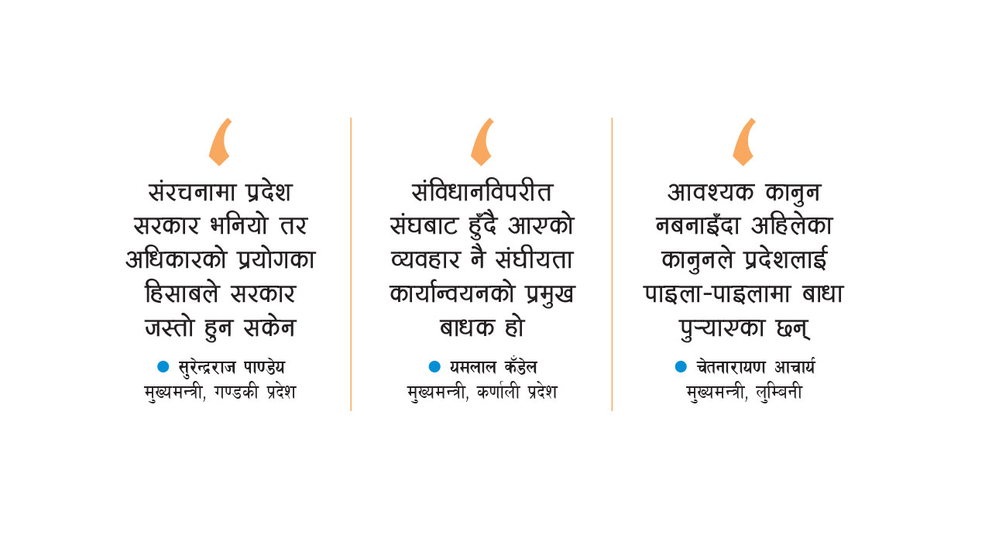
Gandaki Province Chief Minister Surendra Raj Pandey says that the provincial government has not been able to exercise its powers in the way of a government. ‘The structure calls it a provincial government, but it has not been able to exercise its powers accordingly,’ he said. ‘The local level has also been deploying police and mobilizing the city police to carry out the work according to the powers it has received in its area. But the province, which has constitutionally been given the right to maintain peace and security throughout the entire province, has not been able to break the bank in that matter.’
Chief Minister Pandey says that the union has refused to give the police to the province. ‘Why do you not want to adjust the police even after so many years?’ He said, ‘The issue of the police is just one example, the province has been made difficult to do its work according to its authority step by step.’
 The federal government has brought the Police Personnel Adjustment Act, 2076 BS. According to that act, the police officers with the federal government should be adjusted and handed over to the provincial government. But the federal government has not taken any steps towards that. Even though the Police Adjustment Act has been brought, the union has not brought a new police act.
The Chief District Officer and the Chief of Police residing in the district are employees under the federal government. Each province has an internal affairs minister to oversee home administration. But they are in a position of no role.
Karnali Province Chief Minister Yamlal Kandel says that the union has not made a law to transfer authority to the province based on the suspicion that ‘the province cannot do it’. ‘The provincial government has been in operation for 8 years. But since then, there has been only suspicion about the province,' he said, 'The country has gone federal. The constitution created provinces, but the mentality of any sector, whether political or administrative, has not changed. The centralized mentality that has been ingrained in everyone has hindered the effective operation of the province.'
Chief Minister Kandel says that the province has been limited to a request-making government. He says that the provincial government can only request the Chief District Officer and the District Police Chief in case of any problem. 'It is up to them to accept or reject our request,' he said, 'If the structure of the provincial police had been formed, the provincial government could have played a role in the rule of law and peace and security.'
Lumbini Province Chief Minister Chet Narayan Acharya said that the existing federal law is hindering the province step by step because new laws have not been made or amended. 'The main source of income of the province is the forest. But the province has a problem with allowing sand and gravel from rivers and felled trees from the forest,' he said, 'The union continues to interfere with the rights given to the province by the constitution. Reforms in the Forest Act are one of the main issues being raised by the provincial government.
Gandaki Province Chief Minister Pandey said that the province is losing billions of rupees in revenue due to the lack of a federal forest act in accordance with the province's rights. There is a dispute between the union and the province over the right to forests. The provincial governments have complained that the union has restricted the rights of the province through the Forest Act and regulations. The province currently does not have the right to acquire land required for any new plan and development or decide on the right to occupy land in forest areas. The provincial government is facing problems in some development projects due to problems arising in land acquisition.
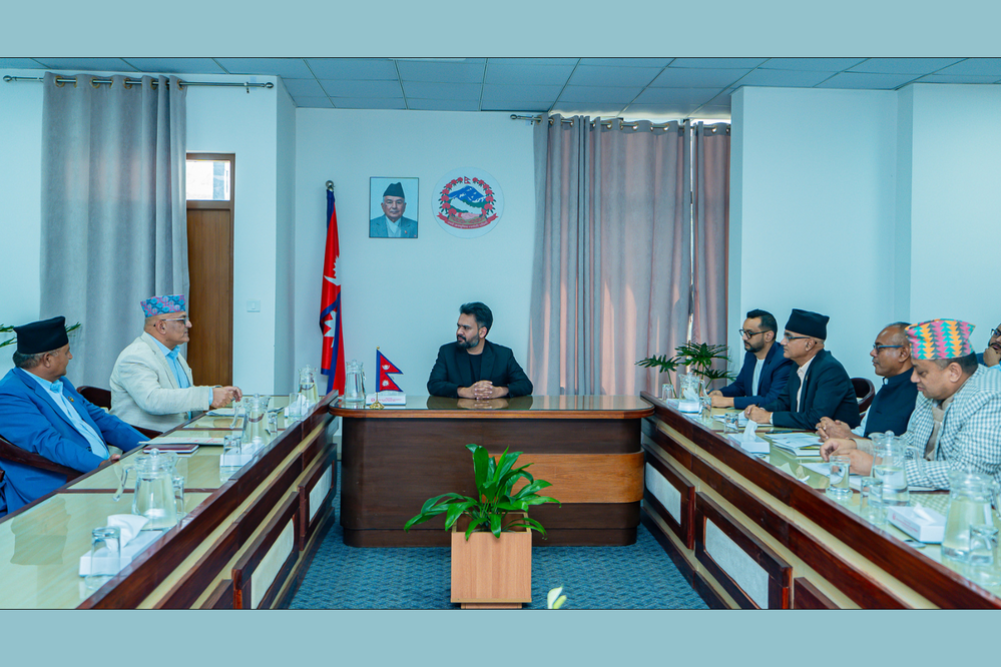
The chief ministers have already said that a federal law should be made that gives the province the right to acquire land. Lumbini Chief Minister Acharya informed that this was also raised with priority in a meeting with Prime Minister Balendra Shah a few days ago. "If you try to build a hospital or widen a road, there is difficulty in obtaining the land required for that," he said. "People blame the provincial government for not being able to do the work due to legal complications."
Article 56 of the Constitution states that the basic structure of the Federal Democratic Republic of Nepal will be three levels: the union, the provinces, and the local level. Article 57 has divided state power among all three levels. The Constitution has given 35 exclusive powers to the union, 21 to the provinces, and 22 to the local level. Similarly, there are 25 lists of common powers for the union and the provinces, and 15 lists of common powers for all three levels. It is believed that all three levels work according to that list of powers.
There is a constitutional provision that the provinces or local levels must make laws that do not conflict with federal laws. Therefore, making federal laws is the first necessity. But the federation has not made any laws that are considered essential, such as civil servants and education. As a result, the provinces have a problem with the recruitment of employees.
The constitution has given the right to basic and secondary education to the local level. The right to higher education belongs to the provinces. But in practice, both of these rights have so far been vested in the federal government. Similarly, transportation within the province falls within the jurisdiction of the province. The provincial government has been carrying out other tasks, from distributing driving licenses to opening transport offices. However, the responsibility of printing driving licenses lies with the federal government. The revenue collected by the traffic police for violating traffic rules goes directly to the federal government's account.
Gandaki Province Chief Minister Pandey says that the federation is collecting many types of revenue that the province should receive. He also says that the federation has not been treated fairly in the distribution of the revenue collected. "According to the constitution, 70 percent of the workload falls on the provincial and local levels, but the union has been keeping 70 percent of the revenue," he said, "15 percent each has been given to the provincial and local levels."
The Chief Ministers say that when the union also cuts the grants received, there is a problem in paying for projects that have already been contracted and the provinces are facing a financial crisis as a whole. The equalization grant allocated to the provinces has been cut by 28 percent this year.
The chief secretaries of the provinces and secretaries of the ministries (joint secretary level employees) are sent by the union. The post of secretary has been vacant in five of the 10 ministries in Lumbini since last Bhadra. According to Chief Minister Acharya, the union government has not sent a secretary despite repeated requests to the union government.
The Chief Ministers say that since the provinces do not participate in the performance evaluation, transfer and promotion of the secretaries sent by the union, they are not responsible to the provinces. Prime Minister
In the discussion with Shah, the Chief Ministers also drew attention to this. ‘It is not known how long the secretaries who come to the ministry will stay. The practice of transferring and leaving within 2/4 months has also caused problems for the province,’ said Chief Minister Acharya, ‘Sometimes the ministries become neglected. It would have been better if the secretary had not been in charge for at least one financial year. The secretary should be in charge from the budget implementation to its finalization stage.’
Acharya shared his experience that when the secretaries assigned by the union gave more importance to the circulars or verbal instructions from the union government than to the laws made by the legislature of the province, the legislative powers of the province have sometimes been reduced.
The provincial governments, which are facing problems in exercising the sole powers granted by the constitution, are far from exercising the common powers of the union and the province. Clear laws have not been made on the issues mentioned in the common powers. Laws have not been formulated to remove the ambiguity in the collection and distribution of local natural resources and resources, including mining and riverine resources, stones, and sand, which are in the list of common rights of the province and local levels. Since it is not clear which level will do what in the list of common rights of the federal, provincial, and local levels, there is a situation of duplication in operations, offices of the same nature are opened by all levels, or there is a conflict of rights in some areas.
Karnali Chief Minister Kandel says that due to the ambiguity of who will do what, duplication occurs in some areas and work is obstructed in some areas. He mentioned that the province has not been able to operate fully effectively as envisioned by the constitution due to the lack of laws to implement single or common rights and clearly direct them. ‘The provincial structure itself is autonomous. It is not a unit subordinate to the center. It is an institution that should operate according to the distribution of rights made by the constitution,’ he said. ‘The constitution itself states that the relationship between the three levels will be based on the principles of cooperation, coexistence, and coordination. But the behavior of the federation on the contrary is the main obstacle to the implementation of federalism.'