Constitutional expert Bipin Adhikari says - There was no such practice in the past. Many other things have been included, from continuing the Sagarmatha Dialogue initiated by the previous government. This is an important step towards creating a common document in the coming days.
We use Google Cloud Translation Services. Google requires we provide the following disclaimer relating to use of this service:
This service may contain translations powered by Google. Google disclaims all warranties related to the translations, expressed or implied, including any warranties of accuracy, reliability, and any implied warranties of merchantability, fitness for a particular purpose, and noninfringement.
The Rashtriya Swayamsevak Sangh (RSS)-led government, which has secured a single majority in the House of Representatives, has brought a draft of the 'National Commitment', including issues included in the election manifestos of rival political parties. The government made public the 18-point draft of the national commitment on Monday, including the election promises of the nationally recognized parties, the Rashtriya Swayamsevak Sangh (RSS), the Nepali Congress (NCP), the Nepali Muslim League (UML), the Nepali Congress (NCP), the Labor Culture Party (NCP), and the RPP.
The Council of Ministers led by Prime Minister Balendra Shah had brought out the '100 Agenda' related to governance reform in its first meeting on Chaitra 13. Item No. 3 of the agenda states that 'to prepare a 'National Commitment' by synthesizing the implementable issues included in the manifestos, pledges, and commitment letters of all political parties participating in the election in order to institutionally implement the main essence of the Constitution, the strengthening of the democratic system, and the mandate expressed through the elections, and to establish common ownership of the Government of Nepal in it'.
The government has prepared and made public the draft of the 'National Commitment' for the implementation of this item of the agenda. The government has given time to the parties to submit their opinions and suggestions on the draft until 10th Baisakh. After receiving the opinions/suggestions, the government is preparing to finalize the draft and implement it.
In the 'One Hundred Agenda', it is said that the necessary structure will be established under the Office of the Prime Minister and Council of Ministers and given responsibility to immediately implement the national commitment by linking it with the annual policy and program, budget and reform agenda. The draft of the national commitment states that 'the work of monitoring and inter-agency coordination for its effective implementation will be carried out by the Secretary in charge of the Development Management Sector of the Office of the Prime Minister and Council of Ministers'.
The draft national commitment includes commitments under the headings of stability and reform in the economic sector, respect for the agricultural profession and self-reliance, tourism and civil aviation, energy development and utilization, mining and minerals, infrastructure development, employment as the basis of prosperity, education and health, forests, environment and climate change, good governance and corruption control. Similarly, there are also points on administrative reform and service delivery, electronic good governance and technology, social justice and inclusion, international diplomacy and foreign relations, knowledge, skills and capital utilization of the Nepali diaspora, sports, disaster management, cooperatives and microfinance.
The 'national commitment' has determined ministry-level priorities. Under the point titled 'Stability and reform in the economic sector', it is said to upgrade to a middle-income country. The government has stated that it will investigate the assets of those who have held public office since 2046 in a transparent and legal manner to control corruption. ‘In addition to institutional strengthening of constitutional bodies, policy decisions to be made by the Council of Ministers will be defined. A law on whistleblower protection and a law on conflict of interest will be formulated to protect and encourage those who provide information on corruption,’ the draft commitment letter states. ‘The scope and rights of political leadership and administrative leadership will be clearly defined by law.’
The draft also states that government employees will be freed from political affiliation. ‘Policy and legal arrangements will be made to end party affiliation among employees working in various state bodies, as well as the abolition of party trade unions within the government service,’ the draft states.
The government is committed to adopting the method of honesty and ethics testing in appointments to the judiciary and to appoint judges on the basis of meritocracy and a competitive system. Under the administrative reform, it has been said that the number of ministries of the Government of Nepal will be kept at 17. There is also a commitment to induct 25 percent new and capable human resources into the government service within the next five years.
The draft commitment letter also mentions that concrete legal, policy and institutional reforms will be made to end the structural discrimination that has been going on in the society for generations.
The draft also mentions a commitment to provide voting rights contrary to the provision in the constitution that a person who has renounced Nepali citizenship and acquired non-resident citizenship will have economic, social and cultural rights. ‘The continuity of citizenship, ancestral property and voting rights of non-resident Nepalis will be ensured by making constitutional and legal provisions,’ the draft commitment states.
 The government has made a commitment to replace the uncontrolled and weak regulation of cooperatives and microfinance and bring the non-banking financial sector under the direct and powerful supervision system of the National Bank. ‘To protect the earnings of cooperative savers, an integrated savings protection fund will be established and arrangements will be made to provide payments to savers of distressed institutions on a priority basis,’ the draft states.
The draft states that sports tourism will be promoted by organizing bilateral, regional and international games in Nepal. ‘By using sports as soft power, Nepal will be established as a regional and international event venue, Nepal’s international image will be improved and diplomatic relations will be expanded through cricket diplomacy,’ the commitment says. ‘Political appointments in sports administration will be completely abolished and professional leadership and a transparent budget system will be implemented.’ A commitment has been made to complete the under-construction infrastructure in the sports sector and to build modern and fully accessible sports infrastructure at the provincial level.
The government has stated that it will implement it after fulfilling the national commitment. ‘The national commitment will be linked to the annual policy and program, budget and reform agenda for the upcoming fiscal year 2083/84 and subsequent years. The implementation of this commitment will be included by various thematic ministries and agencies in their annual programs and budgets,’ the draft commitment states.
Nepali Congress MP Bhishma Raj Angdembe also said that he had taken the draft of the national commitment positively. ‘The official opinion of the party will come after the meeting,’ he said.
UML leader Ain Mahar commented that the commitment document was ambitious, although some issues were positive. ‘The issue of continuing the Sagarmatha Dialogue is positive. The issue of students working while studying is the same,’ he said, ‘Abolishing trade unions will not be possible.’ He said that although the draft commitment document is said to be common to all six parties, there have been no discussions with the parties.

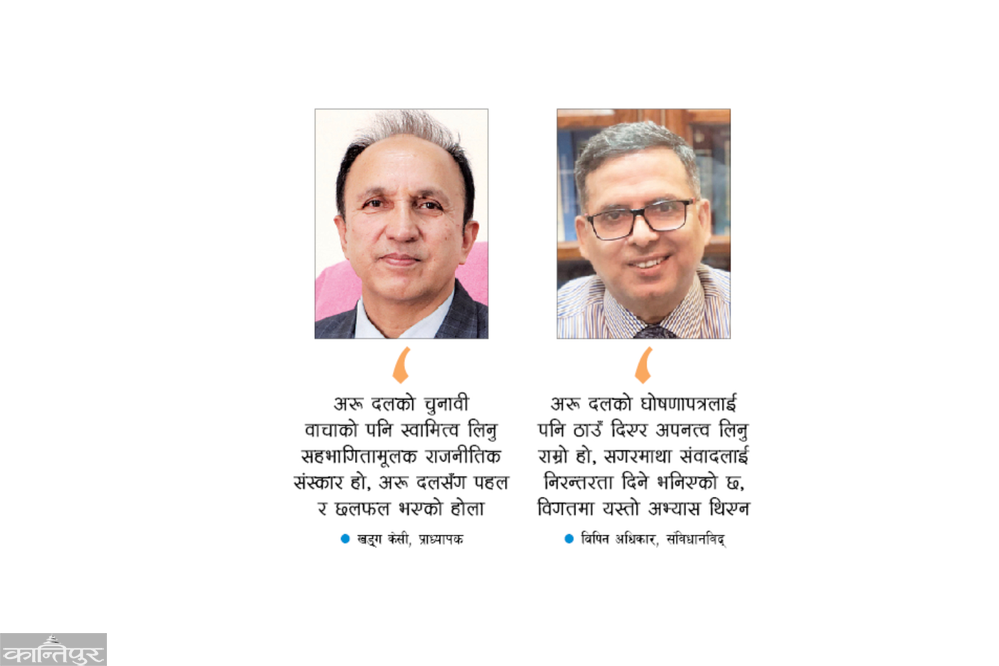
Professor Khadga KC responded that taking ownership of the election promises of other parties is a participatory political culture. 'This is a positive initiative overall. There must have been initiatives and discussions with other parties. It is a good thing to accept the commitments of the Sagarmatha Dialogue, the Climate Conference and other parties,' he said.
Constitutional scholar Bipin Adhikari says that giving space to important issues like constitutional amendments and adopting the manifestos of other parties is a good start. "This was not a practice in the past. Many other things have been included, including continuing the Sagarmatha Dialogue initiated by the previous government. This is an important step towards creating a common document in the coming days," he said.


