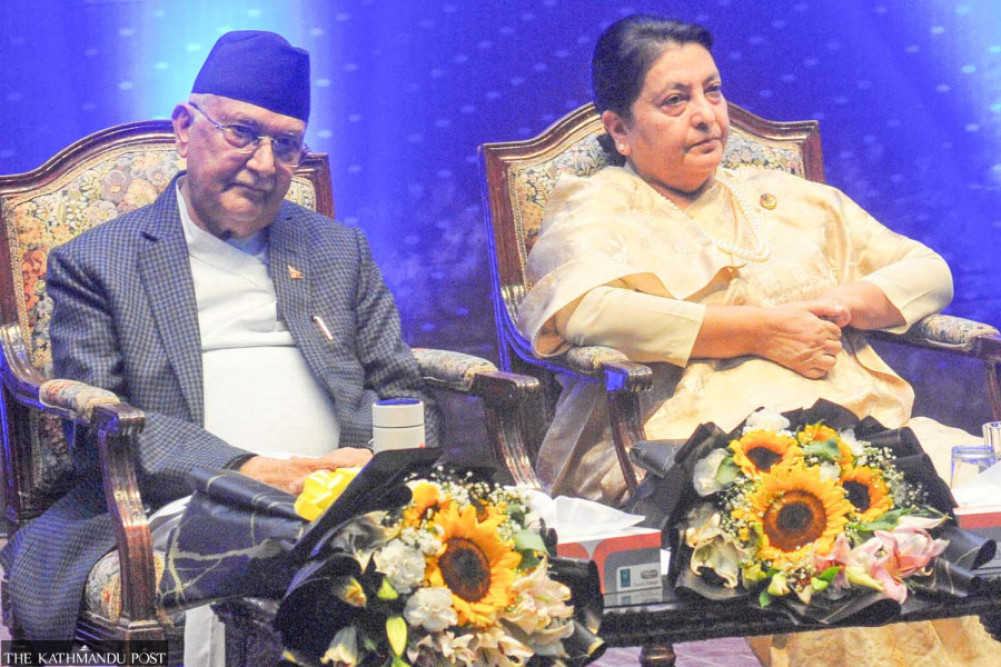
Last year, Bhandari could not muster enough strength to defeat then Prime Minister Oli. Now that Oli is seen as politically weak, Bhandari's party has reactivated its efforts to return to politics.
We use Google Cloud Translation Services. Google requires we provide the following disclaimer relating to use of this service:
This service may contain translations powered by Google. Google disclaims all warranties related to the translations, expressed or implied, including any warranties of accuracy, reliability, and any implied warranties of merchantability, fitness for a particular purpose, and noninfringement.
Even a few days before the Gen-G rebellion of Bhadra 23 and 24, the then Prime Minister and UML Chair KP Sharma Oli was active in preventing former President Bidya Bhandari from joining the UML. But 7 months later, Bhandari, who is also the former vice-chair of the party, is in the race to join the UML leadership.
Politically, Oli has become weaker than before. In the Falgun 21 election, Oli not only lost from Jhapa-5, the party itself shrank to the third position with 25 seats. He had to spend a few days in judicial custody for an investigation into allegations of suppressing the youth rebellion.
Bhandari has also increased her political activism after the demand for a special general convention within the party for the revival of the UML became strong. 'He is constantly in contact and meeting with UML leaders,' said Krishna Bahadur Rai, a leader considered close to Bhandari, 'but I do not want to reveal the names of the leaders he is meeting.'
Last Friday, Bhandari had also interacted with editors at the Madan Bhandari Foundation office in New Baneshwor. Bhandari met with the editors at a time when voices were being raised in favor of a special general convention within the UML. Leaders who were close to Bhandari when she was UML vice-president say that Bhandari's meeting should not be seen as a renewal of political activism.
They say that Bhandari became active because she felt that it would not be appropriate to remain silent when she was in political trouble. 'It is not fair for her to remain silent even when she sees this condition of the party for which she herself has shed sweat and blood,' said a leader close to Bhandari. Rai also believes that Bhandari should become active and revive the UML. He says, 'I think he should not step back if he is in a position to lead the party. But this is my personal opinion. I have not even discussed it.'
Bhandari's personal secretary Rajkumar Rai says that the current meeting has no meaning in the internal politics of UML. Earlier, when Bhandari tried to enter active politics, the UML Central Committee itself had stopped her. Many supported Oli's move to stop Bhandari at the second general convention held on Bhadra 20-22. The convention also removed the provision that the president cannot serve more than two terms and the age limit of 70. This provision was removed to pave the way for Oli to become the president for a third term. That move sidelined the issue of generational transition under UML leadership. In addition, the party did not follow the path of transformation as per the essence of the Gen-G movement. Even after the Gen-G movement, Bhandari could not utilize the opportunity she got.
After failing to actively return to politics, Bhandari tried to show her influence from outside at the 11th general convention held in Mangsir. Leaders also say that Bhandari supported senior vice-chairman Ishwor Pokharel, who had filed a candidacy against Oli for the post of chairman. Even though a panel was raised against Oli, the general convention delegates did not believe Pokharel. In the 19-member secretariat, Gokarna Bista and Yogesh Bhattarai won the vice-chairman and deputy general chairman positions from Pokharel's side. Pokharel himself was defeated by Oli by a huge margin.
In the parliamentary elections held on Falgun 21, UML won only 7 seats out of 165 in the direct route. UML won 25 seats in total, including 18 seats out of 110 in the proportional route. The demand for a special general convention is being raised as the party continues to lose public support. Meanwhile, Bhandari's political activism is being watched with interest. Analysts say that the Nepali leftist movement has reached its weakest point in history. They believe that Bhandari's return alone will not be enough to lift the communist movement when fundamental restructuring is needed. 'If the UML is to restructure the party, it should hand over leadership to the second or third generation,' says political analyst Keshav Dahal, 'Bhandari is not a suitable person to lead the party.' Deputy General Secretary Bhattarai also says that a proposal for a special general convention has come from the younger generation in the party. But he says that there is still work to be done to give it substance. According to the UML's statute, a special general convention must be called if 50 percent of the general convention delegates demand it. 'There has been no discussion about restructuring the party or bringing Bhandari to the party leadership through a special general convention,' he said. Similarly, he says that there is only a slim chance of holding a UML special general convention. The UML Central Committee itself had concluded that the former head of state's return to active politics would not send a positive message to national politics. 'It seems that Bhandari has wanted to enter active politics for a long time, but it has been stopped because of Oli,' says political science professor Krishna Pokharel. He also says that Oli stopped Bhandari, estimating that he would be weak if Bhandari were allowed to enter the UML. Now, Bhandari is trying to return to politics again because Oli is in a weak position within the party,' says professor Pokharel. Why are South Asian leftist parties being pushed back? Analyst Dahal says that Bhandari's activism may further weaken the left movement. 'In the coming days, politics should move forward in a collective and institutional manner rather than in an individual-centric manner,' he says. After the Gen-G movement, the old parties are facing a crisis of political existence. Analysts say that the latest election results are also the result of personality-centric politics.
Gajendra Thapaliya, Chairman of the Nepal Intellectuals Council of UML, says that the demand for a special general convention is not a campaign against any leader. He also said that the campaign is not being launched to install any leader. 'Our campaign is for the overall restructuring of the party, which is also the demand of the present time.'