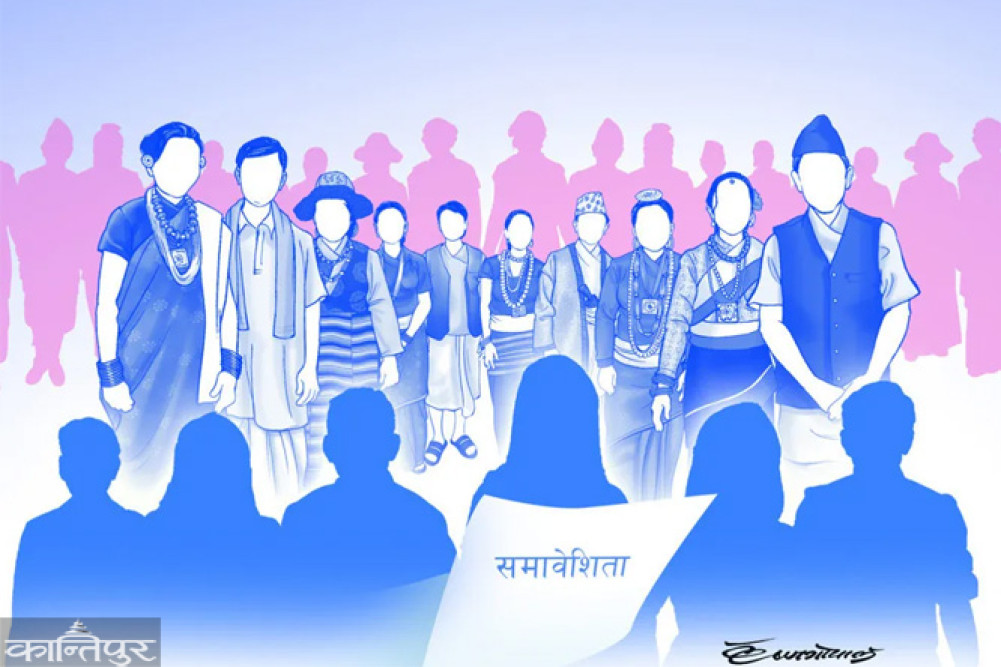
Election Commission to give parties time to correct inclusionary grouping failures
We use Google Cloud Translation Services. Google requires we provide the following disclaimer relating to use of this service:
This service may contain translations powered by Google. Google disclaims all warranties related to the translations, expressed or implied, including any warranties of accuracy, reliability, and any implied warranties of merchantability, fitness for a particular purpose, and noninfringement.
The Rashtriya Swayamsevak Sangh (RSS), Congress, UML, NCP, Shram Sanskriti and RPP have submitted the names of those to be elected through proportional representation to the Election Commission. The political parties that have crossed the 3 percent 'threshold' in proportional representation submitted the list on Sunday.
Out of the 110 seats in the proportional system, the Rashtriya Swayamsevak Sangh (RSS) has won 57, the Congress 20, the UML 16, the NCP 9, the Shram Sanskriti 4 and the RPP 4. The Election Commission had written to the parties on Thursday to send the names of the candidates to be elected through the proportional system within three days after allocating the seats.
The list received from the parties will be checked from Monday to see if the names match the inclusive group, informed the Commission spokesperson Narayan Prasad Bhattarai. ‘If there is any discrepancy in the list, we will write to the concerned party again to bring it together,’ he said, ‘only after that the list of elected MPs will be published.’
After the list is published, the certificate of election will be distributed. After the finalization of the members of the House of Representatives elected through the proportional system, the Election Commission will prepare a report and submit it to the President. After that, the path to forming the government will be opened for the Rashtriya Swayamsevak Sangh (RSS). ‘We have set a target of submitting the report to the President within a week,’ said the Commission spokesperson Bhattarai.
Section 60 (6) of the House of Representatives Election Act stipulates that parties must submit their lists to the commission in the order in which they are included in the closed list, based on the number of seats won by the party, with representation of Dalits (13.8 percent), indigenous peoples (28.7 percent), Khas-Aryas (31.2 percent), Madhesis (15.3 percent), Tharus (6.6 percent) and Muslims (4.4 percent). At least 4.3 percent of the selected names must be from backward areas. The federal parliament should be formed through proportional quotas, including 33 percent women representation from the respective parties.
The largest party in the House of Representatives, the Rashtriya Swayamsevak Sangh (RSS), has 182 seats, including proportional representation. One-third of them, or 61, must be women. The Rashtriya Swayamsevak Sangh (RSS) has no representation in the National Assembly. The number of directly elected women in the RSS is 13. Therefore, the RSNP should have at least 48 women represented through proportional representation, with 16 from indigenous peoples, 18 from Khas-Arya, 4 from Tharu, 8 from Dalit, 9 from Madhesi, and 2 from Muslims.
The RSNP finalized the names of candidates to be elected through the proportional system in a secretariat meeting. Before the secretariat meeting, party president Ravi Lamichhane and senior leader Balendra Shah had discussed who would be elected as MPs through proportional representation. After the decision of the meeting, General Secretary Kabindra Burlakoti submitted the list to the Election Commission.
RSNP spokesperson Manish Jha informed that the list was prepared and sent to the Election Commission as per the legal provisions. According to him, 17 names, including 16 women and 1 man, have been recommended in Khas-Arya. 2 women and 2 men have been submitted in Tharu, 7 women and 2 men in Madhesi, and 3 women in Muslims. 7 women and 1 man have been selected from Dalit 'cluster', 13 women and 3 men from indigenous peoples. "Until the commission verifies them politically and legally, those names will only be proposed by us," Jha said.
The Congress has decided in the Central Working Committee meeting and sent the names of 15 women and 5 men to be elected through the proportional system to the Election Commission. There are 62 members from the Congress in both houses of the federal parliament. There are 24 Congress MPs in the National Assembly, and 18 have been directly elected to the House of Representatives. Of the total number of members (62), 33 percent, or 21 women, should be represented by the Congress. There is one directly elected from the Congress and five women in the National Assembly. The remaining 15 were selected by the Congress through proportional representation.
General Secretary Pradeep Poudel informed that the names of the seats that the Congress will get through the proportional system were unanimously finalized. Due to the policy of not repeating names of MPs who have already been elected through the proportional system, there is a majority of new faces in the Congress list. Arjun Narsingh KC, who has been a minister several times from Khas-Arya and has contested the most elections in contemporary politics, has been selected from the Khas-Arya 'cluster'. His selection is being criticized everywhere. The 78-year-old KC, who is number one among the men in the Khas-Arya group in the closed list of proportional candidates, is the father-in-law of party president Gagan Thapa.
KC, who harshly criticized the then president Sher Bahadur Deuba by raising the issue of generational transfer, has been criticized for not leaving his turn. Although he was in the Congress during his student politics, KC entered the national panchayat in 2038 BS and contested the election. At that time, he also became a minister of state. He was defeated when he contested the election for the second time in 2043 BS. In 2045 BS, he became the president of the district panchayat. During the panchayat period, he worked closely with the then Prime Minister Surya Bahadur Thapa. After 2046 BS, he returned to the Congress. He won the elections in 2048 BS, 2051 BS, 2070 BS and 2079 BS. During that period, he became a minister several times. This time, Bhai Jagadishnar Singh KC was the candidate from Nuwakot-2, where he has been contesting, but was defeated.
Bhishmaraj Angdambe, who is becoming a proportional MP from the indigenous peoples group, is also a long-time leader. He won the 2070 Constituent Assembly election from Panchthar. He was defeated in 2074 and 2079. He was the Joint General Secretary in the Deuba-led Working Committee.
Madan Krishna Shrestha, who was selected from the indigenous peoples group, is a resident of Bhaktapur. He is number 16 in the closed list of the indigenous peoples group and was selected due to his disability. Chandra Mohan Yadav, who was selected from the Madhesi group, is the son of former President Ram Baran Yadav. Rina Upreti, who represents Khas-Arya women, is the wife of former Minister Bal Bahadur KC. UML has recommended Vice President Ram Bahadur Thapa and Secretary Padma Aryal as proportional MPs. While all (11) office bearers who contested directly were defeated, the UML is going to make two office bearers MPs through proportional representation.
Former Vice President Guru Baral and former Chairman of the National Planning Commission Pushparaj Kandel have also been recommended from the UML. In addition, Bhumika Subba, Gangadevi Shrestha, Kulbhakta Shakya, Tukabhadra Hamal, Eshudakumari Baral (backward areas) have been included. Kriparam Rana, Bishnumaya BK, Neeta Ghatani, Ringala Yadav, Yashodha Kumari, Chandreshwor Mandal and Sajida Siddiqui have also been selected by the UML. The UML has won nine seats directly, of which there are no women. The UML has 10 MPs in the National Assembly. Seven of them are women. In the process of finalizing the 16 candidates to be elected through proportional representation, the UML has achieved one-third women representation.
The NCP has submitted the names of Pramesh Hamal, Balawati Sharma, Parashuram Tamang, Bhim Kumar Budha, Prem Bayak due to disability, Jog Kumar Barbaria Yadav, Parbati BK, Ganesh Bishwakarma and Maisai Chaudhary to the Election Commission. Hamal is a former ambassador. Sharma, who has become a member of the Constituent Assembly, is the wife of leader Devendra Poudel. Poudel was defeated in Nawalparasi (Bardaghat Susta Paschim)-2 directly. Bayak was selected due to disability.
The list of the NCP was finalized by the coordinator of the NCP, Pushpa Kamal Dahal, and the co-coordinator, Madhav Kumar Nepal. The NCP has won eight seats directly. The NCP has 17 MPs in the National Assembly, 8 of whom are women. The Shram Sanskriti Party held a central committee meeting in Dharan on Sunday and selected four candidates. According to party spokesperson Satya Ghale Gurung, Purna Prasad Limbu has been selected from the indigenous people, Ambika Devi Sangraula from the Khas-Arya women, Radhika Ramtel from the Dalit women, and Rubikumari Thakur from the Madhesi women.
In the direct election, Shram Sankriti has won 3 seats (all men). Shram Sankriti Party is not represented in the National Assembly. Rastriya Prajatantra Party has selected Bharat Giri, Khusbu Oli, Saraswati Lama, and Tahir Ali. In the direct election, RPP has won only one seat (men). RPP is not present in the National Assembly.
Indigenous Peoples
Rashtriya Swayamsevak Sangha: Basumaya Tamang, Ganga Chhantyal, Sumnima Udas, Anushka Shrestha, Ojaswi Sherchan, Sirjana Shrestha, Rajani Shrestha, Kusum Maharjan, Bhumika Shrestha, Pramila Kuluj, Sujata Tamang, Kripa Maharjan, Eliza Gurung, Ram Lama, Khusbusarkar Shrestha and Mingma Gyabu Sherpa
Congress: Madan Krishna Shrestha (disabled), Bhishmaraj Angdambe, Geeta Kumari Sendang, Gangalakshmi Awal, Geeta Gurung and Renuka Kaucha
UML: Bhumika Subba, Gangadevi Shrestha, Ram Bahadur Thapa Magar and Kulbhakta Shakya
NCP: Parashuram Tamang and Bhimkumar Budha
Labor Culture: Purna Prasad Limbu
RPP: Saraswati Lama
Khas-Arya
RSP: Prativa Rawal, Rachna Khatiwada Khatri, Lima Adhikari Acharya, Vidushi Rana, Samiksha Baskota, Shraddha Kuwar Kshetri, Tika Sangraula (backward area), Kranti Shikha Dhital, Aakriti Awasthi, Srishti Bhattarai, Manju Bhusal, Prabha Karki, Shobha Khanal, Ratna Kumari Thapa (backward area), Gyanu Poudel, Prabha Dhakal and Ramesh Prasai
Congress: Arjun Narsingh KC, Kali Bahadur Sahakari, Sushila Dhakal Acharya, Rukmini Devi Koirala, Rina Upreti and Sita Thapaliya
UML: Padma Aryal, Tukabhadra Hamal, Eshudakumari Baral (backward area), Guruprasad Baral and Pushparaj Kandel
NCP: Pramesh Hamal, Balawati Sharma and Prem Bayak (disability)
Labor Culture : Ambikadevi Sangraula
RPP : Bharat Giri and Khusbu Oli
Dalit
RSP : Rima Vishwakarma, Amrita Vick, Sita Badi, Smriti Century, Sushma Swarnakar (Dimple), Tara Vishwakarma, Khima Vick and Prakashchandra Darjee
Congress : Harinadevi Kami, Pavitra Vick and Manmaya Vishwakarma
UML : Vishnumaya Vick and Nita Ghatani
CPN : Parvati Vick and Ganesh Vishwakarma
Shram Culture : Radhika Ramtel
Madhesi
RSVP : Punam Kumari Agarwal, Nisha Mehta, Lalita Kumari, Ankita Thakur, Sarita Mahato, Kamini Kumari, Sunitakumari Chaudhary, Purushottam Suprabhat Yadav and Khagendra Karna
Congress : Chandramohan Yadav, Neenukumari Karna and Rekhakumari Yadav
UML : Ringla Yadav, Yashodakumari Yadav and Chandrashwar Mandal
CPN : Jogkumar Barbaria Yadav
Labor culture : Ruvikumari Thakur
Muslim
RSVP : Samina Mian, Afsana Banu, Ghazala Shamim Mikrani
Congress : Sahjan Khatun
UML : Sajida Siddiqui
RPP : Tahir Ali
Tharu
Raswapa : Geeta Chaudhary, Karisma Katharia, Surendra Chaudhary and Premlal Chaudhary
Congress : Pramilakumari Gachchdar
UML : Kriparam Rana
CPN : Nirasha Chaudhary