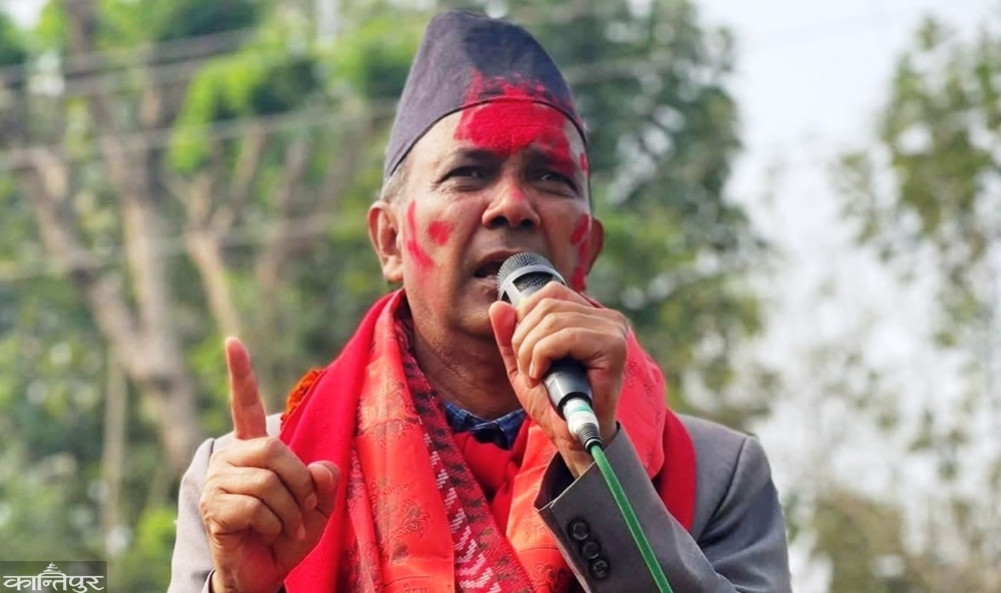
Mohanlal Acharya, who worked as an expert during the constitution-making process, started his political journey by joining the Rashtriya Swayamsevak Sangh (RSS) after the Gen-G movement of last Bhadra. Elected from Kapilvastu-1, he has broken the legacy of the UML and the Congress since 2048.
We use Google Cloud Translation Services. Google requires we provide the following disclaimer relating to use of this service:
This service may contain translations powered by Google. Google disclaims all warranties related to the translations, expressed or implied, including any warranties of accuracy, reliability, and any implied warranties of merchantability, fitness for a particular purpose, and noninfringement.
Mohanlal Acharya, an expert on the constitution, has reached the highest place to make laws, the federal parliament. He has been giving necessary advice to make laws until now, and has himself reached the place of making laws. He became the candidate from the Rashtriya Swayamsevak Sangh (RSS) in Kapilvastu-1 and started his parliamentary journey by winning by a huge margin.
He broke the legacy of the UML and the Congress since 2048 in Kapilvastu-1. Acharya, who is working as an expert, said that he started his parliamentary journey by joining the RSSW after the Gen-G movement of last Bhadra to give the country a way out.
There was a competition between two new faces here. Acharya won by a margin of 18,288 votes. Acharya got 34,148 votes while his closest competitor, independent candidate Ashish Sharma, got 15,860 votes. After not getting a ticket from the party, Congress leader Sharma had filed his candidacy as an independent candidate. Sharma is also an expert in good governance in banks and financial institutions and a young entrepreneur. Acharya won the election in Constituency No. 1, which has a relatively high development potential among the three constituencies, defeating 19 candidates from the party and 14 independent candidates.
The election was made more complicated when 3 Constituent Assembly members were in the election contest in this constituency. Although it was difficult to compete with experienced leaders, hydropower experts, commanders of the then Maoist People's Liberation Army and young entrepreneurs, he managed to secure a large number of votes from the people and made his way to the parliament. Acharya, who holds a master's degree in two subjects, faced sharp questions from voters during the election campaign and said that those with knowledge and expertise should be given opportunities to work.
A candidate for the House of Representatives for the first time, he has experience of working as a Constituent Assembly expert for seven years. He has experience in lawmaking, research and legislative review of laws for various government agencies including the Office of the Prime Minister and Council of Ministers, Ministry of Federal Affairs, Ministry of Law, Justice and Parliamentary Affairs, Ministry of Health and Population and Ministry of Agriculture. The 53-year-old Acharya from Siddhipur, Banganga Municipality-4, has a master's degree in international law and sociology.
An expert in lawmaking at the association, provincial and local levels, strengthening of local judicial committees and special capacity building training, Acharya said that he has given priority to agriculture. He said that he will respect farmers, provide easy access to irrigation and fertilizers.
He said that the plan has been formulated with the aim of marketing agricultural produce, taking initiatives for operating medical colleges and developing the Buddha Circuit as a tourism hub on the world tourism map. He said that he will work to make the lawmaking process people-oriented, practical and implementable and advocate for making laws that are felt by the general public. 'Law should not be limited to books, but should be a means of providing justice, security and trust in the lives of citizens,' he said, 'I will take strong steps to ensure the rule of law, end corruption and against impunity.'
He said that public positions will be made service-oriented and a governance system directly accountable to citizens will be developed. He claims that a program has been created targeting youth to create jobs, develop skills, promote startups and expand opportunities within the country as an alternative to foreign employment.