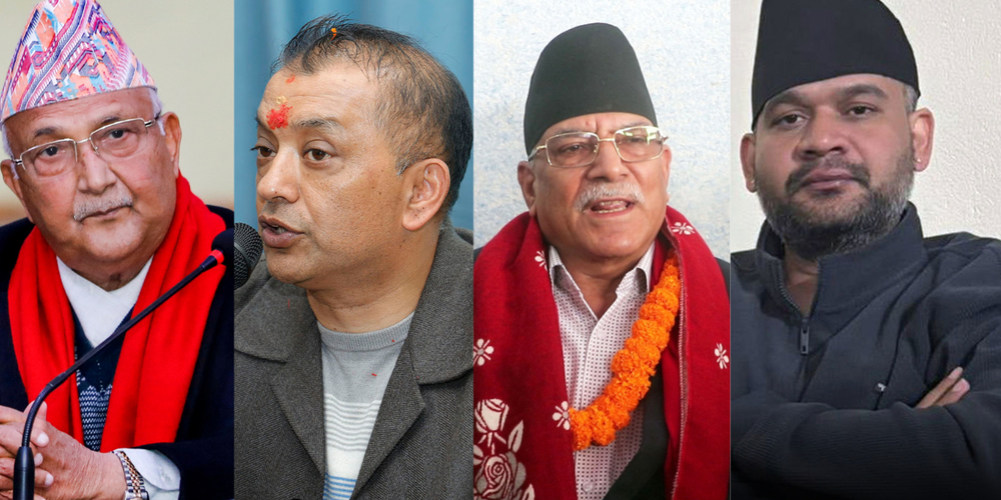
It will take a few more days for the party's manifesto to be released, and the commitment letters of the leaders who have been declared prime ministerial candidates are also yet to be released.
We use Google Cloud Translation Services. Google requires we provide the following disclaimer relating to use of this service:
This service may contain translations powered by Google. Google disclaims all warranties related to the translations, expressed or implied, including any warranties of accuracy, reliability, and any implied warranties of merchantability, fitness for a particular purpose, and noninfringement.
Without preparing manifestos, political parties have already started door-to-door campaigning. They are also campaigning through digital means.
None of the parties participating in the elections on 21 Falgun, including Congress, UML, CPN, Rashtriya Swayamsevak Sansthan, JSP Nepal, Ujjaya Nepal, Janmat, Nagarik Unmukti, Shram Sanskriti, etc., have brought out election manifestos. Almost all political parties are in the process of preparing manifestos.
Congress has nominated President Gagan Kumar Thapa and Rashtriya Swayamsevak Sansthan senior leader Balendra Shah as the future Prime Minister. Although it has not been officially announced, Chairman KP Sharma Oli is seen as the future Prime Minister by UML. None of them has brought a commitment letter with plans to do after becoming Prime Minister.
UML Chairman Oli Jhapa-5 and Nepali Communist Party (NCP) Chairman Pushpa Kamal Dahal have returned to the federal capital after registering their nominations in Rukum East. Rashtriya Swayamsevak Sansthan's Shah has been touring the eastern hilly districts to meet Rashtriya Swayamsevak Sansthan leaders, activists and voters after filing his candidacy in Jhapa-5. He also returned to Kathmandu on Saturday. Congress President Thapa is going to the voters of his constituency Sarlahi-4 on Sunday. He had registered his candidacy through Wares on 20th Magh.
Congress has formed a committee under the coordination of President Thapa, UML President Oli, NCP leader Narayan Kaji Shrestha, and Rashtriya Swayamsevak Sangh (RSS) Vice President Swarnim Wagle and is writing the manifesto. Other parties have also mobilized their teams to prepare the manifesto. This time, they claim to include realistic commitments in the manifesto rather than overly ambitious ones.
The election manifesto contains the political and policy perspectives of the parties, plans for the country's socio-economic reforms, and commitments to the voters. However, due to the tendency of political parties to make one commitment and act differently, voters do not often vote based on the manifesto.
Former Vice Chairman of the National Planning Commission, Dipendra Bahadur Chhetri, says that there is a tendency to go to the elections by showing the 'image' of a person rather than policies, principles, and plans. ‘Even when announcing the future Prime Minister, policies and plans should be brought to show what changes will be made compared to yesterday. But that does not seem to be the case,’ he says. ‘It may be that its importance is decreasing because the things written in the commitment letter are not being implemented. It may also be that the people have been underestimated.’
Chhetri comments that the announcement of the future Prime Minister was also rushed. ‘In 2056, the Congress had declared Krishna Prasad Bhattarai as the future Prime Minister and entered the elections. The Congress got a majority in Bhattarai’s name. He was made Prime Minister but was not allowed to last long,’ he says, ‘Even now, it is impossible to say what the situation will be like tomorrow.’
Political analyst Lokraj Baral considers it natural to announce the future Prime Minister and go to the elections. ‘They bring a manifesto of 20/30 pages, and no one seems to pay attention to it. If the party benefits by promoting a person, then it should be considered natural,’ he says. ‘Leadership is an important factor. Voters believe that a leader with integrity, trust, confidence and ability will do something when he goes to government. There is more trust in the party than in what is written in the manifesto. The common citizen is currently looking for trust, confidence and honesty in the leadership.''
Congress leader Mahesh Acharya, who is also a former finance minister, says that problems arise when parties include in their manifestos issues that cannot be implemented to become popular. According to him, the manifesto is not only a 'platform' for the party to set its agenda but also a means of two-way dialogue with the citizens. 'Through this, the party introduces its past, leadership, conduct, behavior and programs to the public. Citizens also seek the role of the parties in solving the problems they have faced in areas such as development, rights and access to services.
Based on that, they select the most suitable one. For that, a manifesto is needed,' says Acharya. 'Only topics that can be done within a period of five years, are visible and are in line with national needs should be written in the manifesto. The work that can be done and the legal and administrative obstacles that may arise during the implementation phase, the need for motivation and monitoring should be taken into account.’
Acharya’s analysis is that parties give importance to the power struggle without paying attention to such aspects when bringing out their manifestos. ‘Our time was spent on gaining power. Power alone is not everything to instill trust in the people. I do not believe that one becomes the leader of the country as soon as one becomes the Prime Minister,’ he says. ‘To become a leader, one must win the hearts and trust of the people in other ways. It must be confirmed that honesty and character work. These things should be reflected in the manifesto.’
The Congress has entered the elections after changing its leadership from the special general convention. Party President Gagan Thapa has been saying – ‘Let’s change the Congress, let’s change the country.’
Spokesperson Devraj Chalise says that the party is preparing to bring out its manifesto with this as its main policy. He says that not only the face of President Thapa but also the history of the party, international trust, the party’s institutional base, maturity, experience and the trust of the common citizen are attached to the Congress. He said that President Thapa's decision to contest the election in Madhesh is also linked to the campaign to make the Himalayas, hills and Terai emotionally strong.
'After becoming the Prime Minister, there are dreams, perspectives, plans and programs of their own. For that, the President himself has taken charge of the manifesto and is taking suggestions from experts in various fields and is working on the manifesto,' Chalise said, 'We are trying to move forward with the vision of 'Visit 10'. It contains ten main plans. This time, we are trying to bring a manifesto that is short and understandable to the general voters so that it can be implemented and easy for the common citizen to remember.'
Thapa, with the dream of becoming the Prime Minister, had conducted a detailed study on the work to be done within five years, which was named 'Project Governor'. 'Project Governor' includes a long study on reforming the civil service administration, amending laws, new plans and programs, their deadlines, making public services faster, good governance and ending corruption. Within this, a report has been prepared by studying the sectors of agriculture, tourism, aviation, education, health, energy, forests, urban development, international relations, etc. Thapa is preparing to bring the manifesto based on the study that the government has prepared by making a list of short-term, medium-term and long-term tasks. According to Chalise, the manifesto will be released within a week.
UML is continuing the national goal of ‘Prosperous Nepal: Happy Nepali’ in the manifesto. Stating that the Congress-UML coalition government before 24 Bhadra took the initiative to achieve political stability in one year, one month and 24 days, UML is preparing to write in the manifesto the work done in the areas of good governance, economic growth and others during that period.
UML has formed a manifesto writing committee under the coordination of Chairman KP Sharma Oli. The committee's vice-chairmen are Ram Bahadur Thapa and Bishnu Poudel, general secretary Shankar Pokharel, and leaders Ishwor Pokharel, Pradeep Gyawali, and Bishnu Rimal.
The party has concluded that international forces played a role in the dissolution of the UML-led government last Bhadra. Therefore, it is preparing to raise the issue of nationality prominently in the manifesto. The UML is explaining the Gen-G movement on Bhadra 23 and the incident of Bhadra 24 differently in the manifesto. The argument is being made in the manifesto that the Gen-G movement of Bhadra 23 was hijacked and the destruction of Bhadra 24 was caused.
'We will explain the plan to justify the destruction of Bhadra 24, to prohibit the old forces, and to do it through elections,' said Gyawali, a member of the manifesto writing committee.
Gyawali says that the manifesto will also write about how to restore democracy to normal and how to strengthen the state. ‘We will include good governance, corruption control, transparency, public service delivery, economic prosperity, tackling climate change, development of information technology and the progress that can be made with its support in the manifesto,’ he says. ‘The issues that can be implemented in the coming days will be included in the manifesto. We will take forward the long-term commitments made in 2079 BS this time too.’ Gyawali also informed that the manifesto will be brought out soon as the candidates have gathered at the doorsteps. ‘The manifesto will be released with the title of guarantees, commitments and resolutions that the UML will make after forming the government under its leadership,’ he said.
The NCP is prioritizing good governance, social justice and prosperity.
The Nepali Communist Party is preparing the manifesto by including the themes in line with its goal of moving forward on the socialist path. The policies of good governance, social justice and prosperity put forward by the previous government led by Coordinator Pushpa Kamal Dahal are being included in the manifesto with priority.
Pramesh Hamal, a member of the manifesto writing committee, said that programs that will overcome despair and instill hope along with economic and social transformation will be brought out in the manifesto. He informed that preparations are underway to make the manifesto public by 15th Magh. ‘The manifesto will contain programs for socio-economic transformation, good governance, and employment,’ he said. ‘Since a socialist roadmap can only be drawn through public access, programs will be prepared accordingly.’
Hamal says that only programs that the country’s resources and means can support will be committed. ‘The goals of some past programs were ambitious. Now, we will formulate policies and programs in a way that is realistic and achievable with resources and means,’ he says.
In the previous election, the then Maoists had raised the issue of a direct executive prime minister. This time, the NCP is confused about moving it forward. However, preparations are underway to include the issue of amending the constitution to change the form of governance.
Rajendra Shrestha, another member of the manifesto writing committee, who is drafting the manifesto by forming subgroups of political, economic, social, and administrative issues, informed. ‘We will include national independence, federal democratic republic, and social justice as the core. We express our commitment against status quo and regression,’ he said.
The manifesto writing committee includes Hamal, Bhim Rawal, Dev Gurung, Girirajmani Pokharel, Shakti Basnet, Rajendra Shrestha, Pampha Bhusal, Ramchandra Jha, Hari Chaudhary, Hakikulla Khan and Ajambar Kangmang. Former chairman of the National Planning Commission, Min Bahadur Shrestha, is also on the committee. Other members include Pushpa Rajkarnikar, Chandramani Adhikari, Achalraj Pandey, Indu Acharya, DP Dhakal, Balram Baskota, Yuwanath Lamsal, Prem Khanal, Jaya Karki, Nahendra Khadka and Gokarna Bhatta.
The RSVP is writing a manifesto in 7 sections
RSVP President Ravi Lamichhane had asked party Vice President Swarnim Wagle, who is also an economist, to write the budget for the coming year from a public forum. "Looking at the enthusiasm and energy that is being shown towards the party from all over the country, I can say this much - Doctor Saab, start writing the budget for the coming year," he had said at the party's integration announcement meeting held in the capital on December 21. His statement also meant that Wagle would be made the finance minister if the Rashtriya Swayamsevak Sangh (RSS) forms the government.
Wagle, who was asked to write the budget, is currently busy writing the manifesto. The RSS has formed a committee under the leadership of Vice President Wagle to write the manifesto, and the committee includes leaders such as Sobita Gautam, Maheshwor Ghimire, Krantishikha Dhital, Araniko Pandey, Ram Gurung and Nandan Yadav. The manifesto is set to be made public on February 1 or 7.
Wagle informed that the work of writing the manifesto in seven sections is underway. He said that the party will take a policy of strengthening the structure provided by the constitution. "The priorities of our manifesto are economic development, good governance, employment, middle class-oriented, youth-centered leadership, private sector, and road infrastructure development," Wagle said. "The party will not adopt a policy of changing the structure of the seven provinces as provided for by the constitution. A provincial structure is needed for national unity. We have been saying that reform of the provincial assembly is necessary to make the provinces prosperous." Wagle said that the RPP will write the manifesto based on the policies it has been adopting in the past.
RPP's main issue is a Hindu nation with religious freedom
RPP is preparing the manifesto by forming a committee led by Chairman Rajendra Lingden, including Professor Geeta Bhakta Joshi and former Secretary Kedar Bahadur Adhikari. "The work of preparing the manifesto is almost in the final stage, we will make it public in a few days," said RPP spokesperson Mohan Shrestha. "The political aspects of the manifesto will include issues such as the monarchy as a guardian institution, a Hindu nation with religious freedom, and a directly elected executive Prime Minister."
He said that the issue of investigating the assets of those who came to political leadership after 046 will also be included in the RPP manifesto. ‘We are presenting an alternative roadmap for the situation and system,’ Shrestha added, ‘We made an honest effort in accordance with the commitment we expressed to the people in the 079 elections. Even now, we will bring an alternative roadmap for the country’s socio-economic transformation and the achievement of our political objectives.’
Janmat focused on ‘exit and development’
Janmat Party is writing a manifesto to bring policies and programs to bring a way out of the current situation for the country. ‘We have put forward the main slogan of exit and development,’ said party president CK Raut, ‘The country is currently in crisis, the solution to it is the philosophy of a new republic. That means a system where the directly elected executive, heads of constitutional bodies are also elected, and MPs do not become ministers. This can provide a way out for the country. We are writing the manifesto by including this issue.'
The manifesto for the public opinion is being written by a committee led by Basanta Kushwaha. Chairman Raut said that the agenda for autonomy for the provinces and local levels will also be in the manifesto. 'It seems that in today's politics, there is no need for a manifesto, no agenda at all. Politics without policies and principles will lead the country to disaster. Political parties and independent candidates should put their agendas before the people when going to the elections,' he said, 'There is an unfortunate situation of populism now. There are those who say they will strengthen the province for votes, but they do not participate in the elections and do not vote.'
Hydropower in Ujjaya Nepal's manifesto
The Ujjaya Nepal Party led by Kulman Ghising is writing a manifesto with a policy for development in the fields of hydropower, tourism, agriculture and others. A group including party central member Kedar Khadka is involved in writing the manifesto. According to party spokesperson Raju Thapa, the first phase of writing the manifesto has been completed and feedback and suggestions from experts are being sought.
The manifesto is being finalized and prepared to be made public in a week or two. ‘The manifesto for the upcoming election is being written based on the statute and manifesto submitted to the Election Commission during party registration,’ said spokesperson Thapa. ‘The policy will be to assimilate the basic principles of the constitution. After that, we will move forward with periodic programs for 10 years.’
JSP Nepal emphasizes strengthening federalism
The manifesto of JSP Nepal, chaired by Upendra Yadav, is being written by a team led by General Secretary Ram Kumar Sharma. Spokesperson Manish Suman informed that the policy of proportional representation and inclusion, federalism, strengthening the provincial structure, and further strengthening the local level are among the priorities of the manifesto. ‘The manifesto writing has reached the final stage,’ he said. ‘We will make the manifesto public this week.’
After the dissolution of the House of Representatives due to the Gen-G movement, new and old parties are competing in the upcoming House of Representatives elections. Candidates from all parties have put forward the issue of 'good governance against corruption', which has emerged as a major issue in the Gen-G movement. Along with this, candidates are going to the voters by raising employment, education, health improvement and promotion of local products as major issues.
While parties have prepared manifestos with promises that they could not implement in the past, this time they have stated that they are preparing manifestos with programs and goals that they can implement. After being nominated on Magh 6, the candidates have been going door-to-door with local issues as a priority.
Candidate understanding the minds of voters
UML's Kshitij Thebe, who is going door-to-door in Taplejung as a candidate for the first time in the House of Representatives elections, said that he is meeting voters by listening to the demands and concerns of the voters. 'I am going door-to-door and discussing issues such as making the youth entrepreneurial, promoting tourism, marketing agricultural products,' he said. 'Quality education, health and other issues are being raised. The plan is to move forward by absorbing the voices of the voters.'
First-time candidate JSP Nepal's Bobby Yadav is also going door-to-door in her constituency Saptari-4. She is a leader who returned from employment in Qatar. 'Since I myself have gone for foreign employment, my issue is to create an environment where people can find work in my own country,' she said. 'If there is a good policy in technical education, employment can be created. I will run a campaign to end violence against women. I will become a medium to bring the voice of the streets to the House.'
Nepali Communist Party's Lekhnath Neupane, who is a first-time candidate from Gorkha-2, said that he went to the doorsteps of voters with 'only as many promises as I can make.' 'I do not do impossible things. I say as much as I can. I have tried to raise possible issues,' he said. 'If the MP does not lead the development work, there will be no budget. I am committed to bringing a proportional budget from the union with the support of the people.' He also said that he will work hard to improve community education.
Former Nepali Congress president Sher Bahadur Deuba has fielded former Nepali Congress president Nain Singh Mahar as his candidate in Dadaldhura, a constituency that he has won continuously since 2048 BS. Respecting the role played by Deuba in the Far West, he said that he is a candidate as his successor. ‘There is a lot of unfinished work to be completed,’ he said, ‘Dadeldhura has to be made prosperous.’
Pukar Bam, the candidate for Kathmandu-4 from the Rashtriya Swayamsevak Sangh (RSS) party, claimed that he is not only a candidate who raises issues but also a candidate who completes them. ‘I have worked as a coordinator in the Satyagraha for universal health care, leadership for good governance, and the Gen-G movement, so I have a plan for how to build Kathmandu-4,’ he said.