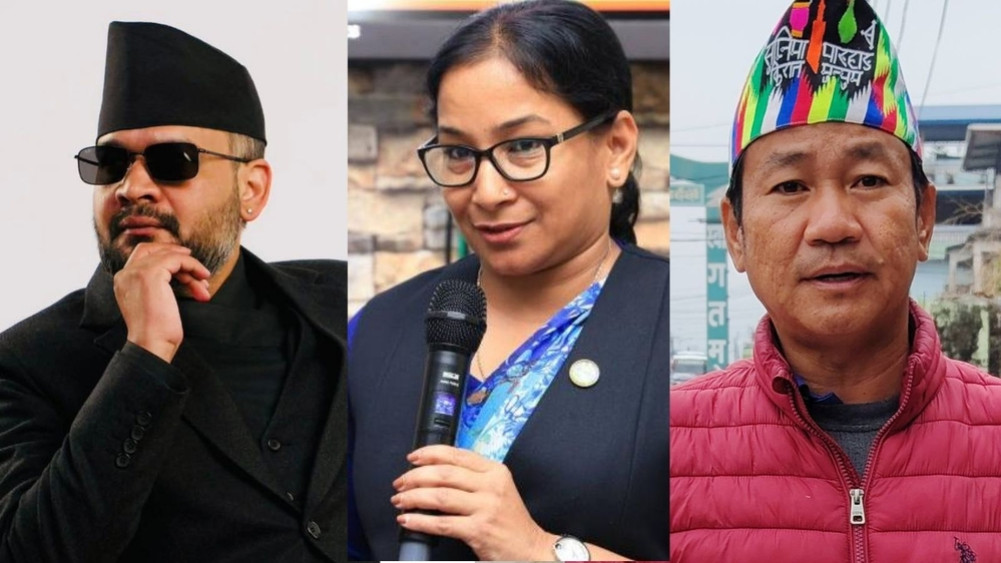
Kathmandu Metropolitan City Mayor Balendra (Balendra) Shah, Bharatpur Metropolitan City Mayor Renu Dahal, and Dharan Sub-Metropolitan City Mayor Hark Sampang have resigned from their posts before the end of their terms. After resigning from the post of mayor before the end of their terms and formally entering party politics, a review of their three-and-a-half-year tenure has begun.
We use Google Cloud Translation Services. Google requires we provide the following disclaimer relating to use of this service:
This service may contain translations powered by Google. Google disclaims all warranties related to the translations, expressed or implied, including any warranties of accuracy, reliability, and any implied warranties of merchantability, fitness for a particular purpose, and noninfringement.
As the atmosphere heats up for the House of Representatives elections to be held on 21 Falgun, mayors from the country's major metropolitan and sub-metropolitan cities have stepped up their electoral activism by resigning. Kathmandu Metropolitan City Mayor Balendra (Balen) Shah, Bharatpur Metropolitan City Mayor Renu Dahal, and Dharan Sub-metropolitan City Mayor Hark Sampang have resigned from their posts before the end of their terms.
After resigning from the post of mayor before the end of their term and formally entering party politics, a review of their three-and-a-half-year tenure has begun.
Balen, Renu and Hark—all three have fulfilled some of the promises they made to the voters, while others are incomplete/insufficient. Kathmandu Metropolitan City Mayor Balen submitted his resignation to Deputy Mayor Sunita Dangol on Sunday. Immediately after resigning, Balen reached the headquarters of the National Independent Party in Banasthali and formalized his entry into the party.
Acting Mayor Sunita Dangol called an executive meeting on Sunday and informed the mayor about Balen's resignation from the post. She also praised Balen's contribution to the development, good governance, urban management and prosperity of the metropolis under his leadership. She also expected to receive continuous advice, suggestions and support from Balen.
Balen, who became the mayor of Kathmandu by running as an independent candidate in the 2079 elections, is rumored to be running from Jhapa-5 in the upcoming House of Representatives elections to be held on 21 Falgun. After the central committee meeting on Sunday, President Rabi Lamichhane and Balen reached Janakpur. Balen was elected as the mayor of Kathmandu Metropolitan City by securing 61,767 votes in the local level member elections held on 30 Baisakh of the same year.
According to the constitutional provisions, the policy and program and budget for the new fiscal year should be brought by Asad 10. However, due to a dispute between Mayor Balen and Chief Administrative Officer Saroj Guragain, Kathmandu was unable to bring the budget for the current fiscal year on time for the first time. The dispute over the expansion of the New Road sidewalk had also led to misunderstandings between Mayor Balen and ward chairmen.
As the tussle with the deputy mayor, chief administrative officer, and ward chairmen increased, Mayor Balen was unable to even hold an executive meeting of the metropolis. Therefore, the metropolis brought the budget that was to be brought by 10 Asad on 29 Asad. The metropolis has spent only 15.81 percent on capital expenditure in the first six months of the current fiscal year. The metropolis, which brought a development budget of Rs 15.5 billion 17 million 19 days late, has so far spent only Rs 2.45 billion 17 million. Even though the work is done, the bills are not brought, so the expenditure is not visible, said Naveen Manandhar, spokesperson of the metropolis.
‘The trend of expenditure up to Pus is similar, a little work is done before Pus but the bills are not received, the expenditure is not visible,’ he said, ‘The bills come after Chait-Baisakh and the expenditure is visible.’ Since Balen became mayor, the capital (development) expenditure of Kathmandu Metropolitan City has not even crossed 50 percent. In the first fiscal year of 2079/80 after becoming mayor, the metropolis spent only 25.91 percent on development. In 2080/81, capital expenditure was 42.31 percent and in 2081/82, the metropolis has stated that only 44.73 percent of development expenditure was spent on capital expenditure.
Balen had made 28-point commitments during the election. One of its points was to arrange a training program for skill, entrepreneurship, sports, music, art and leadership development in community schools one day a week. Accordingly, a Book Free Friday program has been started in community schools within the metropolis every Friday. And, in the academic session 2081, 30,779 students got the opportunity to study on scholarships in schools within the Kathmandu Metropolitan City.
‘After the Metropolitan City made the scholarship system-based, 5,895 students have received girl scholarships, 1,322 Dalit scholarships, and 455 students have received disabled and residential scholarships,’ Balen wrote on social media, ‘19,306 students from grades 1 to 10 and 3,801 students in grades 11 and 12 have received scholarships in institutional (private) schools.’
There is a legal provision that even private schools must transparently select at least 10 percent of the total student population and provide free scholarships. But the Ministry of Education was not able to implement this provision. Kathmandu Metropolitan City has been providing scholarships that Singha Durbar could not provide since 2080.
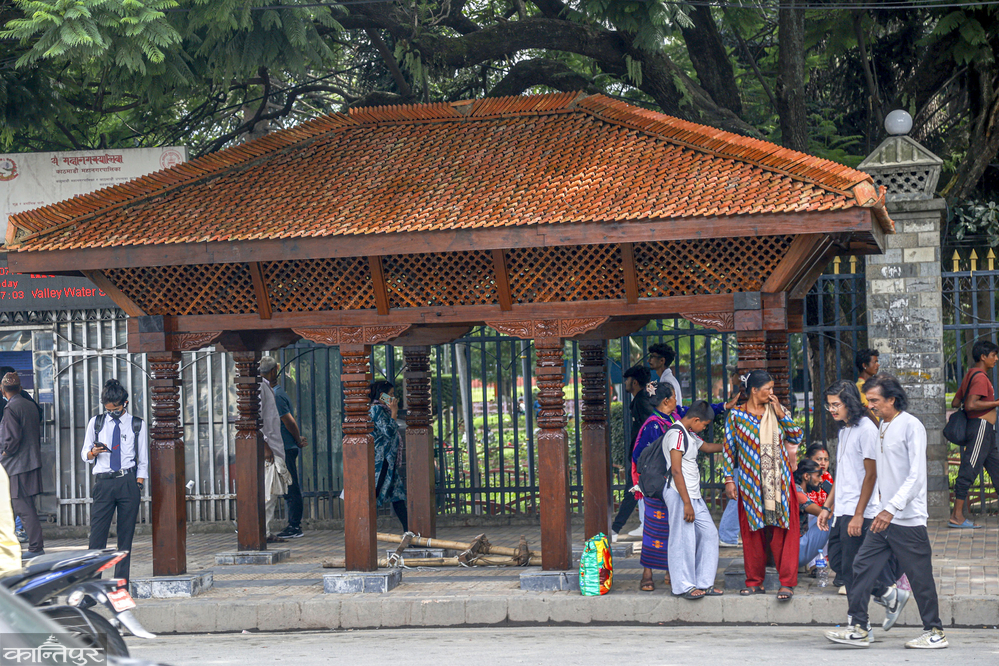
A well-equipped ambulance has been brought into operation under the Health Department. In terms of infrastructure, the Physical Infrastructure Ambulance is maintaining infrastructure such as roads and sewers. However, even though the ambulance is operational, it took months to re-blacktop about 350 meters of Ganesh Marg in Shankhamul. As per the election commitment, falchas (bus stops) are being constructed at bus stops.
The metropolis has intensified the construction and reconstruction of traditional falchas from bus stops to inner city areas. Although the metropolis planned to construct falchas at 50 different places, construction has started at 25 places so far. According to Manandhar, spokesperson of the metropolis, work has been done in education, health and infrastructure in a way that the residents of the metropolis can feel. Balen had also broadcast the executive meeting live as per the commitment. However, despite the promise that branches of the Innovation Center would be brought into operation in the metropolis, it could not be fulfilled.
Balen, during his election campaign, promised to bring public and metropolitan transport under a single umbrella organization and start 100% electric public transport, but there has been zero progress in that. The metropolis has been conducting skill fairs by inviting applications. Ward Chairman of Metropolitan-11 Hiralal Tandukar has commented that Metropolitan Mayor Balen has not done the expected work in three and a half years. ‘Even if work was done within our own ward, we would not know, so there would be obstacles from neighbors and settlements,’ he said, ‘We should have worked in consultation with the relevant ward.’
He says that the work could not be done as per the target because he went it alone without discussing it even in the executive. Balen had promised to collect organic, plastic and glass waste separately. But even though it was started, it was not continued. Balen’s plan to manage waste with high-level technology also remained incomplete. He even had a dispute with the Mayors Forum meeting on the issue of waste management.
Balen had walked out of a meeting held in Lalitpur Metropolitan City on 14 Kartik 2080 under the leadership of Mayors Forum Chairman Chiribabu Maharjan, saying that he was not allowed to speak. The forum had issued a statement on 15 Kartik 2080, calling the statement made by Balen on social media regarding the topic of the meeting, which was to discuss how to manage the waste management of the Kathmandu Valley in a long-term and integrated manner, extremely indecent, unbecoming, regrettable and misleading.
Although 16 meetings have been held so far, Balen has attended only 3 meetings. Balen was absent even from the meeting called by the interim government's Prime Minister Sushila Karki after the Gen-G protests.
Bharatpur Metropolitan City Mayor Renu Dahal is also running for office in the upcoming elections in Falgun. She is preparing to become a candidate from the Nepal Communist Party in Chitwan-3. Coordinator Pushpa Kamal Dahal's daughter Renu is preparing to resign from the post of mayor and run for office. ‘Yesterday, a highway had to be built to travel on blacktop roads. Today, even the roads to your homestead are blacktopped. Yesterday, you had to find out where the blacktop roads were. Today, you have to find out where the blacktop roads are not,’ said Mayor Dahal while inaugurating the administrative building of Bharatpur Metropolitan City last Friday.
Renu claims that 1,072 km of roads have been blacktopped in the Bharatpur area during her tenure. In the first year of her first term as mayor, a total of 96 km of roads were blacktopped. When discussing the main works done by Renu as the mayor of the metropolis, the first thing that comes to the forefront is widening the roads. The 6-kilometer (km) section of the East-West Highway from Narayangadh Pulchowk to Gondrang near Bharatpur Tikauli has been made into 6 lanes, while other internal roads in the metropolis are also wide and almost all are blacktopped.
Renu was elected mayor in the 2074 BS and 2079 BS local elections in coordination with the Nepali Congress. Although he won by a narrow margin in the first election, the margin widened in the second election. In the first election, there was an incident of ballot paper tearing as the counting of votes was being finalized, in which Renu's party was accused of winning by tearing the ballot paper when it was seen that leaders and activists of the then Maoist Center were involved.
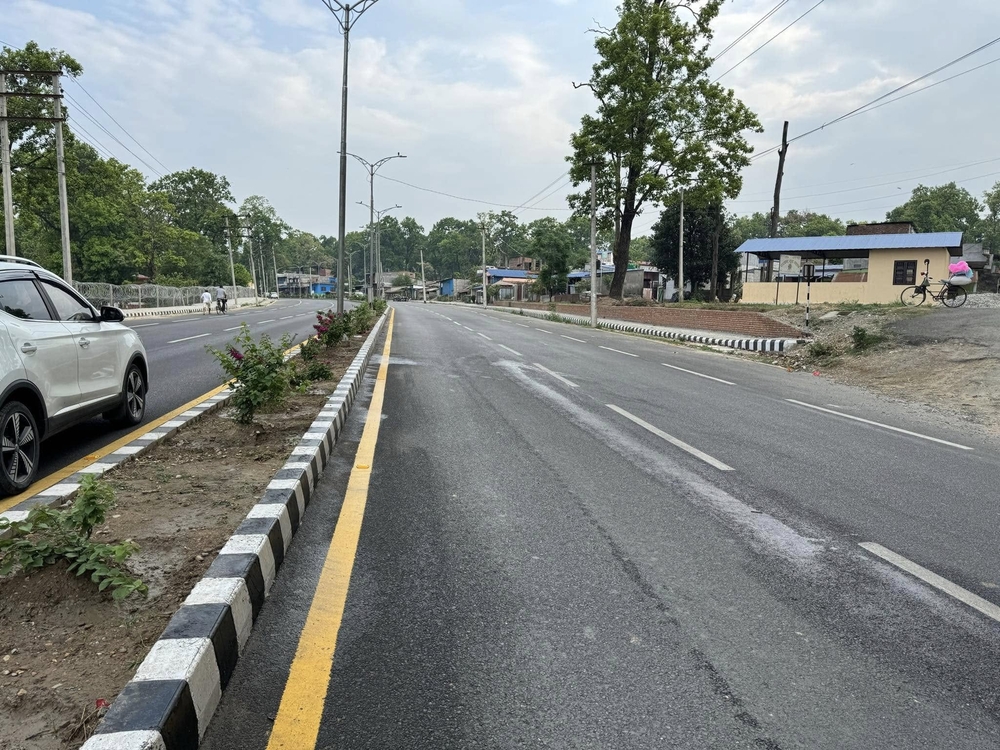
When the first municipal assembly of Bharatpur Metropolitan City was being held on 21 Poush, 2074 BS, Mayor Renu made a commitment in a written speech - 'We will not say what we will not do and will do what we say.' Renu had announced in the first municipal assembly that the construction of an auto land would be started on two bighas and 17 kattas of land in Bharatpur-3, which is in the name of the metropolitan city. But there is still no sign of the auto land being built. Bharatpur Metropolitan City, which generates more than 80 tons of waste per day, does not have a systematic landfill site for waste disposal. This issue has been raised since the first municipal assembly.
In the policy and program presented by Renu in the 17th Municipal Assembly held last Ashar, it was mentioned that a public-private partnership model would be started for the construction of a landfill site. However, it has not been implemented.
The construction of the City Hall and the construction of the Gautam Buddha International Cricket Stadium are the pride projects of Bharatpur Metropolitan City. These projects, which have been in the news since the first Municipal Assembly, have not yet been completed. Renu claims that the construction of the 88-kilometer-long ring road and the embankment of the Narayani River, which have been completed in the metropolis, have provided convenience as well as security to the residents of the metropolis.
'Before the 2074 local elections, Bharatpur was a metropolis in name only, and did not have the minimum infrastructure required to be a metropolis.' In the manifesto issued for the 2079 local elections, it was said that the urban infrastructure of the metropolis would be made in line with Asian standards in the coming year. For which, some ambitious plans were in the manifesto.
The election manifesto mentioned installing 'artificial intelligence' traffic lights at the intersections of Narayangadh and Bharatpur, and constructing flyovers and underpasses at necessary places. It also included issues such as declaring Bharatpur a formal medical city and forming an effective medical board. However, these plans have not been implemented.
Labor Culture Party President and Dharan Sub-metropolitan City Mayor Hark Sampang has also resigned from the post of mayor in preparation for the House of Representatives elections. On Sunday evening, he formally submitted his resignation to Deputy Mayor Aindra Bikram Begha. Hark is preparing to become a candidate from Sunsari Constituency No. 1 in the House of Representatives elections.
Hark Sampang, known as a social activist, was elected as the mayor of Dharan as an independent candidate in the 2079 local level elections. He defeated the candidates of the Nepali Congress and CPN-UML by securing 20,821 votes. This result indicated that people's trust in politics that is different from party politics, alternative thinking and personality-centered politics is increasing in Dharan.
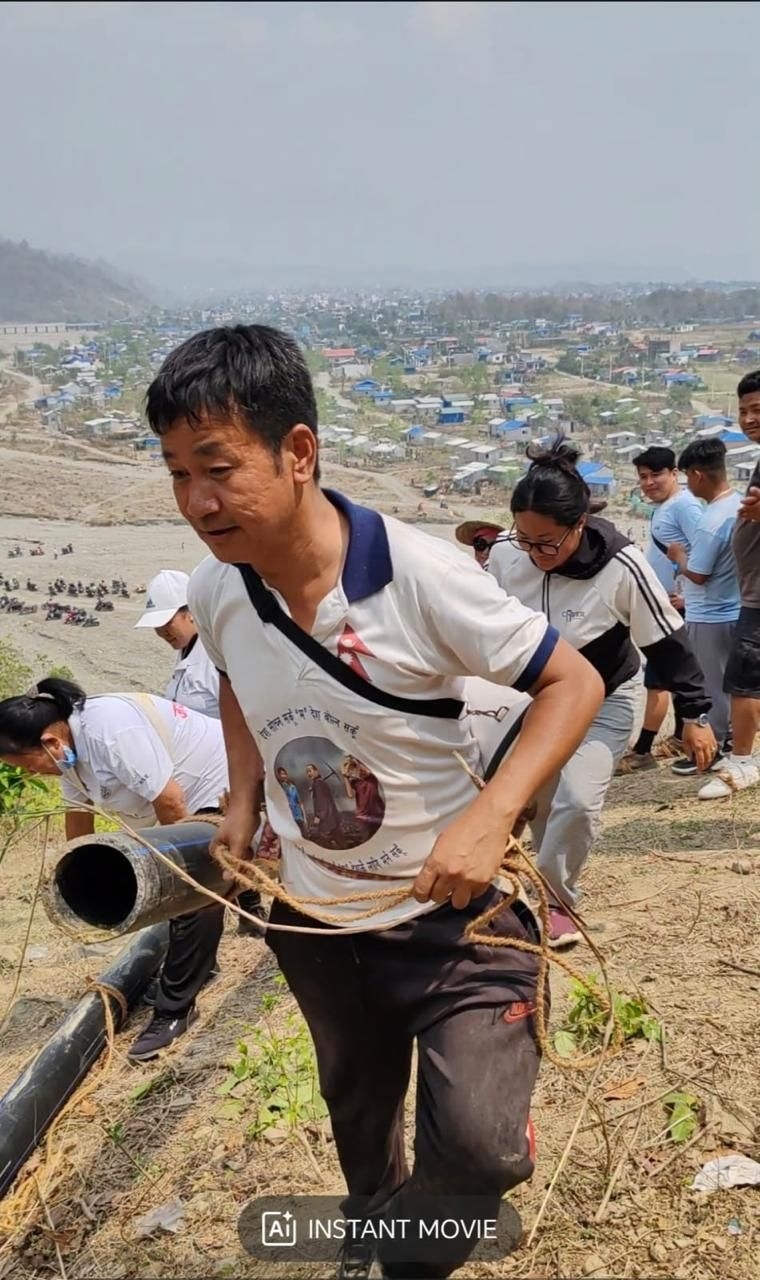
After becoming mayor, Hark made drinking water, health, education and labor culture the mainstay of his tenure by making public 27 agendas. As soon as Hark was elected, he developed labor culture. He opposed the traditional thinking of focusing development on budget and contracts and put forward the concept that citizens should participate in labor themselves. After becoming mayor, Hark himself was seen carrying stones, working in the river embankment, cleaning the sewers and participating in sanitation campaigns.
The most tangible achievement of Hark's tenure was the initiative taken to solve Dharan's long-term drinking water problem. Dharan is a city that has been facing water shortage for decades. Hark initiated a plan to bring water from Pakuwa, Sardu, Seuti, Bhalu and Kokaha rivers. In particular, extending the pipeline from Kokaha 1 and 2 through a 42-kilometer forest road and bringing water to Dharan on the 98th day is considered historic.
According to the Water Management Board, currently about 1.2 million liters of water comes to Dharan from Kokaha daily, while Dharan's daily demand is more than 30 million liters. Although not a complete solution, it has quenched Dharan's long-standing thirst to some extent.
Sanitation and public health have also been a central agenda of HARK. Through regular sanitation campaigns, sewage management and anti-drug campaigns, HARK tried to link health with civic behavior. The 'Say No to Drugs' campaign is considered to have spread awareness among the youth. But there has also been criticism that the expected progress in health infrastructure, hospital management and long-term policy reforms has not been made.
Building a self-reliant economy based on local resources is another agenda of HARK. The 'Maya Dharane' turmeric industry operating in Dharan-20 is a result of this thinking. Turmeric produced by farmers in the agricultural pocket area is processed and brought to the organic product market. The industry produces about 200 kg of turmeric daily and purchases it from farmers at Rs 300 to Rs 320 per kg.
This has provided direct economic benefits to local farmers, women and youth. But not all projects have been successful. The ‘Maya Dharane Laundry Soap Industry’ got embroiled in legal and environmental disputes after it attempted to operate in the Jalakanya Community Forest, which falls under the National Forest Area. The industry has not yet been able to operate due to protests and procedural disputes.
Hark has also been accused of constant disagreements with executive members, ward chairmen and political parties, a single-minded decision-making style and weakening institutional processes. He launched a Shramdan campaign for tourism development and built a Shram Culture Park, which is now emerging as a new tourist destination in Dharan.
The Lahures have also built a Gorkha Park under Hark’s leadership. He had announced that he would stop the increasing monkey terror in the future. But Hark’s plan did not succeed. He had an agenda of improving the health sector and building his own city hospital in Dharan. This agenda could not be fulfilled either.
Hark had sent a letter to the ministry demanding the return of the Chhata Chowk land in the name of BP Koirala Institute of Health Sciences. Although the discussion of building a city hospital started after the insurance dispute, this discussion remained limited to rumors.