Time and again, parties have nominated leaders or relatives who have already become ministers, MPs, or other candidates.
We use Google Cloud Translation Services. Google requires we provide the following disclaimer relating to use of this service:
This service may contain translations powered by Google. Google disclaims all warranties related to the translations, expressed or implied, including any warranties of accuracy, reliability, and any implied warranties of merchantability, fitness for a particular purpose, and noninfringement.
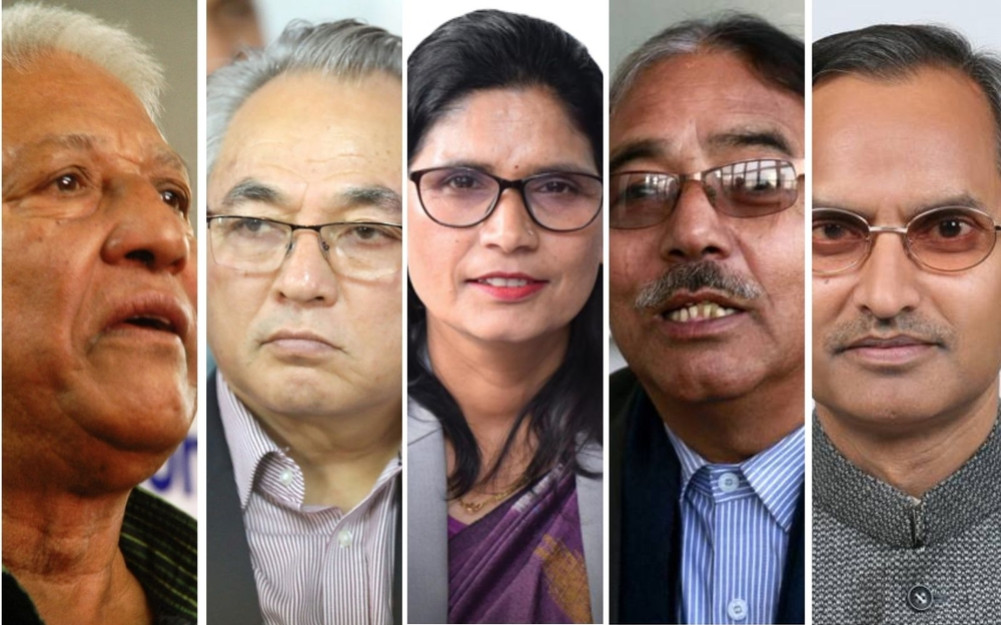
The closed list of proportional representation candidates prepared by major political parties for the House of Representatives elections has once again been dominated by established and influential individuals. Although it is said that this time there will be opportunities for newcomers, the parties have repeatedly nominated ministers, leaders who have already become MPs, and their relatives as candidates for the proportional representation system.
Contrary to the spirit of the proportional electoral system that ensures representation of neglected, oppressed classes, communities and marginalized groups, parties have fielded candidates with access. Although the parties have also put forward some new faces in the proportional system. But they have mostly put access in the forefront.
The Congress has fielded Sanjaya Pokharel Paudel, daughter of President Ram Chandra Poudel, and Dr. Chandra Mohan Yadav, son of former President Ram Baran Yadav, as proportional candidates. Sanjaya is a new face, while Chandra Mohan became a member of the Constituent Assembly in the 2070 election. Chandra Mohan, who contested the by-election to Dhanusha-5, which was vacant after Ram Baran Yadav became President in 2065, was defeated by UML's Raghubir Mahaseth.
Similarly, 78-year-old Arjun Narsingh KC, who has been contesting elections and becoming a minister since the Panchayat period, has been placed at the first number of the Khasa Arya 'cluster'. KC is a leader who has been writing and speaking on the issue of generational change in politics. KC, who was close to the Congress and engaged in student politics, contested the national panchayat elections in 038 BS. After winning the elections, he became a minister of state in Surya Bahadur Thapa's cabinet.
He was defeated in the national panchayat elections in 043 BS. He became the district panchayat president in 045 BS and returned to the Congress after the political changes in 046 BS. He was elected from Nuwakot in the 048 and 051 House of Representatives elections. He became an MP in the 070 Constituent Assembly and 079 House of Representatives elections. He became the Minister of Health in 052 BS, the Minister of Housing and Physical Planning in 057 BS, and the Minister of Urban Development in 070 BS.
KC, who has had repeated opportunities, is being criticized within the Congress for being made a proportional candidate. Leaders and activists are criticizing him for talking about generational change but not leaving it alone. Arjun Narsingh KC's brother Jagadishwar has been recommended for direct elections from Nuwakot-2.
Former ministers Bhimsendas Pradhan and Romi Gauchan Thakali have also been included in the proportional representation. Thakali had nominated his son Yogesh as a candidate in the 2079 election, raising the issue of generational transfer. Yogesh, who won from Mustang at that time, has been recommended for direct elections this time too. Central member Bal Bahadur KC's wife Rina Upreti KC and sister Goma KC are also on the closed list. Both have been recommended from non-establishment camps. Leader Bimalendra Nidhi has nominated his niece Ninu Karna as a proportional representation candidate.
The Congress had made a criterion that no one who was a proportional representation MP from the 2064, 2070, 2074 and 2079 elections would be allowed to repeat this time. That is why, despite the large number of new faces on the closed list, they have access to the front lines.
The Congress has selected candidates by distributing seats proportionally to the provinces based on the number of votes cast in the provinces. Accordingly, 18 candidates have been nominated from Koshi, 21 from Madhesh, 22 from Bagmati, 11 from Gandaki, 17 from Lumbini, 10 from Karnali and 10 from Sudurpaschim.
The criteria of the Congress were to ensure at least one representation from each district. However, not a single candidate from Okhaldhunga, Khotang, Bhojpur, Dhankuta, Chitwan, Kavrepalanchok, Lalitpur, Sindhupalchok, Lamjung, Manang, Myagdi, Pyuthan, Rukum East and Jumla has been included in the closed list. The highest number of candidates have been nominated from Dhanusha and Sunsari (8/8), Kathmandu (6) and Jhapa (5).
UML Vice President Ram Bahadur Thapa, who was the Defense Minister in 2064 and the Home Minister in 2074, is the first proportional candidate in the list of leaders who have had repeated opportunities. UML Vice President Guru Baral has been made the number one candidate in the Khas Arya 'cluster'. He was defeated for the vice president position in the recently concluded 11th general convention of UML.
Former Minister Padma Aryal is the number one candidate in the women's 'cluster'. She won from Syangja-2 in the 2074 election and became the Minister of Health and Land Management. UML has also made Gen-G youth Nita Ghatani a proportional candidate.
UML Election Department Chief Neeraj Acharya said that the closed list of proportional candidates has been submitted to the Election Commission after considering experience and contribution and including youth. "Proportional candidates have been made by combining three generations," he said. However, the group of Vice President Gokarna Bista and Deputy General Secretary Yogesh Bhattarai has expressed dissatisfaction, saying that the establishment party has prepared the closed list 'arbitrarily'. They have expressed dissatisfaction that leaders who have had opportunities in the past have been placed on the proportional list.
....
In the 2079 election, the Congress had placed Prakash Sharan Mahat at the top of the Khas Arya men's list, Arju Rana Deuba on the women's list, and Bimalendra Nidhi on the Madhesi list. Raghuji Pant and Eknath Dhakal were at the top of the Khas Arya from the UML. Hitraj Pandey from the Maoists and Pashupati Shumsher Jabra from the RPP took the opportunity by being elected through proportional.
In the first Constituent Assembly (2064 BS), where proportional representation was provided for the first time, Binod Chaudhary from UML, Diwakar Golchha and Zipchiring Lama from Congress, and Motilal Dugad from Nepal Navnirman Party became proportional representation members. Girija Prasad Koirala, who has been Prime Minister five times, also became a proportional representation member at that time.
In the second Constituent Assembly, Rajya Lakshmi Golchha from UML and Kamal Thapa from RPP Nepal became proportional representation members. In the 2074 BS House of Representatives, businessman Motilal Dugad from UML, Umesh Shrestha, Zipchiring Lama, Divyamani Rajbhandari, Bahadur Singh, Binod Chaudhary and others became proportional representation members from Congress.
Constitutional expert Khimlal Devkota commented that the same trend has been repeated in the list of proportional representation candidates this time as well. ‘Leaders and parties have not been able to bring backward classes, geographies and communities into the mainstream according to our constitution and the distribution of state power,’ he said. ‘Although the proportional list seems to be more advanced than the past, the parties acted arbitrarily.’
Devkota pointed out that the parties have not been able to balance caste, language, culture and geography in the selection of candidates. He said that leaders and parties have misused the proportional election system by putting forward those who have access and have had opportunities in the past. He said that arbitrariness in candidate recommendations will continue until clear criteria for the proportional system are set through an amendment to the constitution. ‘Even after the Gen-G movement, leaders have not improved. There is even a tendency for those with access in professions and businesses to become proportional parliamentarians by paying money. This should be stopped by enacting a binding law,’ he said.
The Supreme Court has issued a directive order to amend the law for the practical implementation of the principle of proportional inclusion. The constitutional bench, comprising five judges including the Chief Justice, has given a lengthy explanation about who should be included in the proportional system, including the definition of the 'Tarmara class'.
Senior advocate Balkrishna Neupane had filed a writ petition in the Supreme Court on 21 Paush 2079, alleging that the House of Representatives was dominated by those who had been repeatedly elected in the name of the proportional electoral system, had become ministers, were relatives of top leaders, and were members of the Tathabatha (Tarmara class). Hearing on 30 Falgun 2080, the bench comprising the then Chief Justice Bishwambhar Prasad Shrestha, Justices Ananda Mohan Bhattarai, Prakash Man Singh Raut, Prakash Kumar Dhungana, and Sushmalata Mathema said that further amendments should be made to the law in accordance with the right to proportional inclusion.
The Supreme Court had said that the law should be amended to end the tendency of Tathabatha to take over state bodies by taking advantage of the policy related to proportional inclusion.
‘Inclusion is meant to prevent elite capture of elected bodies by the leaders of society. However, if the upper layer of the class, who are financially well-off, highly educated, have repeatedly become ministers/MPs, and have high economic and social status, reaches the elected bodies of the state, there is a possibility that the main objective of the Constitution to establish an inclusive state structure will be defeated,’ the order states. ‘Considering the preamble of the Constitution, the provisions related to fundamental rights, the directive principles of the state, and all the provisions made in the Constitution regarding proportional inclusion, it seems desirable to further amend the existing law for the practical implementation of the proportional inclusion principle.’
Stating that the principle of inclusion has been adopted to prevent the tendency of the leaders of society to capture elected bodies, the Supreme Court has again ruled that only the upper layer of the class, who have repeatedly become MPs and ministers, and have high economic and social status, should be elected in the name of inclusion. It was said that it would not be appropriate. The full text of the judgment states, ‘When (such) individuals reach the elected bodies of the state, there is a possibility that the main objective of the constitution to establish an inclusive state structure will be defeated.’
Treasurer Mahato had filed a writ petition in the Supreme Court alleging that the right to equality under Article 18 of the constitution was not implemented and that the lower classes were not getting participation in the proportional system. While hearing it, the Supreme Court had explained that this provision did not exist for the Tarmara class. Before that, in the Ganesh Panjiyar case, the Supreme Court had explained the Tarmara class and said that the reservation that was due to the lower classes was being taken over by those with high status.
Political analyst Tulanarayan Sah says that due to the lack of honesty and impartiality in political parties and their top leaders, those with access have always been elected through the proportional system. "People from communities that never have the status to win elections directly are asked to be included in the proportional representation," he added. "Overall, women, Dalits, indigenous peoples, and Madhesis win fewer elections. They are asked to be given opportunities. But through this loophole, people from distant places, relatives, and those with access have been becoming MPs." He says that people from economically weak, non-highly educated, and backward communities should be included in the proportional representation list by making a clear provision in law.
Political analyst Krishna Pokharel says that the misuse of the proportional representation system that has been going on since the past has continued this time too. "Women, indigenous peoples, backward areas, Dalits, Tharus, and Madhesh should be made MPs through proportional representation," he said. "But parties have been misusing it against political values and norms." He emphasizes that the proportional representation system should include the marginalized and backward classes.

![यी हुन् कांग्रेसका ११० समानुपातिक उम्मेदवार [सूचीसहित]](http://assets-cdn.ekantipur.com/uploads/source/news/kantipur/2025/politics/congress-16102025093400-1000x0.jpg)

