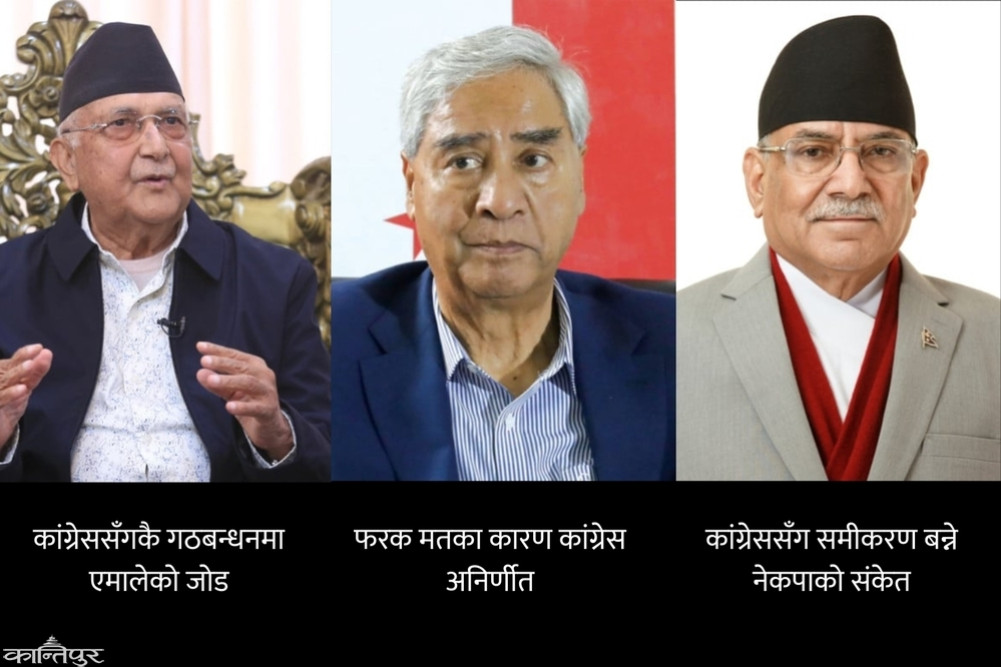
The UML is in constant dialogue with the Congress to enter into an alliance to prevent its influence in the National Assembly from waning.
We use Google Cloud Translation Services. Google requires we provide the following disclaimer relating to use of this service:
This service may contain translations powered by Google. Google disclaims all warranties related to the translations, expressed or implied, including any warranties of accuracy, reliability, and any implied warranties of merchantability, fitness for a particular purpose, and noninfringement.
Discussions have intensified regarding the alliance equation between the three major parties - the Nepali Congress, the UML, and the Nepali Communist Party (NCP) - ahead of the upcoming National Assembly elections on Magh 11.
In particular, the UML has increased its activity, realizing the need for an alliance to protect its numbers. If there is no alliance, there is a risk that the current 10 seats in the UML National Assembly will be reduced to two. 8 members of the UML are leaving since February 20.
The NCP has become the largest party in the current equation of the National Assembly. Earlier, the Maoist Center was the largest party with 17 members, but after the merger with the Unified Socialists, its number has increased to 26 in the 59-member National Assembly. The term of office of 8 members of the UML, 8 members of the NCP, 1/1 member of the Democratic Socialist Party (LSP) and the Janata Samajwadi Party Nepal (JSP, Nepal) and independent MP Bamdev Gautam is about to end.
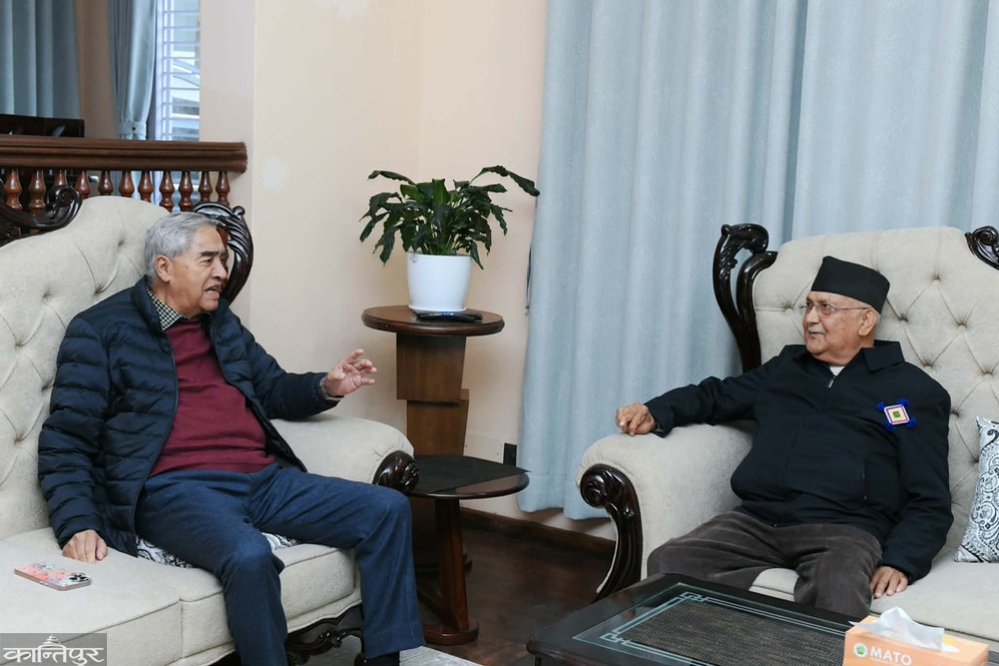
Meanwhile, UML Chairman KP Sharma Oli and Congress President Sher Bahadur Deuba held a discussion on Monday. Oli, who went to Deuba's residence in Maharajgunj with General Secretary Shankar Pokharel, discussed the issue of the National Assembly alliance and the restoration of the House of Representatives. According to Oli's Chief Personal Secretary Rajesh Bajracharya, the two leaders discussed contemporary political issues including the restoration of the National Assembly and the House of Representatives. It has not yet been decided who to form an alliance with, it will be clear in two to four days -
Prakash Sharan Mahat , Congress spokesperson The UML, which had 18 seats including the National Assembly Speaker until two years ago, is now in a weak position. At that time, the UML had lost 8 seats in the competition with the ruling coalition including the Congress and the Maoist Center. In the elections held for 19 members on Magh 11, 2080, the UML had managed to save only one member out of the 9 vacant seats. In the division between the Congress, the then Maoist Center, the Unified Socialist Party and the JSP, the Congress got 10 seats, the Maoists got 6, the CPN (S) got 2 and the JSP got 1 seat. Out of these, the UML won one seat in the Maoist division.
Due to that experience, the UML is insisting on an alliance with the Congress this time. The UML is in continuous dialogue with the Congress to prevent its influence in the National Assembly from waning.
A UML leader said that the foundation of the seven-point agreement reached with the Congress has not yet been broken. ‘The agreement has not been broken on our part. What the Congress decides is its matter,’ the leader said, ‘Our priority is not only the National Assembly elections, but we are also talking about cooperating on subsequent political issues.’
The Congress has not yet reached a clear decision on who to form an alliance with. According to Congress spokesperson Prakash Sharan Mahat, parallel discussions are underway with both the UML and the NCP. ‘Discussions are underway with leaders of both parties.’ But it has not been decided yet who to form an alliance with,’ he said, ‘It will be clear in two to four days.’
We have not reached the stage of making a decision, we will meet with the Congress in a few days and discuss it -
Narayan Kaji Shrestha , NCP leader Opinions seem divided within the Congress too. One side is emphasizing the need to continue cooperation with the UML, while the other side has been arguing that cooperation with the NCP will bring stability at both the parliament and government levels. Coordinator Pushpa Kamal Dahal has been interpreting the recent example of cooperation between the Congress and the NCP in the Madhesh Province government as a sign that a Congress-NCP equation could be formed in the National Assembly as well.
NCP leader Narayan Kaji Shrestha said that discussions are underway with the Congress to form an alliance in the National Assembly. A week ago, Dahal met Congress President Deuba and discussed the cooperation between the Madhesh government and the National Assembly. ‘We are in continuous discussions, but we have not reached a point where a decision can be made,’ Shrestha said, ‘We will meet with the Congress in a few days and discuss it.’
In the National Assembly election, the provincial assembly members of the respective provinces and the local level chiefs, deputy chiefs, chairmen and vice-chairmen of the same province are voters.
The vote weight of provincial assembly members is 53 and that of local level chiefs and deputy chiefs is 19. Of the three major parties, the result is almost certain to be in favor of whichever two parties form an alliance with. Therefore, this election has become a battle for UML to save its existence. The Congress, on the other hand, seems to be trying to secure its political gains by keeping both options open. Congress leaders say that Congress is sure to get at least 10 seats even if it joins with UML or NCP.
Two years ago, Congress won all 10 seats in its alliance with Maoists, NCP-S, JSP-Nepal and LSP. Congress now has 16 seats. This time, there are no members whose terms have expired from Congress. If there is an alliance, Congress is likely to be the largest party in the National Assembly after Falgun 20.
The foundation of the seven-point agreement reached with Congress has not yet been broken - UML leader
NCP has been saying that the same share-sharing agreement from two years ago can be used as a basis. Congress leaders understand that UML has also indicated that it is ready to give at least 10 seats to Congress. ‘There was internal and external pressure on the Congress to break off cooperation with the UML during the then government, and now it seems that there will be pressure again on whether to join the UML or not,’ says a Congress leader. ‘On the one hand, making a major party like the UML ineffective in the National Assembly may have an impact on the political imbalance in the future, on the other hand, it is not easy for the Congress to join the UML.’ UML Chairman Oli has only spoken to Congress President Deuba about the alliance. CPN leaders are also holding discussions with Deuba and acting President Purna Bahadur Khadka. According to an official close to Deuba, there has been no rift between UML Chairman Oli and Congress President Deuba even in the days after the Gen-G movement. On the contrary, Deuba is seen in close relations with Oli.
Another Congress official said that the agenda of restoring the House of Representatives was carried out as per the advice of Deuba and Oli. Oli has given Deuba the impression that the UML wants to repay the 'mercy' of making him the Prime Minister by restoring the House of Representatives. Deuba also seems confident in it.
Even though the Congress Central Working Committee meeting decided to go for elections, the Congress has reached the court to file a writ petition on the issue of restoring the House of Representatives after the dialogue with Oli.
UML reaches the Supreme Court with a writ petition against the dissolution of the House of Representatives
Congress is also preparing to file a separate supplementary petition in the Supreme Court against the dissolution of the House of Representatives.
UML’s then Chief Whip Mahesh Bartaula said that since the writ petition was filed based on the institutional decision of the then parliamentary party, there is no need to keep everyone’s signatures. "In case the court wants to identify us later, we will appear at any time with the signatures of our 75 MPs. Now, since the writ has been filed based on an institutional decision, the majority will automatically be reached after the Congress files a supplementary petition," he said.
Members whose terms in the National Assembly are expiring
UML: