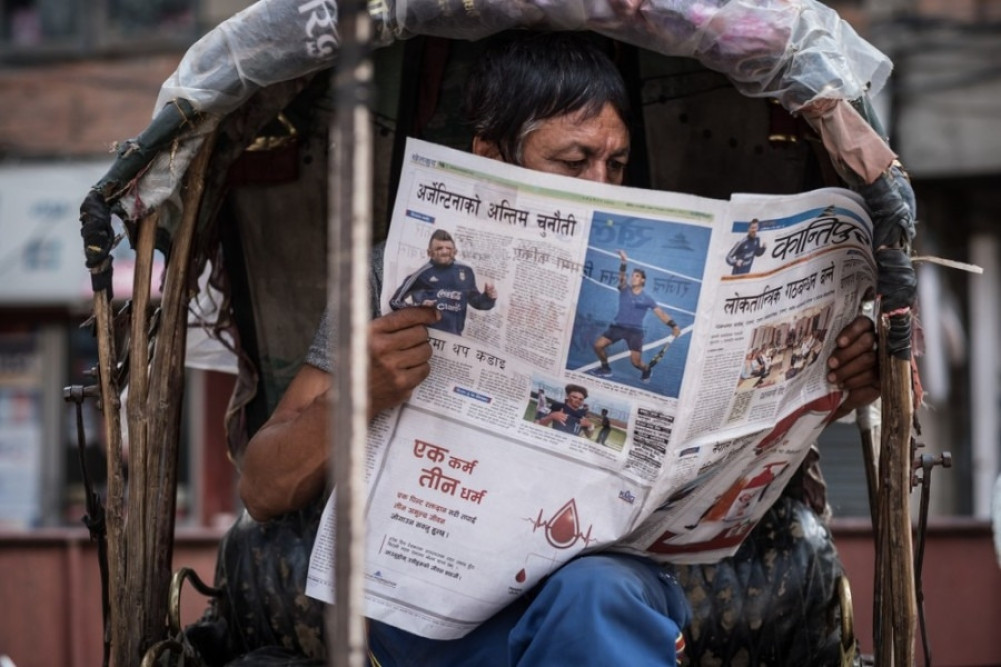
The power of the media is important in society. It is the duty and dharma of the media to raise its voice against social injustice by disseminating truthful information, which helps strengthen democracy.
We use Google Cloud Translation Services. Google requires we provide the following disclaimer relating to use of this service:
This service may contain translations powered by Google. Google disclaims all warranties related to the translations, expressed or implied, including any warranties of accuracy, reliability, and any implied warranties of merchantability, fitness for a particular purpose, and noninfringement.
Like the country's political, constitutional, industrial and social structures, the media sector also needs a deep review, introspection and reform. The flood of 'misinformation' and 'disinformation' makes the sensitive role of credible, responsible and accountable journalism all the more necessary.
In this context, Kantipur has started a debate series to give special place to criticism, critique, review, and suggestions. We are waiting for the participation of stakeholders and experts in an objective and responsible debate.
It was almost two decades ago. At that time, some Nepali media were reluctant to use the word 'democracy'. The movement of political parties against the direct rule of the king was going on for the establishment of 'full democracy'. Some media had already used the word 'democracy' instead of 'democracy'.
In a live radio interview, I had to have another debate with the head of that media organization after I used 'democracy' instead of 'democracy'. After a few moments of blundering about the use of the word ‘democracy’, he said that he had no objection to the word, but reflecting a strategy to protect his business, ‘I know, you are doing your journalism but never forget I am doing my business.’ (I know, you are doing journalism but never forget I am doing my business).
After this sentence of the entrepreneur, my immediate debate ended, but the debate in my mind continues to this day. That media entrepreneur had succeeded in obtaining a television satellite broadcasting license before other media organizations at that time. In other words, investment in the media is not selfless. The number and size of investment in media in Nepal is not small. However, the presence of the media is weakening.
In this ‘Media Debate’ series of ‘Kantipur’, an attempt has been made to take a general look at investment in the media, a society dominated by populism, and the dimensional changes seen in the world of journalism in the era of technological transformation.
The power of the media is important in society. It is the duty and duty of the media to raise their voices against social injustice by disseminating truthful information, which helps strengthen democracy. The media is an effective medium for providing information, raising public awareness, monitoring government and non-government activities, and conveying the voice of the grassroots to the government. However, due to various aspects of controlling the media, there has been a deviation in the practice of journalism. In addition, trust in the media is shrinking. The theoretical ideal of journalism is on one side, but the practice is on the other. The rapid technological transformation is creating ambiguity in journalism, crises are escalating, and various forms of media control are emerging.
There are many forms of control over the media (media capture). According to Binod Bhattarai, who has done his doctoral research on this topic, control over the media is expressed in four broad forms. There are practices of bias in content selection, unprofessional/unethical practices, controlling advertising and information sources to influence journalism itself, and politically biased (political cliché) to capture the opinion-forming process (Bhattarai, 2025).
When selecting content with bias, there are acts such as bargaining to stop news, turning a blind eye instead of monitoring, hiding news of corruption, and protecting certain groups. Unprofessional and unethical practices include the practice of spreading fabricated content without verifying information or covert journalism, in which leaders, businessmen, or other vested interests are active. All acts of middlemen, bargaining, and bargaining under the guise of journalism are unethical. From these aspects, there is no place for Nepali media to be safe from criticism.
Investment in the media sector
In Nepal, investment has been made in the media by the government and the private sector. There is government investment in all forms of media and these media are relatively institutionalized. It is their duty to support the policies and programs of the ruling party. They are limited to the government's propaganda machine, which cannot be critical journalism.
Journalism practice remained guided by the authoritarian political system of the Rana and Panchayat periods. During the establishment and restoration of democracy in 2007 and 2046 BS, the private sector media advocated for democratic governance. Until then, private sector investment was limited to the print media only. When the country adopted an economic liberalization policy after 2046 BS, the door was opened for private sector investment in the broadcast media.
After the policy reforms with the introduction of liberal new democratic practices, the private sector started investing in the print media, radio (since 2054) and television (since 2058). As technology took a leap, the private sector took the lead in investing by introducing online technology. After the volume of private sector investment increased dramatically, professionalism is believed to have increased in the Nepali media in the 2050s. Previously accustomed to the charm and content of government media, the Nepali 'audience' has found different tastes, diversity, and editorial stances in news, ideas, and other content produced by the private sector.
As the number of media organizations increased after private sector investment, the institutional form could not develop in that proportion. Because businessmen, politicians, and other interest groups from various backgrounds invested directly or indirectly in the media. In the absence of transparent investment, regulation also became weak. The economy that has weakened with the earthquake and the Corona pandemic has made the media world even weaker. There has been financial pressure on the media to monitor every sector. In the absence of a reliable business model, corporate influence in the media has increased. The media sector has not been able to remain independent and its credibility has been shrinking.
According to the records of our government agencies, which uphold the constitutional provision that registration cannot be revoked, the number of registered print media is 8,040, while according to the annual report of the 'Press Council Nepal', which keeps publication records, out of the 4,941 in publication, the number of dailies is 754 and the number of regular publications is only 182. The number of FM radios is 1,204, while the number of televisions with broadcasting licenses is 249. More than 5,000 online media are registered. The number of media is large, but the impact on society is limited.
As the influence of social media expands, the number of 'content creators' has increased equally. The 'audience' has reached a point where it is unable to distinguish between content produced by completing the journalistic process and content produced independently by utilizing technology. The number of people who consider content producers on YouTube or other networks to be journalists is also increasing. Here, it is necessary to further broaden the aspect of media literacy. Otherwise, the spread of false or toxic information will spread.
Many media organizations have opened in Nepal due to the public welfare advertising facilities and other concessions provided by the state to the media. The media that falls under the small investment self-employed category are legally alive only to receive concessions. Their impact and expansion are minimal. For example, before the introduction of mobile phone services in Nepal, newspapers and journalists used to get two telephone lines (for phone and fax) under the concession.
The fax line business of newspapers was very flourishing at that time. Knowing about such concessions, even employees of the Information Department at that time used to register newspapers in the names of relatives and enjoy this facility. After federalism, local governments have also been able to provide concessional support to the media, where newspaper journalism has flourished. Journalists working in mofussils have called it mayorship or deputy mayorship.
Investment in content production
With the large number of media, there should have been a wide variety in media content. There is a need for innovation and creativity in the content of all types of media. Newsrooms are run by limited manpower. Most radio stations have only presenters, no reporting manpower. The networking of content produced in Kathmandu is extensive. Radio stations have shrunk to relay or repeater stations. Television newsrooms are shrinking. News bulletins are filled with news agency content. There is no creativity in producing opinion content. Content based on interviews dominates. Dramas and documentaries, which are considered creative and imaginative, have stopped being produced. In the sluggish economy after the earthquake and the Covid pandemic, the publication of magazines and weekly newspapers has almost stopped, and daily newspapers that used to run regularly have shrunk to a few pages. As the so-called large newsrooms are shrinking due to the impact of Covid, some of the editors who left have started producing YouTube content. With the pressure of time and technology, all media have now joined digital platforms.
If quality content cannot be delivered, the audience cannot be held back. Because there are many alternative content options available on digital platforms, audiences have reached a subscription model by following the content of their interest. In this regard, traditional media has now reached a state of stagnation. It is imperative to increase the amount of investment to produce quality content. Media entrepreneurs, who are struggling to save their organizations, must now find a business model for the medium. We can learn from the practice of models such as premium content and crowdfunding used by some news portals. Lessons can also be learned from the service journalism and subscription models used in foreign countries. Content is the mainstay in the media industry, only then can business expand.
Media merger
To escape from the stagnation, it seems appropriate to engage in media mergers, where investments can be integrated to produce quality media content. Media merger policies can be encouraged by combining ideological, genre or geographical equations.
Now that the number of media outlets is large, the number of media workers is also large. Looking at the number of journalists affiliated to party-based organizations, more than 20,000 are active. After the purge, the number of journalists affiliated to the Federation of Nepali Journalists has come down to around 9,000. There are also journalists who are not affiliated anywhere. Journalist organizations have been established in various fields and genders such as education, finance, tourism, sports. It is estimated that there are more than 100 such organizations. They must have some knowledge and skills of the journalism process. The next option for the institutional development of the media sector may be media merger. Along with media merger, it is necessary to train and orient and empower the old manpower for journalism in the digital space. Otherwise, there will be a risk that this size and number of manpower may be involved in some distorted practice of 'media capture'.
Changing style in content production
Journalism targeting the general public is now outdated. The practice of producing content for the target group by capturing the subject, genre and interest has become widespread. Informal content styles like podcasting, blogging, and vlogging have become the audience's favorite. New styles have been added to content production.
Storytelling, persona creation, building contributions, and multimedia content production and consumption in interactive formats are increasing. In addition, data-driven (data visualization, interactive maps, infographics, etc.) and frequency analysis journalism have added a new dimension. There is a huge shortage of manpower in Nepal for content production of changing styles. Universities and educational institutions should also pay attention to producing manpower according to market demand.
The impact of social media
In foreign countries, branded digital space journalism is in use. Audiences browse the website of their choice or receive information through apps. However, in the case of Nepal, audiences are mostly informed through content shared on social media accounts rather than going to the official web space. The browsing culture of Nepali audiences is different from that of other countries due to the lack of branding or institutionalization. Our media does not have the ability to put video content on their own web space. Most of them embed audio or video uploaded to free space and put it on their sites. That is, we have created content for the organization that provides free space. For example, if YouTube videos earn a large portion, YouTube's parent organization Google earns a large portion. The same is true for other platforms such as Meta or TikTok. In addition, such networks are creating the side effects of algorithmic bias.
Social media users can create and broadcast content. Toxic speech and expression have flooded social media on one hand, while society is becoming polarized on the other. The number of hate speech and crimes has increased. Criticism of legacy media sources on social media has eroded credibility. Negative commenters naturally remain active. Critical commenters are chased away and do not like to respond. Therefore, negative sentiment is spread more. This aspect has become helpful for social polarization.
Content creators/publishers on social media have surpassed institutional media in reporting on event-based activities. Such content that comes without gatekeeping processes raises questions about the accuracy of the content.
Why has the information and ideas that come through institutional media, processed under the editors, not been able to attract attention? Because the content presented by legacy media has not reached the audience that has moved to digital platforms. Due to the convenience of smartphones and the internet, audiences have moved to digital platforms.
The nature of news consumption has changed. Instead of reading detailed news or opinions, people are limited to news, headlines, newsfeeds, summaries, shares or suggested content. Aggregator apps have started selecting content according to personal interests. Audiences are falling into ‘echo chambers’ and ‘filter bubbles’. Another risk is from influencers. They have started creating information and ideas. The number of hate crimes is increasing from influencers. The way to avoid it now is to be ‘high-tech people, low-tech identity’.
Populism dominates
Populism is now dominating the world. When the media becomes weak or inflexible, populism dominates politics. Populist politics gains traction after the creation of commentary based on emotional truth (post-truth) and alternative facts rather than objective truth. The religion of the media that should be monitored is overshadowed by economic pressure and temptation, or even by remaining silent, populists still get support.
Conclusion
In Nepal, the number of all types of media is large even with a population of nearly three crore. In a liberal system, there is no need to object to having a large number. However, the inability to produce quality content is a matter of concern. The lack of diversity is also due to the fact that the business model of all media is the same. If the government were to stop the public welfare subsidies, it can be assumed that the number of media outlets in Nepal would be easily controlled.
Government subsidies are an obstacle to creating a competitive environment. To reduce the flow of false information, it has become imperative to take the lead in media literacy and fact-checking. To preserve the theoretical credibility of journalism, it is necessary to broaden the practice of investigative journalism. This work is possible through mainstream or legacy media. Otherwise, cheaply produced content will further affect a polarized society.