If the state remains in the possession of a centralized and limited group and the participation of other groups within the nation is not based on justice and inclusiveness, then there will be no harmony between the state and the nation and the country will become unstable and weak.
We use Google Cloud Translation Services. Google requires we provide the following disclaimer relating to use of this service:
This service may contain translations powered by Google. Google disclaims all warranties related to the translations, expressed or implied, including any warranties of accuracy, reliability, and any implied warranties of merchantability, fitness for a particular purpose, and noninfringement.
I read the articles published in various publications including Kantipur with interest. At the same time, in some articles, what will be the consciousness of those who imagine the monarchy even in today's age? Concern was also expressed about the line 'such non-conscious'. Concerns and questions were also raised as to what is the source of consciousness of such 'unconscious' people who cannot understand even simple facts. Reading this reminded me of the Canadian Parliament.
Canada's head of state is King Charles of Great Britain. As the head of state of a country with a monarchy, it was his duty to address the sitting monarch when opening the parliament. Charles addresses Parliament and says the true North is strong and independent. He sent a direct message to the US not to attack Canada. It was clear that Charles's address was to convey the message that Canada has an independent existence and is different from America.
I thought why in a developed, strong and democratic country like Canada, why have a king as the head of state? What will be the consciousness of these Canadians. For a moment, I thought that the thinking of these Canadians is not an example of intellectual poverty and backwardness? Yet why do the children of our country's pioneers and many intellectuals bother to migrate? But Canada is a successful and strong democratic country in the world, whose head of state is the king.
Likewise, many countries in Northern Europe have constitutional and figurative monarchies and their foundations are strong, of course for some reason. Is the existence of a monarchy in a successful democratic country in Europe a lack of awareness? In the environment of this reality, the monarchy within the constitution can be a useful institution for Nepal in the current disturbed national situation and international environment for the stability, development and unity of Nepal. The question is worth considering.
About 50 years ago, Samuel Huntington, an influential professor of political science at Howard University, made a prediction in his book 'Political Order in Changing Societies'. He said that the monarchies that were frozen in Europe in the nineteenth century will not last. It is institutionally difficult for the monarchy to manage the energy of declining public consciousness and that energy. So it is in crisis. But the monarchy remains useful in that society, where the monarchy is transformed into a monarchy and remains as a figurative monarchy of national unity by accepting the sovereignty of the people and the supremacy of the people.
If this transformation can be done, the monarchy will be useful for the nation as an institution that maintains stability, psychological security, economic cost and the identity of the nation. Looking at this, it is not a lack of consciousness to say that a monarchy within the concept of people's supremacy is useful to strengthen the identity and existence of Nepal in the current geopolitical situation of Nepal, it is a commitment to the expression of nationalism and the stability of democracy. Our conscious class still ignores the concept and distance of monarchical and monarchical system.
Understanding this concept, Edmund Work, a leading British thinker, opposed the French Revolution in the 18th century. The gist of his argument was that instead of climbing down the ladder and reaching the bottom, accidents occur by jumping out of the window. However, after the end of Napoleon, a new series of anarchy began and the monarchy was restored in France. But Work's logic worked in Britain, and the monarchy and British democracy developed complementary to each other. Suffrage was gradually broadened, new beginnings were made in the field of social justice, and the country was developing into a leading world power. The monarchy was transformed as a symbol of this new power.
The process of nation-building
The form we have in Nepal today, since its inception, the monarchy and then the monarchy have been connected. Nepal was built by Prithvi Narayan Shah. The campaign of unification undertaken by the king of a small Gorkha state will, indeed, always be remembered both from a military and an ideological point of view. In that era I remember three warriors and nation builders. They are Prithvi Narayan Shah, Napoleon and George Washington.
In the era of industrial revolution and ideological consciousness and as a great nation, the influence of Napoleon and Washington was extensive and had a far-reaching impact on the world stage. However, both these leaders also acted against their ideals. Napoleon, the hero of the revolution against the extremism of the French emperor, eventually became the emperor by wearing sripech himself, while Washington, the warrior with the ideal of human equality, kept hundreds of black people as slaves in his house. Prithvinarayan was a tough warrior. He did not make his brothers the kings of any place because Nepal cannot be a country of anyone's share, while even Napoleon, who came at that time under the guise of revolution, made his family members kings.
Prithvi Narayan was a person who believed that British expansionism should be resisted. At present, the Sindhuligarhi museum, which the army has proudly built in Sindhuligarhi, makes this clear. But his country was small, had no industrial technology, and scientific methods of thought had not spread outside Europe. In other words, the technology had not been theorized. For example, the five-story temple in Bhaktapur is a proud and unique achievement of Nepalese in terms of construction science and architecture.
Silpi who made it had imagination and experience in construction. However, there was no classical knowledge. This knowledge was not communal and organized. Perhaps the original was confined to Silpi's mind. But for anyone to learn this knowledge in a procedural and organized manner, theorization of knowledge becomes mandatory. The structure of knowledge had not reached this level at the time of Prithvinarayana. However, the overall form of the collection of expressions expressed by Prithvi Narayan appears as a clear blueprint in the theoretical structure of nation building.
Prithvipath
To understand and overcome the state of unrest, chaos and despair in the country today, Prithvi's statement can be analyzed in 6 points. But before that one should be clear about the difference between state and nation. Because the era of Prithvi Narayan was an era of ideological revolution during the state-nation building in Europe. Basically, a state is a governing structure, while a nation is a structure of participation among different groups living within a state.
If the state remains in the possession of a centralized and limited group and the participation of other groups within the nation is not based on justice and inclusiveness, then there will be no harmony between the state and the nation and the country will become unstable and weak. This thinking that is developing in the twentieth and twenty-first century is evident in Prithvi Narayan's thought (sermon) on how to build Nepal and how to save the country. This is his great gift. This is Prithvipath.
In short, there are the following points in Prithvipath:
(1) Basically, state and nation are different. If there is no harmony between states and nations, the country will be in crisis.
(2) In order to maintain a strong and sovereign nation, the distance between states should be removed.
(3) Prithvi Narayan Shah's sermons are a strategy to remove the distance between states and nations and is a path.
(4) Theoretically there are 6 important parts of Prithvipath.
According to the approach based on the teachings of Prithvi Narayan Shah, the main objective of Prithvipath is to minimize the distance between the state and the nation. Countries in which the distance between the state and the nation decreases, the country remains strong and powerful.
Prithvipath has envisioned 6 different elements to reduce the distance between the state and the nation. They are: (1) Political Structure, (2) Finance and Trade Strategy, (3) Good Governance, (4) Foreign Affairs, (5) Cultural Integration and (6) Security. These 6 elements are interconnected. No single element can build a powerful state by itself. The goal of building a strong and prosperous state can only be achieved through the coordinated efforts of all elements.
For example, the country cannot be strong by saying that the constitution is excellent. How does the influence of political structure relate to other factors? That becomes important. That is, if the value of gossiping about people-oriented politics but making corruption a political way of life is developed, it will have a negative effect on other elements as well, and ultimately the distance between the state and the nation will increase and the existence of the country will be in crisis.
There are various other components associated with the six main elements of building a strong and prosperous state-nation. For example, Prithvi Narayan's view that the leadership should be entrusted after understanding the will of the people in politics is clear in the decision of Prithvi Narayan that he had his wish for Viraj Bakhti but because of the will of the people Kalu Pandey was put forward. But this aspect alone is not enough to be strong. Economics also had to connect with the people.
Otherwise, the argument that politics is people-centered does not reduce the distance between the state and the nation in the country. Instead, it increases the disturbance. In this way, the emphasis of the special sayings of the earth has presented a blueprint for removing the distance between the state and the nation by building a modern strong-prosperous and united nation. It is now necessary to be freed from the consciousness of ignoring this reality and only jumping on foreign slogans, seeing nothing in the thoughts connected with our history.
Current reality
Now let's look at today's reality. It seems that various leaders and analysts who have reached a very high level of consciousness are happy to divide Nepal's development journey into two parts, the dark age and the bright age. Looking at the history of the past, if there had been cooperation between BP Koirala and Shri 5 Mahendra instead of power struggle, the situation of the country would probably have been very different from what it is today. Democracy came to Nepal in 2007 and it was heavily influenced by the anti-colonialism of the 20th century and the quiet anti-foreign revolution in India.
When the Jahanian regime was overthrown in 2007, Nepal was very behind. 93 percent of the people in the country were dependent on agriculture. Only 50,000 hectares across the country had irrigation facilities. Land ownership was feudal. There were 50 doctors across the country. There were 649 hospital beds. There was a telephone system of 335 lines. There were a total of 8,505 students in the primary school. Originally a college. No one knew what chemical fertilizers were. Nepal was far behind in terms of foundation stone construction.
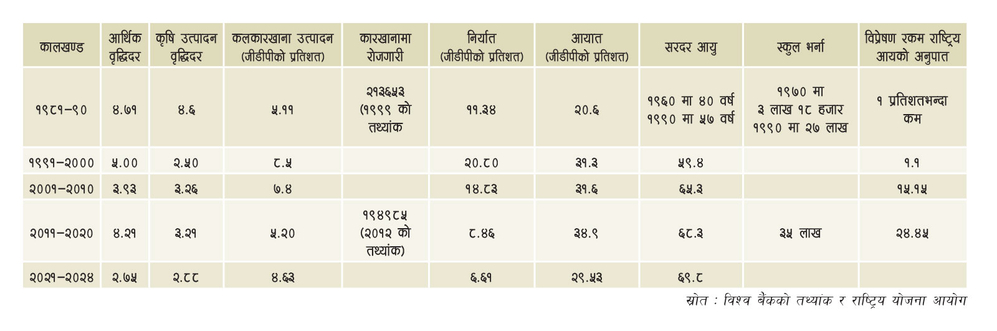
The bedrock of economic development reached almost zero in 2007 while land ownership remained feudal. The slogan that after 2046 the country is taking a leap in terms of development is untrue. From the point of view of development, the annual growth rate was 4.79 percent from 1981-1990, but since 2000, it has decreased and the gap is limited to 4 percent. While China has made unprecedented progress in these 20 years. Every year Salakhala has increased the economy by 10 percent. In India and Bangladesh, national production has increased by 6 to 7 percent.
In Nepal, the livelihood of most people is the plight of the agricultural sector. In the 1980s, annual agricultural output growth was 4.6 percent. But from 1990 to 2000 under the grip of neoliberalism, the annual growth rate of agriculture fell from 4.6 percent to 2.6 percent. Even now it is limited to around 3 percent. If the country's economic development and employment are to be supported, the annual growth of the agricultural sector must be at least 4.5 percent.
Similarly, industrial development has been completely destroyed in Nepal. At present the growth rate of industrial development is decreasing every year instead of increasing. An economy without industrial development today is sterile and dependent. That's why every year millions of Nepalis are leaving the country under compulsion. In 1991, 213,000 Nepalis worked in factories, but in 2012, instead of increasing, it decreased to 194,000.
Nepal has gone ahead in the social field, but gossiping that this is a post-2046 origin is another dishonesty. There were 398,000 students in primary schools in 1970. In 1990, this number increased to 27 lakh 79 thousand and currently stands at 35 lakh. Certainly, from 1960 to 1990, there was a huge effort in primary education. Similarly, the average life expectancy of Nepalis was 40 years in 1960. By 1990, it had increased to 57 years, an increase of 17 years. He turned 68 in 2020. Before 2046, the average life expectancy may have increased by 17 years in 30 years due to expansion in primary health care. It may not have been blessed by God himself.
Holistic thinking
Where are we today compared to yesterday? Certainly political change has taken place in the country. The supremacy of the people has been established and in this process we have set a record for changing the constitution repeatedly. But, does the speed and structure of today's economy remove the distance between the state and the nation? Let's look at the reality. Like an old bamboo, the economy of Nepal has started to grow old before being young. Agriculture and industry have collapsed. This data shows. In the 19th century, tens of millions of young people have been forced to leave the country in the name of Viti's visa, in a state of hunger and poverty.
100,000 young students who have passed class 12 have taken one billion foreign currency from the state and gone abroad every year. Most of them will not return to Nepal. The government is oblivious to this. He is busy looting the whole nation by sending the youth abroad and killing the money coming from there. But it has also exceeded its limits. Due to the activities of the ruling class, which is addicted to corruption and looting, the income has not increased, while the debt burden is continuously increasing.
Now the question comes, why crisis and depression in a country with the best republican constitution in the world? Now it is important to find the answer. Basically, structural exploitation and economic crimes are crossing the border under the guise of democracy and in the name of the people. Nepal is famous in the world for economic crimes and corrupt leadership. There is no guarantee that elections held every five years in any country will advance development-oriented politics. There is no dearth of examples where the very structure of democracy has been used by the fake democrats in power to destroy democracy and loot the country. Just look at Bangladesh and Sri Lanka.
It is clear how the exploitation of the people in the name of democracy was used for some privileged class. Many scholars have pointed out the fact that even if the system has lost its democratic mantle, political structural exploitation can continue in any country. The reality of this exploitation in the historical context was effectively presented by Marx. Other non-leftist sociological thinkers have also shown how social structure and its functioning create tension and conflict in society.
In the context of Nepal, the strife and tension that has flourished within the current political and governmental structure under the guise of democracy is pushing the country towards a destructive rather than a creative state. In fact, today there are a handful of people who want to make the country a failed nation. They are the people corrupt in the name of politics and their weapons the middle class. In this reality environment, the struggle between the forces of national integration and polarization in the country's economic politics is appearing as the smoke before the fire.
Empty slogans no longer work to manage this crisis. In a country where the rulers of the government don't hesitate to make money by selling their citizens, giving slogans of democracy, or are ready to exploit the state for the interests of middlemen, is it not wise to use useful institutions that have traditionally played a role in building the country for democracy and development in a new way?
The approach presented here is the contemplation of mobility along with the consciousness continuity of the earth path. From a theoretical point of view, this modern state is a unified reflection of nation-building, and political economists who expounded this approach in the 21st century won the 2024 Nobel Prize (Darren Acemoglu and James Robinson: The Narrow Corridor/How Nations Fail).
The theorizing about the tension between the state and the nation and its solution is not seen when looking at Prithvi Narayan's sermons separately, but his thinking presented in the integrated and holistic Prithvipath has made it clear that the relationship between the state and the nation should be viewed in an integrated and holistic way instead of looking at them separately. This is the consciousness of the earth path and the need of today.

