In Nepal, there is no centralized body for regulating and monitoring procurement of information technology related software and equipment. The trend of buying software unnecessarily for the sake of commission is rampant across the country.
We use Google Cloud Translation Services. Google requires we provide the following disclaimer relating to use of this service:
This service may contain translations powered by Google. Google disclaims all warranties related to the translations, expressed or implied, including any warranties of accuracy, reliability, and any implied warranties of merchantability, fitness for a particular purpose, and noninfringement.
The authority filed a case in the special court on June 1, saying that there was corruption in the purchase of Terramax technology equipment for the Nepal Telecommunication Authority. The authority has asked 16 individuals and 2 companies to pay more than 3.21 billion rupees.
Less than a week after that, on May 5th, the Authority filed a case in a special court against 5 individuals and one company, including the then executive director of the National Information Technology Center. These two scandals have made it clear that the level of corruption in the information technology sector has been increasing recently.
The government is investing billions in the information technology sector and corruption has also increased at the same pace. In the last three financial years, the authority has filed a case in the special court demanding at least 10.37 billion 72 lakhs in the information technology sector.
According to an unofficial data, from 2074 to 2079, 62 different tenders were called for the purchase of software and equipment related to information technology, with a total budget of more than 62 billion rupees. Many software and equipment purchased by various government agencies through this budget are unused.
Due to commission and corruption, some equipment and software have been purchased without even preparing the necessary infrastructure for use. An example of that is payment gateways. The payment gateway software purchased by the National Information Technology Center in 2075 for the purpose of making payments from within and outside the country completely electronically is still unused.
The state's heavily invested national identity card seems pointless. It is mentioned in the report of the Auditor General that it is not used elsewhere except for some limited work such as making passports, and because there is no interrelationship, its purpose and the reasonableness of the expenditure have not been confirmed. The software manufacturer, which was purchased for more than one billion, has to pay more expensive fees for not even providing the 'source code'.
Department of Transportation Management in 2073 agreed to install embossed number plates for 2.5 million vehicles within 5 years for 4337 million 87 thousand 500 US dollars. After about 9 years, about 300,000 embossed number plates have been printed and only about 50,000 have been installed. The government has not yet been able to confirm its justification as the procurement process proceeded without the necessary preparations.
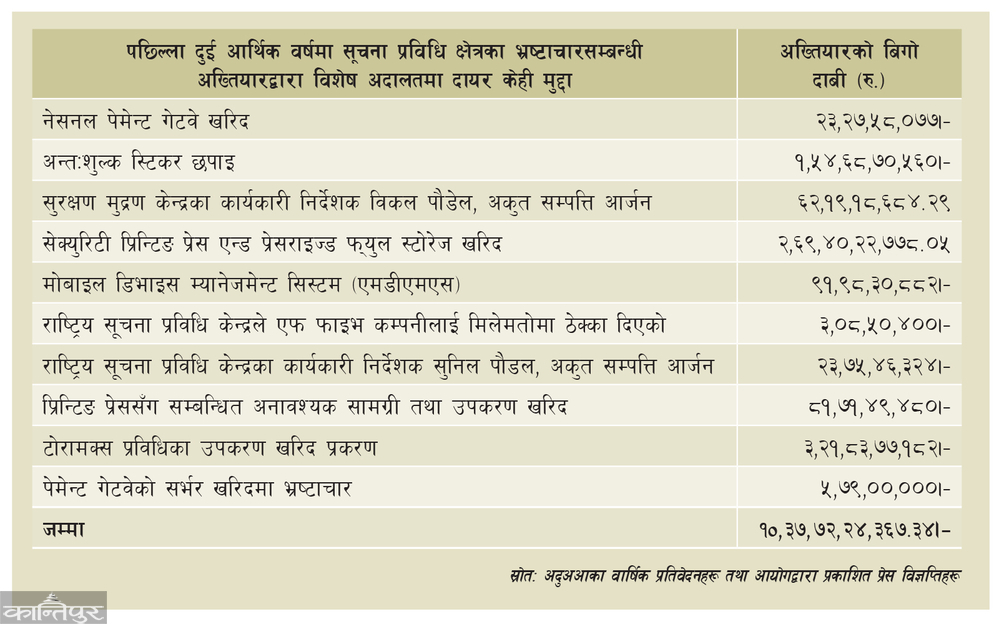
Similarly, the Telecommunication Traffic Monitoring and Fraud Control System (Teramax) and Mobile Device Management System (MDMS) purchased by the Telecommunication Authority to regulate and monitor the activities of telephone, internet service and mobile service provider agencies have not been implemented effectively.
The budget for purchase of Terramax purchase and connection is 2337 million 70 thousand US dollars and the budget of MDMS is 7 million 66 thousand 888 US dollars. Both systems have not yet been implemented. The authority is investigating both of these procurement processes.
The facts of irregularities in the IT lab under the Telecommunication Authority with a total budget of more than 3 billion have been made public. The authority is investigating corruption in the contract agreement worth more than 3 billion rupees in the name of maintenance of the billing system of Nepal Telecom.
in which there is a complaint of corruption in the contract agreement of about 3 billion 15 million rupees without competition from Nepal Telecom. These are just a few examples. The information technology sector, which is considered as the backbone of the country's development, administrative reforms and digital inclusion, has recently fallen into a terrible vicious cycle of corruption.
In Nepal, there is no centralized body to regulate and monitor procurement of software and equipment related to information technology. Some organizations are doing things like changing software every year, not using old ones, buying software and equipment even when they are not needed. The trend of buying software unnecessarily for the sake of commission is rampant across the country.
is an example of this – Simraungadh Municipality of Bara. During the purchase and expansion of the connection of the software of the central system of the municipal management system, the authority filed a case in the special court on 22nd of Chait 2079 saying that the software was purchased by paying 199 thousand 897 rupees but not used.
After one irregularity was found in the field of information technology, the authority started a rapid investigation. After this, the meeting of the secretaries on August 4, 2080 also decided to stop the purchase of unnecessary software in government agencies. Likewise, after a detailed study, the Authority drew the attention of all three levels of government to exercise vigilance in the purchase and operation of this matter through 10 point suggestions on 25th January 2080.
due to corruption
First, the procurement process in most IT projects in Nepal is not open, competitive and transparent. When the government buys information technology related equipment and software, there are problems such as purchasing at a much higher price than the market price, lack of technical evaluation in the procurement process. For example, it is under investigation by the authority that Pearl has tripled the price of the equipment required for the purchase of the payment gateway.
The second is a contracting system based on political access. It seems that political access, relationships and stakes influence more than work efficiency in information technology projects. As the procurement process is under the control of the political leadership, some companies that do not even meet the qualifications have been awarded contracts. For example, during the purchase of equipment at Surakshan Printing Center, a contract was awarded to a company from a single source and a large amount of money was irregularly involved, according to the authority.
Third, lack of skilled manpower and technical knowledge. Many of the government employees involved in information technology projects seem to lack the necessary technology knowledge, information and skills. Which seems to have weakness in contract, implementation and monitoring during procurement. According to a study by the Ministry of Communication and Information Technology, more than 70 percent of the employees of the information technology branch at the local level have not received formal training on information technology.
Fourth, it is difficult to estimate the cost of various software in the information technology sector. Due to the lack of transparency and clear criteria when determining the cost of software used in public bodies, the estimated cost is kept high and the budget is allocated too much. In recent years in Nepal, a large amount of money has been spent on the softwares built or purchased by various ministries and agencies, but the functionality, user access, and long-term usability of those softwares seem to be at a low level. Irregularities are increasing when purchasing poor quality software purchased at high prices.
What to do next?
In order to control the rampant corruption in the field of information technology, an independent monitoring and regulatory mechanism should be formed for large projects related to information technology. Third party evaluation should be mandatory in such projects. Similarly, it is necessary to provide necessary specialized training on technical monitoring to agencies such as the Authority, Auditor General, National Vigilance Center, Public Procurement Monitoring Office, etc.
Likewise, to increase the transparency in the procurement system, all the details related to the procurement process should be opened online in an integrated manner. An independent unit with specialized technicians can be formed under the Public Procurement Monitoring Office for this work. India has made the digital procurement process transparent through the 'Government e-Marketplace System'. Nepal can also learn from this.
Skilled manpower development and mandatory training should be arranged. Basic to specialized IT training should be provided to the personnel involved in such projects, procurement of information technology related areas. India is building technical manpower through the 'National Informatics Centre'. Establishing a similar training center in Nepal is also effective.
Legal reforms are also needed to minimize political interference. In the procurement process related to information technology, arrangements should be made by legally independent technical committee. This may end the practice of awarding contracts on the basis of access.
Open data and citizen monitoring systems should be strengthened. Information technology procurement and contract process, expenditure details, progress reports should be made public regularly through open data portal. Estonia has opened all its government data to the public, which has made a significant contribution to the fight against corruption. Learning from this, strengthening of civil monitoring system for information technology related work, coordination and partnership with civil society organizations should be developed.
Information technology is the cornerstone of advanced Nepal. With its correct use, economic development, employment, establishment of good governance, corruption control, education, health sector can be improved. But as this region falls into the quagmire of corruption, the country falls further into the vicious cycle of underdevelopment. Therefore, it is necessary to make information technology projects transparent, people-oriented, responsive and technically capable in the future. For this, the joint efforts of Nepal government, bureaucracy, civil society and technology field experts are necessary.

