The government and political parties are reiterating their commitment to allocate at least 20 percent of the total budget. However, if a strong and effective mechanism to control corruption is not built, no matter how much the budget is increased, there will be no expected results.
We use Google Cloud Translation Services. Google requires we provide the following disclaimer relating to use of this service:
This service may contain translations powered by Google. Google disclaims all warranties related to the translations, expressed or implied, including any warranties of accuracy, reliability, and any implied warranties of merchantability, fitness for a particular purpose, and noninfringement.
In the year 2081, a total of 444,785 students participated in the SEE examination. Out of which only 242 thousand 92 people i.e. 47.87 percent passed. Studies are also being conducted about the various reasons why school education is so weak.
Separate studies conducted by the Educational Quality Testing Center in 2073 and 2076 have shown that 99 percent of schools are unsuitable from a teaching point of view, lack of basic materials such as drinking water, toilets, sports materials, playgrounds, libraries, and laboratories.
In such a situation, the government of Nepal is spending a large amount of money to improve school education. In the current financial year 2081/82, the government has allocated 2 trillion 3 billion 66 crore rupees to the Ministry of Education, i.e. 10.09 percent of the total budget. In the previous fiscal year 2080/81, 1 trillion 97 billion 29 crore rupees, i.e. 11.26 percent of the total budget was allocated. The government has allocated a significant amount of budget for education. But academic achievement is poor. One of the reasons behind this is academic corruption and irregularities.
The education system is an important foundation for the development of society, equal opportunities and building the future of every child. Only if schools can be developed as centers of knowledge and skill development, it will set the foundation for nation building. But the increasing corruption and irregularity in the entire education sector, including schools, is weakening the educational quality. There are different forms of budget abuse that reach schools when the
facts are poorly analyzed. In which there is a trend of misusing funds by showing unnecessary expenses, hiding funds in the name of building and improving physical structures and using them for personal gain, irregularity of scholarship funds, dormitory expenses and government and non-government assistance funds. Similarly, there is a trend of appointing teachers under political influence or taking irregular benefits, taking bribes when transferring teachers, providing textbooks late or providing old ones, making irregularities in the amount of midday meals, creating bills without purchasing educational materials, and making financial irregularities.
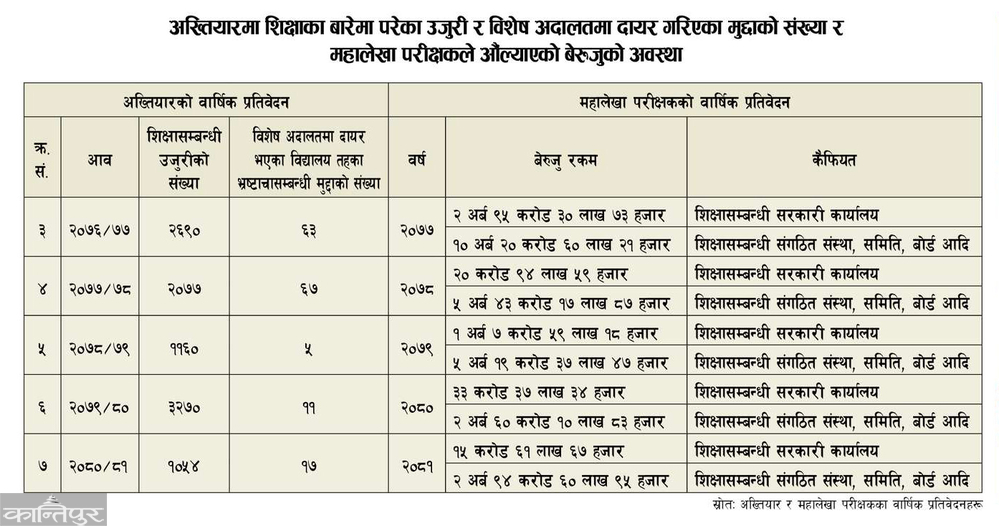
Jagarnathpur Rural Municipality of Parsa can be taken as a terrible example of how corruption is happening at the school level. Rajeshwar Prasad Chaurasia, a school inspector working in the education branch of the rural municipality, took bribes from different people and made fake documents and appointed different people as teachers. The authority investigated this and filed 18 cases against Chaurasia in the special court twice on October 1st and October 6th, 2076. He took 48 lakh 28 thousand 850 rupees as bribe from all the 18 cases filed. This is just an example. These types of irregularities spread across the country in various forms are having a negative impact on the quality of schools.
Moreover, the number of irregularities in the creation of fake educational certificates and permits during the appointment of school teachers quota, relief, temporary teachers is very large. From the financial year 2076/77 to 2080/81 alone, the authority filed 84 cases related to fake certificates of school teachers in the special court. Analyzing this data alone, the educational qualification of some teachers teaching in remote schools is not enough. When people who do not have qualifications teach, it has a direct impact on the quality of school education.
Analyzing the annual reports of the authority and the Auditor General, it appears that there are basically 6 types of financial corruption at the school level. First, corruption in the construction of physical infrastructure. Among them, corruption is taking place in the construction of school buildings, construction of sports fields, fences, construction of sports fields, etc. Second, corruption in various conditional and unconditional grants received in schools. It seems that there is corruption and irregularity in the grants received by the school from all three levels of government and other donors. Third, the transaction of bribery. There are cases of bribery transactions such as appointing a teacher in a school or passing a student or purchasing educational materials needed in a school or agreeing to transfer a teacher from another place in the school. Fourth, appointing teachers and staff on the basis of fake educational certificates and teaching permits. Most of the cases related to education filed by the authority in the special court are related to fake educational certificates and teaching permits. Fifth, corruption in school lunches, scholarships and other services, facilities and materials provided for children and students. Reducing the quality or quantity of mid-day meals, not giving scholarship money to children or irregularity of scholarship amount by writing the names of children who are not in school, textbooks and other educational materials are distributed without actually being distributed. Sixth, misuse and embezzlement of school property. These include irregularity in the rent of the school's land, non-disclosure of income from the sale of school property.
These and other corruptions happening at the school level are having a far-reaching impact on the entire educational sector. First, it has led to a decline in educational quality. Schools and teachers-students are facing problems such as low-quality teaching materials, lack of educational materials in schools, poor management, poor quality of mid-day meals, poor physical infrastructure, lack of sports materials. On the one hand, qualified teachers are not able to teach well and on the other hand, it is seriously affecting the learning ability of students. Second, the morale of both teachers and students has fallen. Irregularity, partiality or unfair assessment, poor educational material, poor quality lunch, irregularity in the amount of scholarship are affecting students' dissatisfaction, disappointment and interest in teaching, while having to pay bribes for transfer is reducing the morale of teachers.
What to do next?
Improving governance at the school level is a major prerequisite for improving the quality of education. Transparency and accountability should be ensured in schools. Financial transactions should be made open and transparent. A system should be developed to give the responsibility of appointing administrative staff to the Teachers Service Commission and stop the appointment of temporary, contractual or relief teachers and, if necessary, appoint people who are on the waiting list of the commission. The local level should arrange some budget so that the social test is done by a third party.
To prevent corruption, strict legal system and punishment system should be implemented. The school management committee can be freed from partisanship and arranged to have local clean image people. It contributes significantly to prevent irregularity in the construction of mid-day meals, scholarship funds, educational materials and physical infrastructure.
Increasing community and parent engagement can have positive outcomes. Parent committees can be empowered to monitor transparency and good governance in school administration. Transparency can be increased by using
techniques. A system should be developed to provide financial and administrative functions of the school, financial details through digital means so that parents and students can easily view them. It is necessary to formulate a long-term policy for good governance in the education sector. For this, it is necessary to develop a long-term policy for teacher training, school management system, and educational quality improvement, to increase cooperation between policy makers, educational experts, civil society and other stakeholders for corruption control.
Recently, the government and political parties have been repeating their commitment to allocate at least 20 percent of the total budget to improve the quality of school education. But if we do not build a strong and effective mechanism to control the corruption in the education sector, no matter how much the budget is increased, it will not produce the expected results. If effective policies are not implemented to control the growing corruption in the education sector and only attention is paid to increasing the budget, it may cause a serious crisis in the education system of Nepal.

