A serious review of Nepal's overall subsidy system (including distribution) along with the effectiveness of the Finance Commission is necessary
We use Google Cloud Translation Services. Google requires we provide the following disclaimer relating to use of this service:
This service may contain translations powered by Google. Google disclaims all warranties related to the translations, expressed or implied, including any warranties of accuracy, reliability, and any implied warranties of merchantability, fitness for a particular purpose, and noninfringement.
Provinces have limited revenue rights in the constitution. Revenue rights include real estate registration fee, vehicle tax, entertainment tax, advertisement tax, tourism, tax on agricultural income, service charge, customs duties and fines and penalties. Real estate registration fee, vehicle, entertainment and advertising tax are also under the tax revenue authority of the local level. A single tax administration has been adopted since the beginning to solve the possible problems in the use of single rights of both the state and local levels.
In this, one level of government collects tax revenue and distributes it to another level of government. Like, vehicle tax is determined and collected by the state. 60 percent of the revenue is kept by itself and the remaining 40 percent is transferred to the municipalities.
Similarly, advertisement tax is determined and collected by municipalities. Entertainment tax is determined by the provinces and collected by the municipalities. Municipalities keep 60 percent of the amount collected from advertisement tax and entertainment tax and transfer the remaining 40 percent to the provinces. The article focuses on the overall financial situation of the province, including internal tax revenue. Calculations including internal income give a message whether the provinces are self-sufficient or not. The statistical details used in the article are from the year 080/081 obtained from the Comptroller General's Office.
Analyzing the tax revenue of the states, the total income of the 7 states under the heading of tax on agricultural income is only 2 lakh 16 thousand. Madhesh, Karnali and Sudurpaschim provinces do not have a single rupee under this heading. However, it seems that the province has achieved an income of 79.8 million rupees from the sale of agricultural products.
Based on the tax classification of the General Account, this income refers to the income obtained by the province from the sale or auction of fish produced by the province itself, from fishing fees or contracts in rivers or ponds, from the sale of agricultural produce or livestock produced by the province itself. Under this heading, Bagmati Province has achieved the highest amount of Rs.388 million, while Karnali Province has achieved the lowest amount of Rs.15 million. In the unitary system, the government of Nepal was not able to collect tax from this tax title.
Experts say that this tax authority has been transferred to the province because of the awkward tax title and the lack of revenue scope. If there was good tax revenue collection, perhaps the province would not have this right.
Provinces have earned a total of Rs 50.6 million from the entertainment tax and advertising tax linked to the local level. Under this heading, Karnali province has earned only 14,000 as entertainment tax. What this indicates is that the municipalities of the whole Karnali province have not imposed advertisement tax or even if they do, they have not distributed the collected revenue to the province. Even the capital province and Bagmati province, which has a large city, have achieved a total income of 70 million rupees from entertainment tax and 17.8 million rupees from advertising tax.
This also indicates that the municipalities of Bagmati Province have not made much effort in collecting the income under these headings. Or, there is also the question of whether the collected revenue was not distributed properly. However, according to the information given by Krishna Prasad Mainali, secretary of Bagmati Province, Ministry of Economic Affairs and Planning, the municipalities are not serious about collecting revenue under this title and in some cases there is even leakage of revenue.
Madhesh Pradesh does not seem to have earned a single rupee of revenue from entertainment tax. It seems that only 1 lakh 65 thousand rupees have been paid in advertisement tax. The province has collected 6 billion 130 million in revenue from the area of tax revenue other than the area of tax revenue authority connected to the local level. This revenue is 3.53 percent of the total income of the province including subsidies of 1 billion 73 billion 300 million.
Analyzing the income of only the provinces that are not connected to the local level, Bagmati Province has the highest amount of 2.27 billion rupees, while the lowest amount is only 24 million rupees of Sudurpaschim Province. When discussing the tax revenue connected with the local level by removing the province's own, the province has achieved a revenue of 29 billion 77 million rupees.
which is 17.18 percent of the total income of the province. Analyzing by integrating both those connected to the local level and those not connected, the local income of the province is 35 billion 89 million rupees. This income is 20.71 percent of the total income of the state. The revenue of the province's own power is 35 billion 89 crores. Bagmati province has the highest amount of 16.68 billion and Karnali province has the lowest amount of 73 million.
This income can be considered as a basis for measuring whether the province can cover administrative expenses from its own earnings. However, since the definition of internal income includes revenue sharing and royalties, this analysis is incomplete.
The contribution of real estate registration is 30.56 percent to the local income of 35 billion 89 crores. Likewise, the contribution of vehicle tax is 34.59 percent. The contribution of these two is 65.15 percent. This indicates that the contribution of real estate registration fee and vehicle tax to the state's internal revenue is high. It is necessary for the province to improve the leakages in these tax revenues and pay special attention to searching for other tax revenue possibilities. It is certain that there will be a challenge in the scope of revenue of the province due to the slowdown in real estate buying and selling. The province should be careful in this regard. Other possibilities need to be explored.
The contribution of tax revenue received from the sale of stone, gravel, sand and wood washed away by the river to the local level is 3.95 percent in the local income of the province. The local broker mafia has a big business in the local tax revenue of stone, gravel, sand etc. There have been reports that the officials of some municipalities and provinces have alliances with such tax mafias. Not only officials but also many leaders are protected in it. If it is managed, not only the province, but also the local level can benefit greatly.
According to the Inter-Governmental Finance Management Act 2074, there is a legal arrangement to distribute 15/15 percent of the value-added tax and excise duty raised from domestic production to the provinces and local levels. This is called revenue sharing. Similarly, there is a provision in this law that 25/25 percent of the royalties of natural resources such as mountain climbing, electricity, forests, mines and minerals will be distributed to the provinces and local levels. Remember, in the reformed parliament of 2073, the government had registered a bill with the provision that the local level would receive only 5 percent and the state would receive 10 percent royalty. At that time, I myself participated in the expert briefing in the Parliament's Finance Committee and made a presentation on the issue of local and provincial rights to natural resources and resources. I met the leaders of all the political parties including the speaker and also drew attention to them in writing.
The share of revenue sharing in the total income of the province is 33.73 percent and royalty from natural resources is 0.91 percent. 15 percent of the revenue from value added tax and excise is pooled across the country and allocated state-wise. However, there is a legal provision regarding the 25 percent royalty of natural resources that only the affected provinces will receive.
The share of royalties collected from the country is not much. On the basis of the royalty amount, the state-wise discussion gives a message about which state is strong or weak in terms of natural resources and resources. It helps the province to make necessary policies.
Based on the total royalty received by the state, the contribution of electricity is 50.24 percent. Forestry is 27.58 percent and rock climbing is 13.72 percent. Mountaineering contributes about 52 percent to the total royalty of Koshi region. This province has received royalty from almost all natural resources. It also conveys the message that this province is rich in natural means and resources. Madhesh Pradesh has not received royalty from any sector other than forest. Since there was no mountain, there was no question of the royalty of Parvathoran. But the province should think seriously about the protection of other natural resources and resources. Due to the fact that only the most important forests receive royalties, Madhesh province should pay attention to its strengthening.
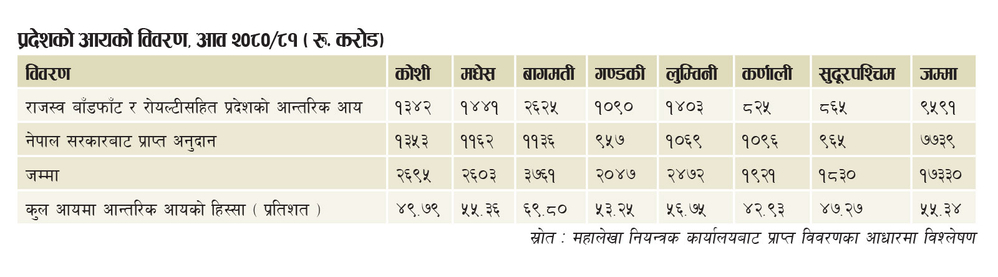
Bagmati Province and Gandaki Province have received significant royalties on electricity. Like the Koshi region, both these regions have abundant natural resources and resources. Lumbini region is good in mineral royalty. But despite the abundant potential of natural resources and resources, Karnali and Sudurpaschim Province are very weak in getting royalties. It is necessary for these provinces to work with long-term thinking. If revenue distribution and royalty are also considered as internal income of the province, the share of internal income in the total income is 55.34 percent. For the remaining 44.66 percent of income, the province depends on the grant from the Government of Nepal.
There are 4 types of grants namely equalization, conditional, complementary and special. The share of equalization subsidy is 57.54 percent of the total subsidy received by the province of 77 billion 300 million. The share of conditional grants is 30.85 percent while supplementary and special grants are 6.46 and 5.15 percent respectively. Special grants are the surest means of mainstreaming provinces that are lagging behind in social, economic, and human development.
Starting from 1965 till 2015, India provided additional financial resources through special grants to 11 backward states including Achham, Jammu and Kashmir. It was abolished in 2015 with the abolition of the Planning Commission of India. But it has continued with the Finance Commission of India adopting the method of giving priority to the backward states in the grant distribution formula itself. A similar method should be followed in Nepal. The government is not serious about this. A serious review of Nepal's overall subsidy system (including distribution) along with the effectiveness of the Finance Commission is necessary.
Revenue distribution, including royalties, the contribution of local income to the total income of the province is 55.34 percent (table). This fact conveys the message that the province is capable of working in areas such as social economic development and construction along with administrative expenses. However, this does not mean that the state is independent, able to stand on its own feet. For self-sufficiency, it is necessary for the province to explore the scope of revenue. Some provinces have created ugly organizational structures. The
also requires their dismissal. Likewise, if the constitution is amended so that the number of ministers of the province is limited to 5/7, there will be no problem in the functioning and existence of the province. Provinces are independent from internal revenue. It is necessary to include the issue of reforming the financial rights of the provinces in the debate on the amendment of the constitution.

