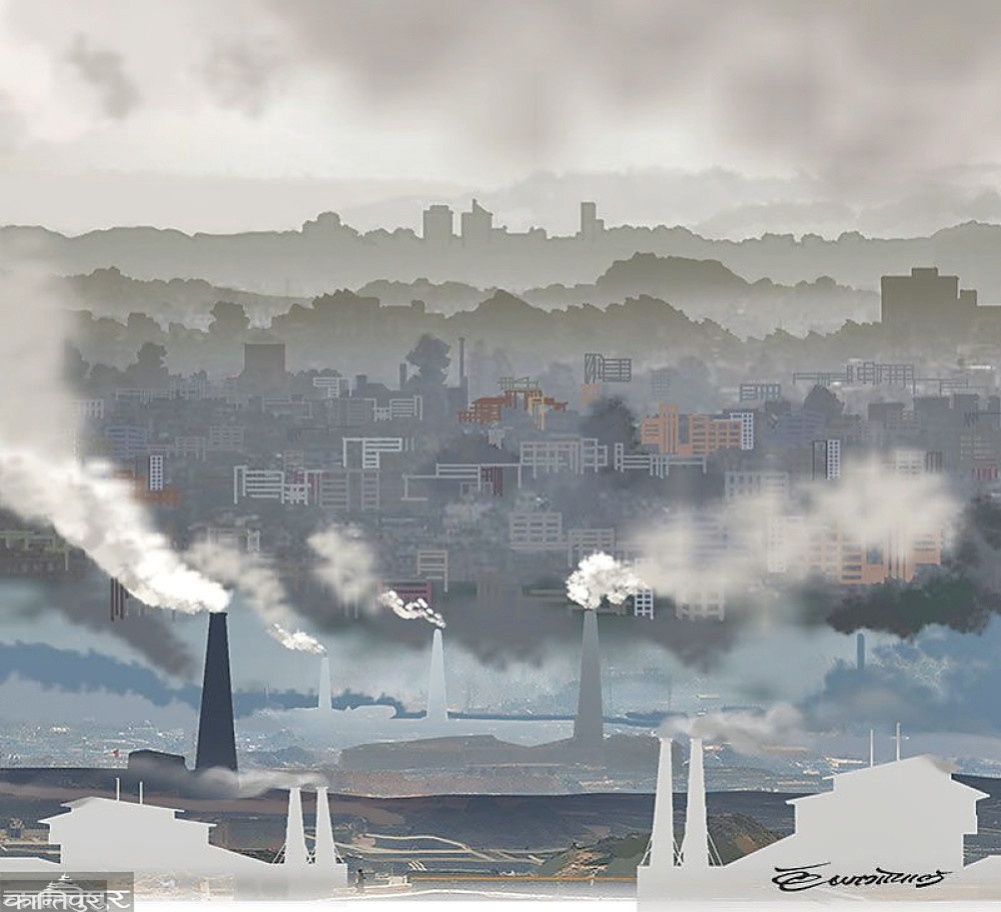
Forest fires have been taking place since ancient times. As this will increase air pollution, it seems that questions will be raised about the benefits that Nepal is getting from the carbon trade concept.
We use Google Cloud Translation Services. Google requires we provide the following disclaimer relating to use of this service:
This service may contain translations powered by Google. Google disclaims all warranties related to the translations, expressed or implied, including any warranties of accuracy, reliability, and any implied warranties of merchantability, fitness for a particular purpose, and noninfringement.
Compared to before, there is a lot of increase in fever in Nepal. The main reason for this is the increase in the amount of PM 10. Currently, the fact that carbon dioxide, carbon monoxide, hydrocarbon, chlorofluoro carbon, sulfur, methane, PM 10, PM 2.5 is increasing day by day is confirmed by various studies.
AQI America mentions that the capital Kathmandu will become the most polluted city in the world, but sometimes there has been some improvement. Other cities of Nepal are also becoming polluted. PM 10 and PM 2.5 are small particles that cannot be seen by the eye, made from a mixture of some chemicals, carbon, sulfur, etc. Studies have confirmed that PM 2.5 levels are increasing in Kathmandu. 1 cubic meter of air should contain 5 micrograms of PM 2.5, but currently 17 micrograms of PM 2.5 have been found in Kathmandu.
Greenhouse gas emissions are increasing day by day. Forest fires in Nepal, burning of agricultural produce in the lowlands and burning of garbage in urban areas are releasing carbon and methane. Dioxin is produced when plastics are burned. Carbon monoxide and lead are emitted from petrol-powered vehicles, while hydrocarbons and sulfur are emitted from diesel-powered vehicles. Chlorofluorocarbons are released from the use of refrigerators and air conditioners. Among these gases, carbon is considered to be the main cause of temperature rise. The amount of carbon is increasing due to the use of more and more mineral products. 30 percent of the world's carbon is generated by China, while 11 percent is emitted by the United States. The recently concluded COP-28 in Dubai made a common decision to cut down on the use of mineral products and agreed to keep the temperature increase below two degrees Celsius until 2030.
Nepal's air pollution is not only an internal cause, but the fumes emitted from the mineral industry in Uttar Pradesh, India is also becoming a major factor. This is confirmed by the high level of air pollution in Parsa, Bara, Rupandehi of Terai. This type of air pollution is happening all over the world. Several years ago, the city of Singapore went dark during the day when a forest fire broke out in Malaysia. Since ancient times, there have been more and more fires in the forests of Nepal. As this will increase air pollution, it seems that questions will be raised about the facilities that Nepal is getting from the carbon trading concept.
The climate of the world is changing day by day and it has created a serious challenge due to its impact on the entire creation world. On the one hand, Himalayan countries are becoming snowless mountains, glaciers are melting, glaciers are breaking and natural disasters are coming. In addition to suffering such a calamity in Nepal, the production of potatoes, barley and wheat in the Himalayan region is drastically declining. On the other hand, coastal and island countries are getting submerged due to rising sea level. Because of the increase in temperature, some animals and plants have become extinct, and the biological diversity has been damaged. As a result the ecological system is disturbed.
Climate change is causing heavy rains, lack of rains, intermittent rains and unseasonal rains. In mid-March 2024, heavy rains hit Dubai, flooding houses and roads. International flights could not take place for two days. Last year, heavy rains in Sikkim, India swept away the 100-year-old Miteri bridge after floods in the Teesta river. Similarly, the heavy rains in Nepal's eastern hills, Sankhuwasabha and Tehrathum last year, caused billions in damage to hydropower projects. In a small country like Nepal, sometimes it rains heavily in the eastern part and sometimes in the western part.
Compared to the annual rainfall in the Sardar region of Nepal, rain is falling every year. Sometimes it is seen that unseasonal rains damage the crops while the crops are ripening, while crops that depend on the weather remain barren due to lack of rain. Recently, South and East Asian countries seem to be more affected by weather conditions. On April 29, 2024, the temperature was 45 degrees Celsius in Bangladesh, 47 degrees in the Philippines and 48 degrees in Myanmar. The maximum temperature in Janakpur, Bhairahawa, Nepalgunj, Terai region of Nepal is seen to reach 43 degree centigrade on April 30, 2024.
According to the World Health Organization (WHO), 35 micrograms of AQI should be in 1 cubic meter of air, there are more than 200 AQI in Kathmandu, which is considered dangerous for health. According to the WHO, up to 100 AKI is considered fine and 100 to 200 I is considered unhealthy. Carbon monoxide, which causes air pollution, is reducing the amount of hemoglobin in the blood, while methane is reducing the immunity and IQ of children. Dioxin is causing blood cancer.
Likewise, chlorofluorocarbons are causing holes in the ozone layer, resulting in the sun's harmful ultraviolet rays coming directly to Earth, negatively affecting eyesight and causing skin diseases. Chemical elements in PM 2.5 are sometimes causing acid rain and causing rust and damage to man-made artistic metal sculptures.
It is necessary to conduct workshops with modern equipment to properly maintain vehicles that cause air pollution in urban areas of Nepal. The funds collected from the pollution tax in the Environmental Protection Fund can be mobilized in this way. If the smoke is tested and found to be more than the standard, arrangements should be made to repair it and send it out. A land use plan should be made and a brick industry should be allowed to operate at a suitable location and a modern filter should be installed in the said industry.
Public awareness should be spread not to burn Jhyas, Patkar and Chhwali while planting crops. In view of forest fires, a large number of forest watchers (pale) should be appointed on contract for February, March and April. Forest arsonists should be identified and punished. For this, it is essential to formulate appropriate policies from the three levels of government and implement laws, regulations and guidelines for implementation.