We use Google Cloud Translation Services. Google requires we provide the following disclaimer relating to use of this service:
This service may contain translations powered by Google. Google disclaims all warranties related to the translations, expressed or implied, including any warranties of accuracy, reliability, and any implied warranties of merchantability, fitness for a particular purpose, and noninfringement.
Nepal expert professor SD Muni from Delhi said in an interview last week that after the end of the permanent power monarchy in Nepal, it is becoming difficult for India to communicate with many powers.
When Muni, who played a role in establishing the republic in Nepal by bringing the then rebel Maoists to a 12-point agreement, is making such comments, how does the northern neighbor China, which is in favor of the monarchy until the end, think about Nepal affairs? Why did China's Nepal policy fluctuate during the Republic period in Nepal? Such questions naturally arise.
China had developed special relations with the CPN-Maoist Center, which had emerged as a new power in Nepal during the Republic period. And, later, China tried to have a closer relationship with the Nepal Communist Party (NCP), which was formed by the merger between the UML and the Maoists.
After the clash between India and China in 2020 in Kashmir's Galwan Valley, their relationship is going through a very tense situation. Even China and India have severed any ties other than sea trade. Its direct impact has started to fall within Nepal. India bans import of explosives for projects being built by China. India also did not want to give permission for an easy air route for Pokhara and Gautam Budh International Airport. Indian policy seems to be that Chinese companies should not be selected in the selection of contractors through global tenders in Nepal. The relationship between China and India is now the most tense since the 1962 war.
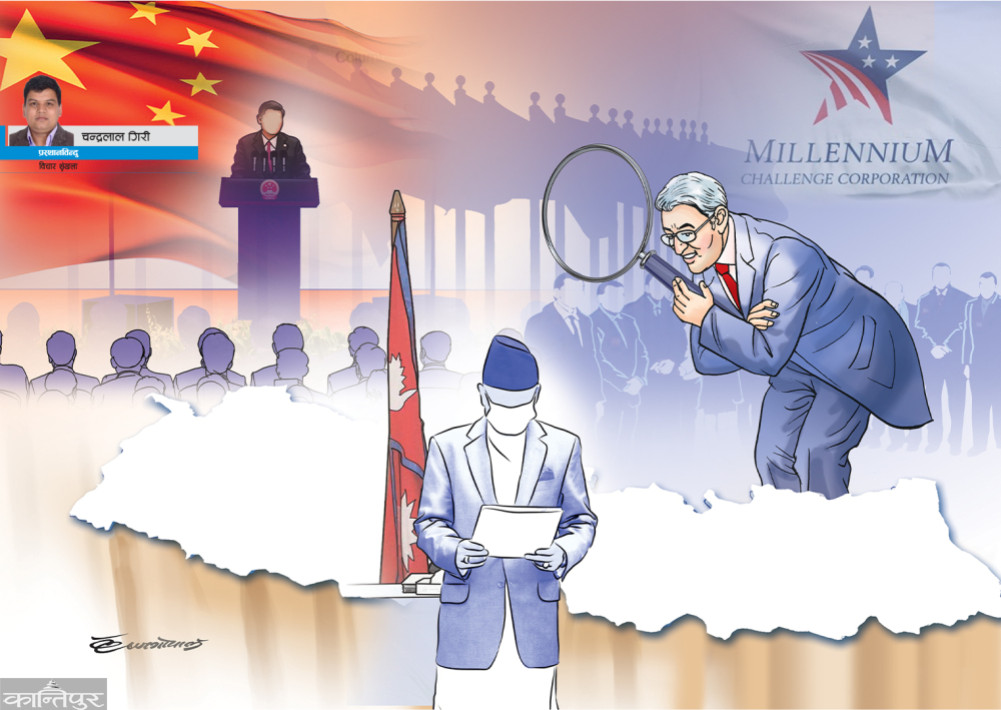
On the other hand, Westerners (Americans and Europeans) have an equally strong presence in Nepal. Moreover, with the Millennium Challenge Corporation (MCC) project, not only has America's activity and interest in Nepal increased, but the American presence has also become stronger. Not only through national and international non-governmental organizations, but also through the democratic governance system, the influence of America and Europe has deeply penetrated Nepal. The influence of the West is increasing not only among the Nepalis in Europe and America, but also among the Nepalese youth who are selling labor and sweat in the Gulf and Malaysia.
Can China simultaneously balance the strong and growing influence of the West, including India, Nepal's traditional first power? Why China's Nepal policy is changing? This article is centered around these questions.
More trust in the Communist Party
China tried to maintain close relations with the communist parties of Nepal in the last 15 years. China had formal relations with the UML before the Maoist peace process. But China began to form formal relations with the Maoists in 1963. At that time, Professor Wang Hoiwei, a senior expert on Nepal affairs in Beijing, reached the Maoist camp in Kamida, Kavre. Through the then Central Command in-charge Varshman Pun, China had extended contact with the Maoists. Currently, he who played the main role in making the alliance between Maoist and UML is the Finance Minister again, but the relationship between China and Maoist has become like the difference between the sky and the ground until Pushpa Kamal Dahal became the Prime Minister for the third time.
Dahal was China-friendly for the first time when he was Prime Minister from July 31, 2065 to May 11, 2066. While going to Beijing to participate in the closing ceremony of the Olympic Games as the Prime Minister, he broke the tradition of starting foreign tours from India. If the Dahal government had not been ousted by the then Chief of Army Staff Rukmangat Katwal case, he would have visited Beijing by the end of May and was preparing to renew the China-Nepal friendship treaty. When he was Prime Minister for the second time from July 20, 2073 to June 2074, Dahal adopted a policy of maintaining balanced relations with both neighbors India and China from an equidistant perspective. But Delhi did not agree on that policy.
After becoming the Prime Minister for the third time through an alliance with the Congress, Dahal completely ignored China's interests and put Delhi as his first priority. In this context, Dahal shrugged his shoulders and formed a five-party alliance with UML. In the role of the eight-point agreement made by the four parties of the alliance, it is promised to develop balanced and broad international relations by prioritizing national interests and concerns. It can be interpreted that the foreign policy of the government led by Dahal was unilateral.
On the other hand, some analysts claim that the Chinese role was seen in the process of forming the CPN after the union between the UML and the Maoists on 3rd June 2075. According to the then head of foreign affairs department of the Congress Parliamentary Party, Narayan Khadka, former Indian ambassador to Nepal Ranjit Rai, and Nihar Nayak, an expert on Nepal affairs in Delhi, China played an important role in bringing unity between the UML and the Maoist center.
Nepal CPC's laboratory
It is understood in the West that China has advanced the 'Belt and Road Initiative' (BRI) project with the idea of establishing alternative ideas and leadership over the world system through the 'C ideology' to challenge the US-led world order.
Before Chinese President Xi Jinping's visit to Nepal, the school department of CPN and CPC organized a training program in Kathmandu on September 23-24, 2019, about "C ideology". Along with this, it started to be analyzed that China has a special relationship with the Communist Party in Nepal. It undermined the opinion that the Chinese role was decisive in the formation of the CPN. The training between CPN and CPC was interpreted as China started to export ideas as well. However, the first training in "C ideology" was done in Nepal through CPN.
Another coincidence is that on January 28, CPC held its first joint interaction program with Nepal's political parties at Solti Hotel. In the presence of CPC's Deputy Head of International Department and Deputy Minister Sun Haiyan, CPC held an all-party interaction for the first time in Nepal on the issue of what should be the Nepal-China relationship in the changed situation, what should be the role of political parties to advance this relationship and how to implement the agreement/understanding between China and Nepal. The Chinese representative said that this is the first time in the world that the CPC has interacted with all parties in this way.
Bitter relationship with Congress
BRI agreement was signed by Nepal on May 12, 2017. Even after seven years, the project implementation agreement has not been reached. The Congress minister expressed agreement in principle on the BRI project. When Nepal was a founding member of the Asian Infrastructure Investment Bank (AIIB) established by China to support the BRI project in 2014, then Finance Minister Ram Sharan Mahat signed and gave in-principle consent to the BRI. At the last stage, when the Congress President Sher Bahadur Deuba started arguing that BRI projects can only be built with the help of subsidies in a meeting with Chinese leaders, it is believed that China is a little more upset with the Congress. Chairman Deuba also said that in the discussion with the small Madhesh-centric parties, the alliance has changed due to disagreements with the Maoists regarding the implementation of the BRI project.
The then ambassador of China, Hou Yanchi, who had met dozens of times with the leaders of the CPN, from the controversy to the division, met the Congress President Deuba only twice. In Humla district, there was a dispute between Congress and China regarding the construction of a building by mixing Nepalese territory. The Chinese Embassy wrote a letter to the Congress on October 28, 2077 and disagreed. Meanwhile, Ambassador Howe could have talked with Deuba as well as the leaders of the CPN. If the Embassy had not written a letter to the Congress, the Congress would not have issued a statement and responded to it.
coercive diplomacy
There were three extreme conflicts within the CPN before the split. It seems that the controversy started especially in Baisakh. While this dispute was going on, the then ambassador of China, Hou, met the leaders of CPN seven times. When there was a dispute for the second time in June, she met the leaders of CPN nine times and became active in resolving the dispute. In the last conflict after August, Hau met the leaders of CPN five times, but CPN did not split.
On the other hand, during this 15-year period of the republic, China has visited Nepal dozens of times. On average, three Chinese delegations visit Nepal every year.
After the arrival of the Republic, Chinese President Xi visited Nepal for two days in October 2019. Before Xi, Chinese Prime Minister Wen Jiabao visited Nepal for four hours in January 2012. China's third-ranked National People's Congress Standing Committee Chairman Li Chansu visited Nepal for three days in August 2079. Chinese Foreign Minister Wang Yi has visited Nepal four times. The newly appointed head of the International Coordination Department of the CPC, Liu Qianchao, visited Nepal for four days in June 2079. Apart from these, many Chinese government, CPC and military officials visited Nepal. CPC visited China with representatives of Nepal's political parties, parliamentary delegations and government officials.
China was also accused of 'micro-managing' the CPN due to this incident. Also, before the approval of the MCC agreement by the Parliament of Nepal on February 27, 2022, there was a fight between China and the US. After the United States expressed that there was difficulty in approving the MCC agreement in Nepal because of China, China responded four times in a span of 10 days by raising questions about the MCC.
Overall, the Chinese activism and pressure diplomacy in Nepal is related to the implementation of the BRI, the dispute within the CPN, the competition with the US, the unstable politics of Nepal and the security interests of Tibet.
Nepal in geopolitics
Druk Phunsum Sogpa (DPT) and Druk Nyamrup Sogpa (DNT), the parties that sought to expand diplomatic relations with China in Bhutan, not only lost power, but now they are also deprived of being an opposition party.
Nepal has a slightly different political scenario than Bhutan. From the establishment of relations with the Maoists to the arrival of the current finance minister Pun, the Maoists that China wants to believe in have been moving towards power erosion through division. It seems that the Maoist Chairman Dahal has also started to realize that the Maoists will lose power when they are close to China, not only the party will split, but also the national status will be reduced. That is why he took a 'U-turn' on China policy when he became the Prime Minister for the third time. Well, it remains to be seen what Chinese policy Dahal will adopt in collaboration with UML. Janata Samajwadi Party (JSP) president Upendra Yadav, who was initially eager to have relations with China, has also lost power in Madhesh due to the party's split. Yadav, who is still not trusted by the founding party of India, invited Yi Ping, a member of the international department of CPC and the deputy minister for the Asia Pacific region, as a guest at the convention of the then Madhesi People's Rights Forum held in Birganj in 2065. A chain of divisions is then believed to have begun in the forum.
Even though the situation in Nepal is not like that of Bhutan, there is still a psychological fear among the leaders of some parties that they will have to lose power and power when they make a close relationship with China. Even the Maoist and then CPN-led governments, with whom China has close ties, did not advance the BRI project implementation process.
Nepal changing policy China
Various developments have shown that after the dissolution of the CPN, China has started to change its 'Nepal policy'.
Prioritizing the Parliament: Since democracy came to Nepal in 2046, China has not prioritized the Parliament of Nepal. The role of Parliament in Nepal has been seen as a decisive role since the Mahakali Treaty in 2053. After the MCC Agreement in February 2022 and the Citizenship Bill in July were also passed by the Parliament, China seems to understand the importance of the supremacy of Nepal's Parliament. Li Chansu, Chairman of the Standing Committee of the People's Congress of China, visited Nepal for four days in September 2022 at the invitation of Speaker Agni Sapkota. Most of the meetings of his visit were held at Parliament House, Baneshwar. A cooperation agreement was also reached between the Nepal and Chinese parliaments.
Initiative to improve relations with Congress: Representing the capitalist and democratic parties, the Nepali Congress is established as a perennial power in the politics of Nepal. When the CPN was in government, there was a rift in the relationship between the Congress and China, but with the dissolution of the CPN, China has taken initiatives to improve relations with the Congress. As soon as Chinese communist at the Ministry of the Chinese Liu, the foreign Li, the Mao Liu, he began visiting Nepal at July 2022 and reinstate relations with the Congress. He reached BP Museum in Sundarijal and spent about an hour. The museum was at once BP Koirala was in prison twice. By visiting the museum, Liu refers to further expansion between China and the Congress. & Nbsp;
is in relation to National Political Parties: In recent times, China seems to have taken policy to expand relations with almost all national political parties in Nepal. Last January 28, CPC on Salty Hotel, the CPC has formed for the first time of Nepal's major political parties to strengthen all the parties by the first time in Nepal. The main reason for the commitment to commit Kathmandu in CPC was a sign of changing the Nepal policy in the Nepal policy before making policy on the annual meeting of the New Year. Although invited to the interaction program, the leaders of Madhesi-cykeeper parties did not participate. On the occasion, UML General Secretary General Shankar Pokhrel did not argue on open by the leaders of the UML generally Shankar Pokharel on the occasion of CPC National Sunspaper. The leader of the party in theoreto the foreign ministries of the party read only a written speech.
concluded is a more concerned with the effects of India in Nepal's influence and activity, India's influence and activity. China, along with US visits and activism, which was strong for implementing MCC project, increased a bit more aggressive diplomacy in Nepal. Initially, China's' Nepal Policy, was like a little communist party-friendly. & NBSP;
India and the United States also belong to their own interests and interests in Nepal. If China is becoming more active and aggressive in Nepal, both of them are likely to cooperate for prevent him together. However, some analysts see that even though they are under unjuncted collaboration between India and the United States. & Nbsp;
seems to have changed the change that the Chinese policy trying to be closer to any one of the missing parties on the basis of any ideology. China, which has the highest and constant support to Nepal's infrastructure development is the major development partner of Nepal. Burial grants have been made by Nepal's larger gift from buying 15 billion each year. Chinese image in among the Nepali people are still not so damaged. & Nbsp; The Executive Director of Nepal and Break Tribhuvan University of Nepal and Asian Research Center (Sinaus), Nepal is a country in unique 'prevailing inheritance' Authorities' nationality. Nepal does not lie to anyone in the sovereignty and independence of the land of Nepal. & Nbsp;
was an urgent blockade against the quake in the 2072 BS to support the Madhesh movement. Because of that, the approach to Delhi in Nepal has become negative to new generation. Similarly, China will not reject an aggressive diplomacy and that Beijing has become a bad and criticism in Nepal.
Giri Sinas are the Chinese Department of China.