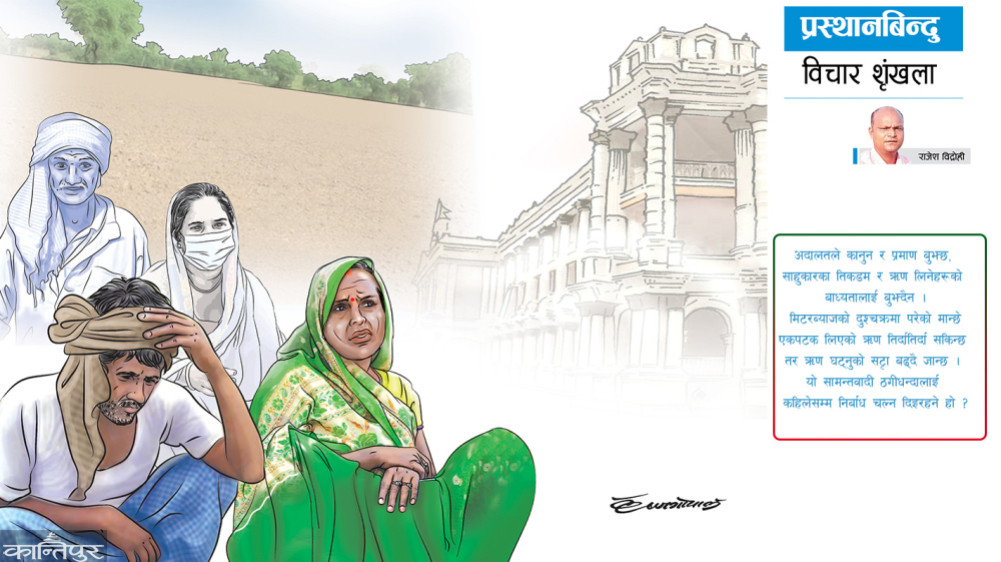
The court understands the law and the evidence, it does not understand the obligations of the moneylenders and the obligations of the borrowers. A person who is in the vicious circle of bad debt can pay off the loan once, but instead of reducing the debt, it increases. How long will this feudalist fraud continue to be allowed to continue?
We use Google Cloud Translation Services. Google requires we provide the following disclaimer relating to use of this service:
This service may contain translations powered by Google. Google disclaims all warranties related to the translations, expressed or implied, including any warranties of accuracy, reliability, and any implied warranties of merchantability, fitness for a particular purpose, and noninfringement.
After the four-point agreement with meterbay victims, the government has recently formed another commission for the second time. Earlier, the three-member Commission of Inquiry on Unfair Transactions (MeterBadge) under the leadership of Gauri Bahadur Karki received 28,000 complaints from the victims. Out of that, 5 thousand 888 complaints were settled. During the discussion, the commission received written documents of 5.57 billion 1.9 million transactions. However, the creditors claimed that 7,628,000,000 is yet to be recovered.
Out of which 2 billion 56 million had no written documents. During the discussion, an agreement was reached for 1 billion 72 million 86 million. The victims got back 218 bigha 10 katta 7 dhur land (793 lots) from the moneylender. However, the Meter Bank Victims Struggle Committee has claimed that despite more than 28,000 complaints and more than 8,000 settlements, the implementation is very low.
According to Manoj Paswan, the coordinator of Meterbajpitit Sangharsh Samiti, the data of the commission regarding the complaint filed and settlement agreement is wrong. By violating the law, some cases have been settled in the village. In some cases, the ward and the municipality have made an agreement. On the basis of administrative access, vertical complaints have been taken and reconciliation has been done. Even now, the process of receiving complaints and registering the complaints continues, which the data commission does not have. From
complaint to agreement and implementation, the commission should have been led. The commission should also have representation from the victims. The court should have considered the complaint filed with the commission with lenience. However, here the commission was seen on one side and the court on the other. In some cases, complaints were also used as leverage. The extreme negligence of the government at all three levels was seen in the commission, court, and administration. The Commission sat in Janakpur and did only the work of taking complaints and counting. The commission did not take seriously even the case where the guilty plea had already been entered into. How is the judicial work of those who do not have evidence when there is no work for those who have evidence? They are more vulnerable and vulnerable in the society.
The first commission formed for three months extended the deadline twice and submitted its report to the Prime Minister in eight months. During this period, the commission spent nearly half a crore, i.e. 42 lakh 72 thousand 658. However, millions of rural victims, who are far from information technology and are oppressed by moneylenders, have not yet been able to file a complaint. Because the meterbaze problem is a social behavior that has been going on for a long time in the form of a feudal social culture, which has now appeared in an extremely distorted form. This feudal system has become more oppressive recently. No settlement, house or person is immune from the meterbad problem. Considering the severity of the problem, 28,000 complaints are very low. There were millions of complaints. However, it seems that many victims do not dare to file a complaint. This can also be a subject of research. And, to ensure that justice is done, the government should have the courage to open the way for the complaints of millions of victims who have been robbed for generations.
The biggest problem with meter loans is the three to four times kapali tamsuk between borrowers and lenders in the beginning. Another problem is that the registration is passed by saying that the land has been bought and sold for several times more than the loan. After the expiry of the Tamsuk, interest is added and the additional Kapali is made several times more. Transactions are based on social trust. Which has no account with the victim. Thus legally trapped in every respect. Courts understand law and evidence, not lenders' tikdams and borrowers' obligations. Every moneylender tricks the borrower into social behavior to advance his hand. They compel signatures and thumbprints on various documents. Creditors are thus legally strong. How long will this feudalist fraud continue to be allowed to continue under the guise of the law and the compulsion of the leaders? When will they be brought to justice? The government has no answer. He even favors the moneylender by showing court and legal obstacles. Sahu has the power of Madhesi leaders and parties and national parties and their leaders. They are also protected by state agencies. How can the cries of weak and vulnerable victims be heard?
A commission formed by order is not as strong as a court. So they are using the court to legalize the meterbadge transactions and protect themselves. Now there is a scene where the victim seeks refuge in the commission and the perpetrator seeks refuge in the court. If the 5,000 complaints that have been reconciled are to be investigated on the spot, it seems that the middle class and perpetrators who have money, power and access have benefited more than the victims. However, those who contributed to the meterbaji movement, are financially weak, politically and administratively have no access, they have not been able to benefit from it. Few have received justice. Their complaints have been left on the sidelines or have been discussed repeatedly without a decision being made. Apart from
settlement, if 23 thousand complaints are properly investigated, it is certain that fewer complaints of real victims and more of dishonest ones will be found. Even after putting the police in charge, there seems to be a manipulation of money, power and access. During the settlement in Siraha, the authority arrested a policeman with a bribe of 50,000. Earlier, during the settlement of the complaint in Saptari, the news that the money was collected from the creditor and the victim was also made public. Out of 28,000 complaints, 8 districts of Madhesh province have the highest number. Barama is the highest in that too. According to the police data, 9,000 complaints have been resolved so far. Since the police got the responsibility, a settlement of 3,000 has been made. 53 police units have been assigned with the goal of solving 100 complaints per day by keeping this case as a special priority. However, only about 20/22 complaints are settled per day.
At this time, the issue of protection and justice of the victim who filed the complaint has become a challenge. Due to debt stress and creditor pressure, the number of deaths due to murder, suicide and heart attacks has increased. 45-year-old Satang Chaudhary of Bara's Kolhbi Municipality-3 Prasauna committed suicide by consuming poison on the bank of the river because he could not pay the money owed to the moneylender. 25-year-old Ajay Prasad Yadav of Barakai Simraungarh Municipality-8 also died of heart attack due to the pressure of moneylenders. Yadav had taken a loan of 4 lakhs from a moneylender seven years ago for the treatment of his cancer-stricken father. Sahu passed with him a tamsuk of 26 lakhs and five katthas of land. Even after filing a
complaint, he has not been able to get it back from the moneylender. Pramendra Kushwaha of Simraungarh Municipality-2 Amritganj has deposited seven lakh 75 thousand in the creditor's bank account as per the agreement in the CDO office, but has not yet been able to get the property back. He has been running for the CDO and District Police Office for five months. But no one listens to her pain. He took a loan of 118,000 from the moneylender. In return for the loan, the moneylender made a payment of 13 lakh 18 thousand two times. After that, the moneylender filed a case in the court and got 26 katta of land frozen. He was arrested after the victim filed a complaint, but he was released within 6 hours because he was the ward president. He has been insisting that he will accept the decision of the court which he does not accept the consent of the CDO office. The court has also looked at the papers and decided in favor of the creditors.
This problem seems to have arisen more acutely because the commission is not more powerful than the court. The complaint of Rupesh Kumar Kushwaha of Barakai Adarshkotwal-6 was also discussed several times. The court ruled in his favor but he could not get the land back. By passing two and a half bigha land in the name of the moneylender, he took a loan of four lakhs. So far 28 lakh 44 thousand have been paid but the loan is still not completed. The creditor has already sold the 23 Kattha land taken from him for 16 lakhs to another person. Under the pressure of the villagers, 10 acres of land were returned.
Now the creditor is saying that he will return the remaining 17 plots of land only after paying 9 lakhs. Shambhu Chowdhury of Bara Karaiyamai Rural Municipality-7, Pipra took seven and a half lakh 54 thousand rupees from the moneylender. Sahu passed 21 kattas of land worth 20 lakhs kattha to him and gave him a Kapali of 30 lakhs more. During the discussion on the CDO, it was revealed that the creditor had given three lakhs to the middleman who brought the debtor and the customer. The money is added to the victim's name. Not only that, the land has been deposited in the bank in the name of the wife and the loan has also been taken. Now, the creditor is insisting to the police that he will not return the land without paying the interest of 30 lakhs, while the wife is claiming that she bought the land.
When Ram Bahadur Chaudhary of Saptari Khadak Municipality-3 received the news, the deadline for filing a complaint had expired. He had repeatedly taken about four lakh rupees at the rate of three and a half hundred to go abroad with Sahu and marry his daughter. For this, the moneylender had to pass the resignation of 16 and a half acres of land and also made Kapali Tamsuk by keeping three double points of the loan. He had repeatedly returned four lakhs to the moneylender, but the moneylender sold all his land to others saying that he still had a lot of money left, and did not return the Kapali Tamsuk. These are only representative events.
Individuals, families and settlements have been uprooted by the meter bagging problem. A person who is stuck in the vicious cycle of debt may be able to pay off the loan once, but instead of reducing it, his debt will increase. Loans are also passed down. So much so that due to the high and cyclical interest rates, even the money and land earned becomes a loan. The cycle is not limited to that, physical and labor exploitation is also involved. Because they have strong access politically and administratively. Therefore, if we look at the meter bagging problem from one point of view, the borrowers are suffering from the creditor, while from another point of view, both the lenders and the borrowers are suffering from the state. In other words, the state seems to be guilty. So it is not just a problem between two parties, it is a mixed problem created by the state.
Creditors have a separate problem. They have also formed a separate organization. They also have a movement. They say that the state does not listen to their pain. There are also a number of people who took the time to take a loan but did not pay a single meter and made a complaint. There are also those who file complaints to get back the land sold years ago after it became expensive. There are also those who take out money from banks and financial institutions and give loans on metered loans. There is also a situation where banks and financial institutions have auctioned the land of the borrowers. 14 to 26 percent of loans have flowed from there. During the discussions under the commission, there is a business of looking at the people and getting the money back. When the government makes laws and commissions, they should investigate the truth and bring everyone under the ambit of action. Everyone's property should be investigated. If properly investigated, some of the complainants may turn out to be richer than the debtors. Some of the so-called moneylenders have also suffered by giving loans. In this way, if some moneylenders are doing bad deeds, then everyone should not be kept on the same scale. The state should not create a situation where one victim is saved and another is victimized.
The problem is not solved by fighting between the creditor and the debtor. Not even by adding commission upon commission. There have been many such commissions in history. Be it Landless Squatter Commission or Truth and Reconciliation. State Restructuring Commission or Lal Commission, Madhesi, Dalit, Tharu, Tribal Commissions. It is clear that they have not been able to do anything except take complaints, prepare salaries and use them as vote banks for political parties.
At present, poor citizens are forced to take loans at high interest rates for cultural festivals, dowry, feasts (death/wedding feasts), education and health care, and at the latest stage for foreign employment. Most marginalized communities are affected in this cycle. At present, after the rise of the meter bagging movement, various forms of social, political and administrative pressure and threats and beatings have increased on the victims. Most of the moneylenders have proceeded with actions ranging from issuing injunctions from the court to blocking the further property of the victims, violating the agreement to invalidate the order of the commission.
The new constitution envisages socialism. However, the government is still following the provisions of the past. Due to which the burning pattern of feudalism like meter bagging is still prevalent in the society. Herein lies the crux of the problem. Acts should be made up-to-date. Over time, the forms and problems of exploitation have become more specific. It can only be a long-term solution if it is made timely. The commission of inquiry should reach the spot and conduct an objective study. Go to the village with the victim and take a decision after understanding the truth. Because the forms of exploitation differ from person to person. Cyclical interest forces you to live around the loan. Commissions should not be led by so-called experts who are far from the problem. Because living in the city, holding programs in five-star hotels cannot solve the problems of the poor. The sufferer knows the pain.
Nepal's legal process is long and complicated. After receiving the complaint, there is a tendency for the state to take bail and bond money at the beginning. Then the victim and the perpetrator become like clients of law and lawyers for years for justice. But justice is not guaranteed. Therefore, the existing law should be changed/amended to make the law and the commission strong and decisive in favor of the judiciary and the victims. There should be alternate arrangements for access to banks and financial institutions. As the commission has made, the victim will be victims of victims, but the middleworld benefit. So all aspects need to find the long-term solution against the state system.