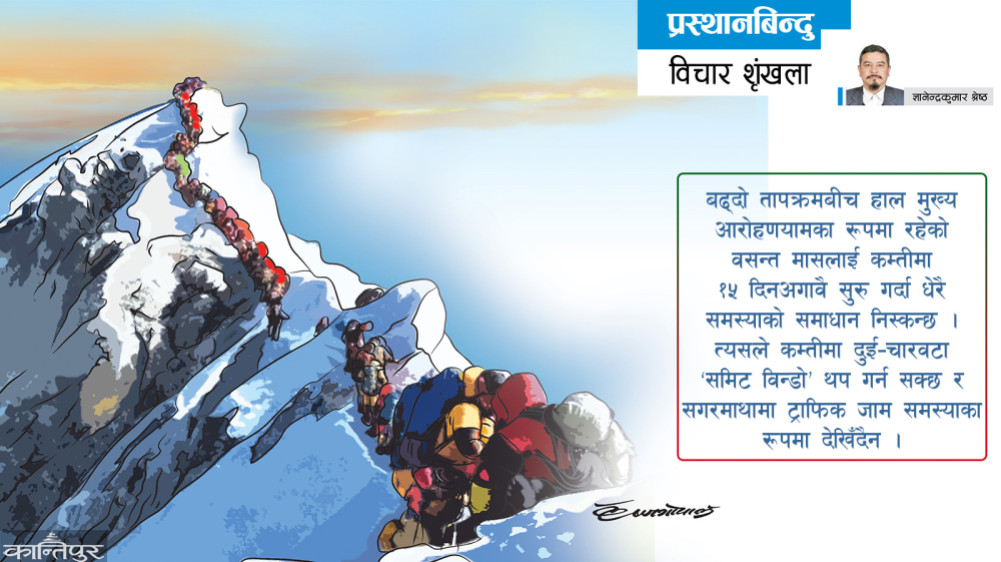
The negative competition that emerged when commercialization was high, the 'cheap popularity' of reaching the highest peak by the 'cheap popularity' of basic mountaineering preparation and record bragging without respect for it, has reduced the dignity of Mount Everest.
We use Google Cloud Translation Services. Google requires we provide the following disclaimer relating to use of this service:
This service may contain translations powered by Google. Google disclaims all warranties related to the translations, expressed or implied, including any warranties of accuracy, reliability, and any implied warranties of merchantability, fitness for a particular purpose, and noninfringement.
As the spring season has started, climbers and climbing companies have already started running towards the base camp with plans to break old and new records. The increase in the number of climbers is a good thing for the government of Nepal, which is highly dependent on tourism for foreign exchange, but in the international world, this number has started to be seen as a 'tragedy'.
'Traffic jams of people hanging on ropes' just below the highest point of the earth has become the new buzzword the world has heard in the last few years. Everest is a unique natural heritage for Nepal. But it is also a symbol that attracts every human being to the world. Therefore, even those who know little about Nepal as a country are many times more familiar with Everest. For many, Nepal is only Mount Everest. If so, have we been able to manage Mount Everest accordingly?
The price of Everest
Although I reached the summit of Everest in 2068 as part of a civil servant's climbing team, I have been going back and forth as a Government Liaison Officer at Everest base camp for almost a decade and a half since then and until recent years. I have witnessed firsthand the rapid leaps of commercialization from its 'cosmopolitan' atmosphere. I closely followed the interests of international media and geopolitical interests. I have mediated and regulated large and small disputes since earthquake rescue. I still remember what a foreign friend said - 'Your responsibility is not limited to the supervision of a climbing team, it is connected with the great reputation of the country. Because a needle falling on Mount Everest means as much to the world as if a mountain fell elsewhere in Nepal, it may not be important to a foreigner.' Even if it is a
, Everest is the only place in Nepal where so many worlds are gathered in one place. Looking at last year's data, the highest number of 479 people from more than 65 countries took climbing permits. The process of climbing Mount Everest is special for the world. The people of the world who are densely settled at and around sea level live on the Khumbu glacier at an altitude of more than 5,000 meters for about three months every year. He challenges the limits of humanity by reaching the top of the earth, pitting himself against the science of the human body. Therefore, the adoption of Mount Everest should not only be seen as a Nepali heritage, it should also be accepted as a common property of the entire human race.
The science of traffic jams
Everest's position is stable, but it cannot be climbed in twelve months. It has its own science and cycle. In the past, they have been climbed even in winter and autumn, although very few times. But in recent years, that trend has stopped and Vasantayam has become the perfect time to climb Mount Everest. But even at this time, extreme challenges such as snowfall and wind speed around the peak become somewhat easier only on a limited few days in the month of May. The climbers reach the summit anxiously waiting for that day and calculating the weather. During such a brief period called the 'summit window', the summit jet stream, which is sometimes at speeds of up to 200 km/h, is diverted somewhat northwards, and there are winds of less than 30 km/h. Climate analyzes are being done all over the world to look for such favorable conditions. They are available for free and also at a premium. Sometimes such a window lasts all day or one-two days and sometimes it lasts only two-four hours a day. Usually five-six such windows appear in May. While
s are predictable, they don't always match. In the 20th century, when weather forecasting systems did not exist, Sherpas recounted their peaking 'by religious calendar', 'by stargazing' or 'by inner soul'. Even now, with weather data, the Sherpas plan to reach the summit between that 'science' and 'faith'. Usually the fourth one from the base camp is Everest is climbed on the
or fifth day. So when they have a slightly wider window, most start to climb. Climbers try to get to the previous window as there is sometimes a risk that the window will not appear in the later period when it is delayed. Under such circumstances, traffic jams are created.
There is a separate business worth crores of rupees for the purchase of weather forecasting data which is crucial in such situations. But if the government of Nepal takes a step forward by placing itself at the center of climbing management, it can establish a one-door system of identification of the 'Summit Window' by purchasing data from two to four world-renowned weather forecasting centers. It is important for the government to do that, because small mistakes on Mount Everest should not be left unturned. Nepal's reputation is being evaluated in the world moment by moment. Depending on the amount of money climbers pay to the company for the highest peaks, there can be a classification of luxury and ordinary climbers. But the minimum standard to protect everyone's life should be ensured for everyone.
Some managerial regulation can be done even when the contact officer assigned by the tourism department is able to work actively in the base camp. They should be able to fully study the activities of the base camp and keep the daily details of the climbing, coordinate with the colleagues in the climbing team and use their authority to regulate and control when the number may be large. It can be regulated by forming an integrated coordination committee of government agencies with different competencies in the base camp. The personnel who will be in such special responsibilities should be selected several months in advance and a program should be introduced to acclimatize them to the weather so that they can stay in the base camp for a long period of time.
is possible Management
If we look at last year's data, more than 650 foreigners and Sherpas successfully climbed Mt. Everest using Mohada from Nepal. It seems that a scientific review is needed to determine how natural this number is for such an uncomfortable place where the human body cannot work. The number of successful climbs is very high. Especially above 8,000 meters called 'Death Zone' i.e. after the fourth camp there is no other camp to stop except after reaching the peak and returning. Nothing compares to getting there. In the
book 'Sherpa', it is explained that 'even a chocolate shell is heavy' and that 'every important step must be taken with great courage' to understand that Sakas. It will reach there as much as possible, if not, it will return. Even if someone is not able to do it to the best of his ability, he becomes indecisive, gets injured or sick, and if he doesn't work even with his helper, it's a traffic jam. A very narrow and often one-way roped-off path in that area would prove fatal if one could not use his feet, mind or both. That can be a stumbling block that can be a big problem for many others.
Renowned climber Rheinholz Messner calls the crowd of climbers "high-altitude tourists" rather than "climbers". Because they depend more on others than on themselves. Such climbers believe that they can reach the summit by being pushed or carried by many Sherpas for money. Technically it's not impossible, but height is primarily associated with one's own body. In very low atmospheric oxygen, the body has to do its own work. No one can take charge of heart rate, blood circulation, brain function, and no matter how adequate the oxygen in the bottles is, they are not 'infallible' at the peak. Therefore, only those with relatively few Hocha mountain experiences, adequate climatic adaptations and no physical problems or diseases that could be reproductive at altitude should be considered eligible for Everest.
But even competent climbers run into trouble during weather disturbances or fate. Arrangements should be made to deploy a rescue team at the fourth base camp in cooperation between the climbing companies to help anyone in trouble. It is necessary for the Everest industry to operate in such a way that the government and companies not only coordinate with each other for safe climbing, but also help each other. During that time, it is necessary to build a strong communication link between Kathmandu - Aadhaar camp and Himal. There are a few ways that
s can be technically managed. For example, on the climbing route of Mt. Everest, two ropes can be used for going up and one for coming back, in rocky points, where there is hard ice, where the overhangs are required. Currently, there is a government system that permits can be issued at any time during the climbing season. The work of obtaining permission should be completed at least by March. Who will have enough time to make a management plan with the climbing management government, Everest Pollution Control Committee (SPCC) or mountaineering management association and related companies. But for climbers who are climbing other mountains in Nepal at that time, it does not matter if they are allowed to climb Everest until the last stage.
It's best to plan the minimum possible opening key three-four summit window and set the maximum number of climbers to send in it. To make the most of the summit window, rope up to at least the fourth camp before the windows open to extend the duration of the climb.
Amid rising temperatures due to climate change, starting the spring mass, which is currently the main Ascension season, at least 15 days earlier would solve many problems. That would add at least two to four summit windows and traffic jams on Everest would not appear to be a problem. Although its probability is practically assessed, its basis will be clear if the climatic trends of at least five previous years are studied.
Nepalese and high-resourced giant climbing companies from different countries are currently in the business of Everest. There are also emerging small and low-capacity companies. Businesses should not be discriminated between small and large, but as it is a business where people's lives are connected, there should be a minimum competency check for the companies involved in climbing Mt. Himalayan guides should be authorized to become guides only after testing their skills-training and experience and their decisions are final. There are many Sherpas as guides in the mountains. But in recent years, many guides have come from other communities as well. It also includes a high number of foreign guides. In recent years, we have seen examples of climbers and guides losing their lives due to falls of climbers despite the guide's rejection at Mathilla camp.
The negative competition that appeared when commercialization was high, the 'cheap popularity' of reaching the highest peak by the 'cheap popularity' of basic mountaineering preparation and without respect for it, is reducing the dignity of Mt. Now the biggest challenge of Everest is such peaks are aspirants to reach. In the name of competition, when climbers are taken for a minimum fee, their minimum safety standards are not being followed and perverse practices such as stealing oxygen are seen in the mountains. In complex situations, the decision-making ability of such companies is also found to be weak. As soon as it is controlled, most of the problems of Mount Everest will be solved and the dignity of Mount Everest will remain forever.
– Shrestha is an officer of Nepal government.