We use Google Cloud Translation Services. Google requires we provide the following disclaimer relating to use of this service:
This service may contain translations powered by Google. Google disclaims all warranties related to the translations, expressed or implied, including any warranties of accuracy, reliability, and any implied warranties of merchantability, fitness for a particular purpose, and noninfringement.
The international relations of any country have multifaceted aspects. Some aspects of foreign policy are permanent while others are changeable. But the statements of any party keep changing with time. At the same time, this article will be focused on the statement of four important topics about Nepal's foreign policy (or not).
First, balanced relationship narration. After the establishment of modern Nepal, Prithvi Narayan Shah explained Nepal as a wedge between two stones. He said that Nepal should have good relations with both of them and maintain a defensive and balanced relationship in terms of strategy, as it is geographically located between countries like India and China, which have a large and ancient civilization. Even though Nepal's inclination towards India was more in some specific period, there is a widespread statement that Nepal should maintain a balanced relationship with India and China, either politically or in public statements.
This statement is prevalent not only among foreign policy scholars but also among policy makers and the public. In our foreign policy, 2077, Nepal has adopted a balanced and independent policy. Just a Google search in English about the balance of Nepal, India and China will turn up about 60 million web pages. This policy has deeply impressed Nepali people. And, it has also served the interests of Nepal so far.
Although we are oblivious to the question of what a balanced relationship is, how it can be achieved and implemented. There are neither many studies nor commentary on it. We are advancing the understanding that has been going on from this history like 'tying a cat in Shraddha'. We have not tried to reach the depth. A balanced relationship has also become a matter of institution for policy makers. Neither the southern neighbor resents nor the northern neighbor longs for a balanced relationship. Scholars also do not need much effort to repeat the same thing, so this statement can be heard and read everywhere.
But are Nepal's interests towards India and China the same or equal?
A person who understands little about Nepal can say that both countries do not have the same interests towards Nepal. Looking at Nepal's economic, cultural, geopolitical or any other aspect, the interests of India and China are different and they are also different in depth. There is no one who does not understand this subject but there is also no one who does not say balance. This is a contradiction in itself. Two countries come together rather than balanced. When you talk about India, you associate China, and when you talk about China, you associate India. Do both have the same interest in every issue of Nepal? Of course not. Since the theory of
balance comes from the theory of realism in international relations, it is based on the 'zero sum game'. Is the principle chosen by Nepal the same? Of course not. The Foreign Policy of Nepal, 2077 has expressed that Nepal will decide its foreign policy on the basis of mutual benefit and respect. In this sense, there is an urgent need to study and research the theory of balance in Nepal. Only then can the need to develop this statement be discussed.
Second, whether it is Nepal's foreign policy or other development issues, everything is analyzed from a geopolitical point of view. Yes, Nepal is facing delicate geopolitics in contemporary times. The whole world is in this crisis, but Nepal is in the midst of China-India and China-US competition. But is every subject a subject of geopolitics?
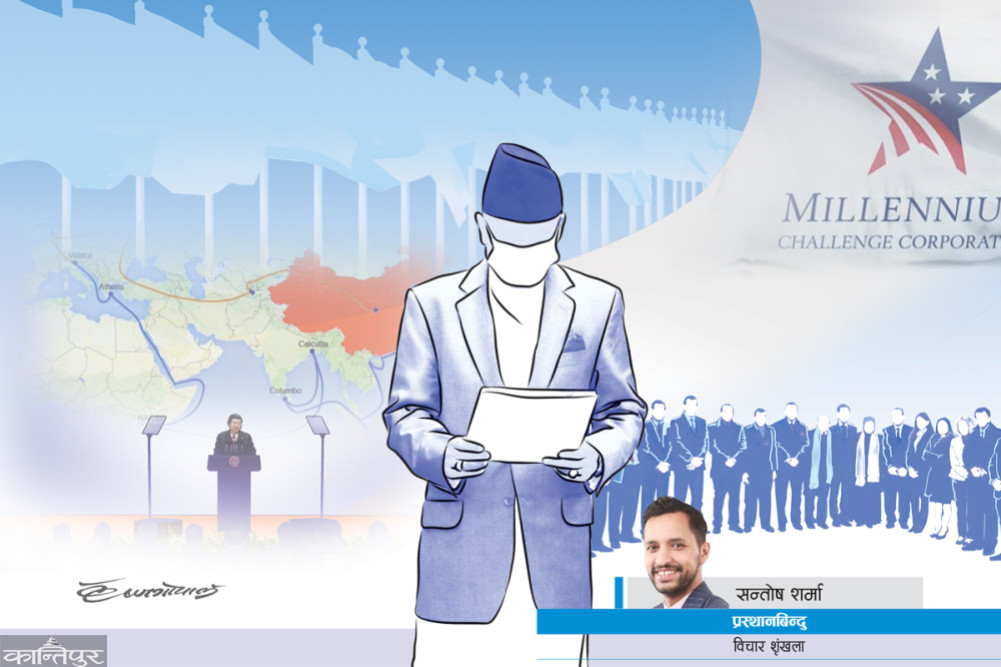
For this let's talk about MCC and BRI. It is well known that the development of the country is low due to lack of infrastructure development in Nepal. Highways, hydropower projects, airports, etc. are the necessary infrastructure for the development of the country. For this, a lot of investment is required, which Nepal's capacity is limited. Foreign aid or investment is indispensable when the country's revenue is difficult to cover regular expenses. These things should be seen first in terms of economic progress and development. But if we look at the debate in Nepal, neither MCC nor BRI was analyzed as a development project. Both these issues were analyzed only in relation to geopolitics. Regarding the US intentions regarding the MCC and the debt trap regarding the BRI.
Saying this does not mean that there is no interest in American or Chinese cooperation. If cooperation is important for the country's development, then what role those projects play in Nepal's development and give proper dividends should be the main point of analysis. Along with that, the analysis should have focused on how Nepal can manage American or Chinese interests and how unnecessary influence can be minimized. We are geopolitically entangled in American and Chinese intentions. Their intention: Nepal is not under control. It is within our control whether to take help, how to take it, whether the project pays dividends after taking help, how to mitigate the side effects. Such a debate hides our weakness behind the veil of geopolitics and hinders the conduct of foreign policy in a realistic manner.
Thirdly, we should see the interest or interference of foreign countries in every change that happens in Nepal. We first see China's hand in the recent alliance change in Nepal. If we look at our debates, it seems that Nepal is not run by Nepalis but by foreigners. The Nepalese are just puppets, Bhupi Sherchan says, 'like a carom board'. There is also a great deal of truth in this statement. Even if you read the autobiographies of the enlightened people of Nepal, the truth of that statement is confirmed. Even so, this is defeatist thinking. The implication of this is to deny the decision-making and agency of Nepali policy makers and hide their shortcomings behind foreign influence.
We label our leaders as foreign agents but do not talk or write much about their personal or party interests in foreign interference. There is definitely foreign interference in Nepal. But we will not go into much depth on how to create the right environment for that. These are purely internal matters. Until we take responsibility for our own statements, we can neither formulate policies independently nor properly evaluate mistakes. Therefore, before looking at foreign influence in any decision, we need to pay attention to our own internal situation.
Fourth, Nepal is a small nation. Nepal is a small country, nothing can happen without the intervention or help of foreigners and many feel that their interests can be fulfilled only by appeasing foreigners. Although Nepal is small compared to India and China, Nepal is not a small country in geographical or other physical terms. But because of the mentality that Nepal is a small and weak country, it has created a feeling of inferiority. The depth of this problem can only be gauged by looking at Nepal's letter to the MCC.
Although sovereign equality is considered as the guiding principle of foreign policy, we have not been able to implement it in practice. Even when a second-rate leader comes from India, China or the US, we stand in line to meet him, and when we go abroad, we consider the trip a success just to meet his counterpart. Among the four statements mentioned here, this statement has been challenged relatively more in Nepal's public debate. Leaders are not the only ones to blame for the prevalence and unchallenge of
statements, the limitations of the imagination of the experts who researched our study and the media are equally responsible. Also, if we look at the rostrum of Nepal's foreign scholars, almost all 60 are men who have been associated with the establishment for a long time. The experience and expertise of that generation should be based and properly evaluated, but the development of new statements cannot be expected from that generation. Now, as the interest and study of international relations is increasing among the new generation, there is room to hope that new ideas and narratives will also emerge. There is a challenge and an opportunity for the new generation to do that. If the new generation fails in this, then the next generation will have to face the same situation as this generation, even if the world conditions change radically.
- Sharma is the co-founder of Nepal Institute for Policy Research and teaches at Tribhuvan University's Faculty of International Relations and Diplomacy.