We use Google Cloud Translation Services. Google requires we provide the following disclaimer relating to use of this service:
This service may contain translations powered by Google. Google disclaims all warranties related to the translations, expressed or implied, including any warranties of accuracy, reliability, and any implied warranties of merchantability, fitness for a particular purpose, and noninfringement.
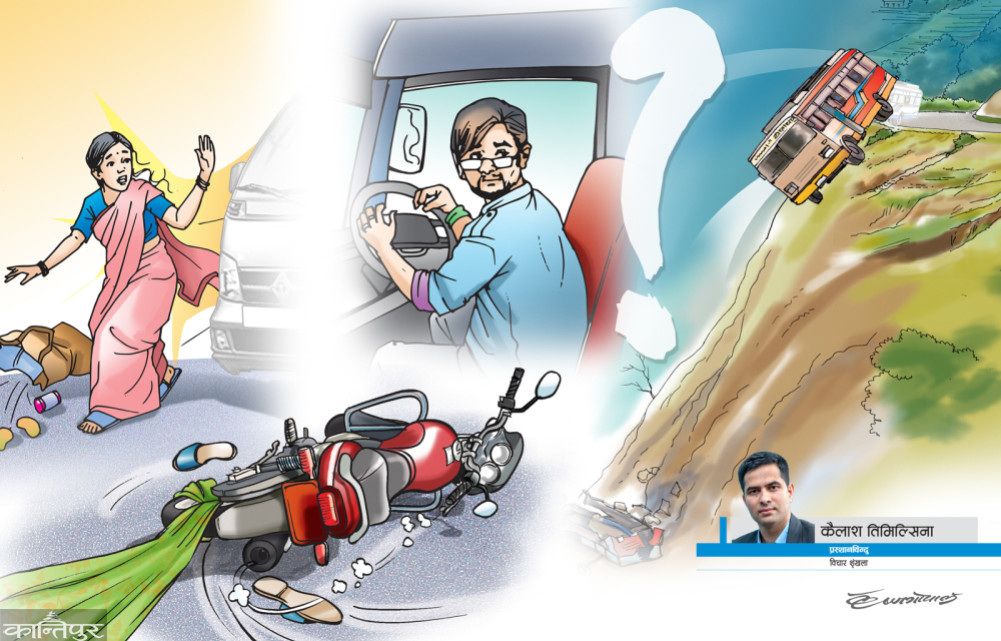
Every news of a road accident brings deep sorrow and pain. Because every day an average of seven Nepalis die due to road accidents. According to the traffic police, there were 10,675 road accidents in the financial year 2079/80.
According to Nepali Times (2023), 2 thousand 320 people died and 28 thousand 856 were injured due to road accidents in April 2022-April 2023. This is more than the human losses from floods, landslides, plane crashes and other natural disasters that year. Even though stakeholders including government agencies, law enforcement agencies and community organizations are making efforts to reduce accidents, the terrifying reality remains.
In this way, vehicles that are considered to be indicators of progress are turning into a silent industry that kills people. Accidents are increasing due to inadequate infrastructure, reckless application of traffic laws or social psychology towards road safety. Failure to control such an alarming situation reflects collective incompetence.
The World Bank has stated that only a few sections of Nepal's road network are paved and the risk of landslides increases during the rainy season. Overloaded vehicles, especially public buses and trucks, increase the risk. The Ministry of Physical Infrastructure and Transport cited overloading as a factor in 35 percent of accidents. Despite existing traffic laws, there has been lax enforcement. In June 2023 alone, more than 40,000 vehicles were involved in accidents due to speeding, according to traffic police department data. Moreover, according to a survey by the Department of Transport Management, only 30 percent of drivers have received formal training, which shows that the destination of passengers is always unsafe. According to the traffic police, more than 1,200 pedestrians died in 2022.
In 2023, 2 thousand 587 people died and 12 thousand 460 people were injured according to traffic police data. The immediate effects of an accident are severe and long-lasting. According to the World Health Organization (WHO), in addition to death, some accident survivors are unable to work. Because they need someone to look after them, performance tends to decline. According to the Road Safety Country Profile, 72 percent of road accident deaths and injuries in Nepal are in the productive age group. Due to this, it is mentioned that there is an estimated economic loss of two percent in Nepal's GDP in 2021. According to Asian Development Bank estimates, road accidents cost Nepal $440 million annually, which is equivalent to 1.7 percent of the country's gross domestic product. Moreover, the psychological impact of road accidents is profound. A survey by the Nepal Health Research Council showed that 30 percent of accident survivors developed symptoms of post-traumatic stress disorder (PTSD) 6 months after the incident. Identification of the
cause
The main causes of road accidents in Nepal are driver's carelessness, inexperience, work load, alcohol and drug use and high speed. It has been mentioned in the police study that the accident rate is high due to distracted driving and non-observance of traffic rules. Long-term driving by the same driver leads to fatigue and the pressure to reach the destination on time increases the risk of accidents. According to the Nepal Health Research Council, when the driver consumes alcohol and drugs, the decision-making ability and coordination decrease, the possibility of accidents increases.
Another reason Nepal is facing road safety challenges is the deplorable condition of the roads. Due to the geographical situation, the physical infrastructure in many areas is very inadequate, even those that are, have fallen into disrepair due to lack of proper maintenance. Countless potholes, poor drainage system, muddy, unclear road markings have increased the risk not only to drivers, but also to pedestrians. The bridges have become dilapidated as sand and stone have been mined and transported from the river. According to the Economic Survey 2079/80, the total length of roads as of February 2079 is 33,996 km, of which 51.3 percent is black paper, 23.3 percent is gravel, and 25.4 percent is unpaved. The condition of black paved roads is also pathetic. These roads are not constructed in a systematic and scientific manner. Accidents occur when the engines or safety indicators of old vehicles plying on the road do not work. According to the traffic police report, more than 70 percent of road accidents in 2023 were caused by vehicles older than 10 years. About 60 percent of the vehicles registered in Nepal are more than a decade old. Another cause of
accidents is the irregularity and disorganized system of issuing driver's license. Driving license in Nepal is issued after a normal written test followed by a driving test. Intensive written tests, practical driving tests in various road conditions and mandatory training are not implemented. There is also a tendency for disabled people to get licenses due to financial transactions between employees and middlemen against the system. Road monitoring and inspection is a weak point in Nepal, which has increased road accidents. Regular assessment of road infrastructure including thorough inspection of road conditions, signals and traffic control equipment has not been done. Accidents have increased despite not being able to invest in CCTV cameras, automatic speed cameras and vehicle tracking systems to identify accident hotspots, analyze traffic patterns, evaluate the effectiveness of road safety measures and obtain much-needed data.
Means of transport like: tippers and unorganized parking of trucks also played a role in accidents. Being forced to stay on the road disrupts traffic flow and increases the risk of accidents. Overloading, overcrowding in vehicles, lack of regular vehicle maintenance and lack of adherence to traffic rules also increase the risk of accidents. Environmental causes such as adverse weather conditions, landslides caused by heavy rains and dry landslides pose additional challenges to road safety.
Successful campaigns in other countries
The government's allocation of 500 million dollars for road infrastructure development in the 2023 budget was the right step. During the implementation period of strict laws, safe road operation, accidents were reduced by 20 percent. Public awareness campaigns such as the 'Safe Travel, Safe Nepal' campaign launched by the Ministry of Health and Population in collaboration with UNICEF have played a decisive role in the development of responsible road behavior culture. The mandatory driver training program introduced by the Department of Transport in 2022 ensured that drivers have the necessary skills and knowledge to drive safely. The Sustainable Urban Transport project launched in 2021 had raised some hopes to reduce congestion and reduce vehicle traffic. The government should continue these programs in a more effective manner.
Developed countries have adopted advanced technology, strict regulations and extensive public education campaigns to reduce road accidents. A key strategy to reduce accidents is the continuous improvement of road infrastructure. This should include traffic lights and pedestrian crossings designed to provide safety for road users. Strict enforcement of traffic rules is an important aspect of accident reduction efforts. In addition, automated devices such as speed cameras and red light cameras can be used to prevent reckless driving. Regular police patrols and roadside checks contribute to ensuring compliance with traffic rules. Investments in vehicle safety technology have also played an important role. Developed countries have implemented strict safety standards for vehicles, including mandatory installation of features such as airbags, anti-lock braking systems (ABS) and electronic stability control (ESC). Campaigns to promote the use of seatbelts and child safety seats have reduced the severity of injuries in crashes.
Nepal needs to adopt Sweden's road safety model, known as 'Vision Zero'. Sweden's road safety is known as a global example. Sweden has one of the lowest rates of traffic-related deaths and injuries worldwide. There road safety is based on the principle of shared responsibility. Vision Zero employs a multi-pronged approach that includes safe road infrastructure design, strict enforcement of traffic laws, education campaigns to promote safe driving behavior and post-accident care.
Prioritizing the ultimate goal of zero deaths or serious injuries on the roads, Sweden has created a collaborative ecosystem involving government agencies, law enforcement, road engineers, vehicle manufacturers and the public. A transport network has been created to reduce the risk of accidents. One of the central principles of Swedish road infrastructure design is the implementation of 'traffic quiet' measures. For example: Roundabouts, bumps, pedestrian crossings, which force the driver to slow down and be alert. Also, the concept of 'forgiving roads' is an integral part of Vision Zero. In this, the engineer prioritizes features that minimize the consequences of human error. Pay attention to clearly visible road signs and lines on wide roads. Another feature is road maintenance and commitment to it. The use of advanced lighting technology increases visibility, which is extremely important in reducing accidents during inclement weather. It is necessary for Nepal to strictly follow such measures.
accident solutions Comprehensive measures should be implemented to reduce the causes of
driver-related accidents. First, training programs should be improved to ensure that all drivers receive thorough instruction in traffic rules, safety practices and defensive driving techniques. It should include initial training for new drivers and courses to reinforce safe driving habits and refresher courses for experienced drivers. Regular checks should be done for driving under the influence of alcohol and drugs. Essential arrangements such as access to driver rest areas and counseling services can help reduce stress and reduce the likelihood of accidents due to fatigue. It is important to address these multifaceted driver-related factors through a combination of training, enforcement, awareness and supportive measures. This can help Nepal reduce the alarming rate of road accidents and create safer roads for all.
In order to improve the method of granting driver's license in Nepal, a rigorous written test and practical driving test in various road conditions, a mandatory training program should be implemented. A comprehensive review of the curriculum of the licensing system needs to be updated. Topics such as road safety rules, defensive driving techniques and emergency first aid, including essential first aid, may also be covered. A comprehensive strategy is needed to reduce the risk posed by older vehicles. Regular inspection, maintenance, driver training on the hazards associated with older vehicles should be conducted. A color-coded sticker or badge can be used to indicate the condition of vehicle indicators by determining the maximum age of vehicles and phasing out old ones.
It is imperative to improve the condition of roads in Nepal through infrastructure development, maintenance and expansion projects. Drivers and pedestrians need awareness programs on road safety practices, proper use of seat belts and helmets, the dangers of speeding and reckless driving. It is important to promote a culture of compliance and accountability on the road, supporting the efforts of law enforcement agencies to punish traffic violators. Considering the important role of motorcycles and bicycles as the primary means of transportation, the use of safety equipment such as helmets and reflective clothing can be promoted. Moreover, conducting public awareness campaigns on road accidents at the local level through the medium of mother tongue and according to cultural context can increase the understanding of road safety rules.
Hilly terrain and remote terrain create challenges for emergency services and medical care required after an accident. Emergency medical services and trauma centers ensure timely medical care for accident victims. Reduces the chance of death and long-term disability.
A combination of driver education and awareness, improvement of infrastructure, provision of safe vehicles, improved license distribution system, proper enforcement of policy rules, strong emergency response system can reduce road accidents. Addressing these challenges requires a multi-pronged approach. Initial efforts between government agencies and private stakeholders in Nepal needs united efforts. & Nbsp;
- Timiltona Handaki is a registorian university.