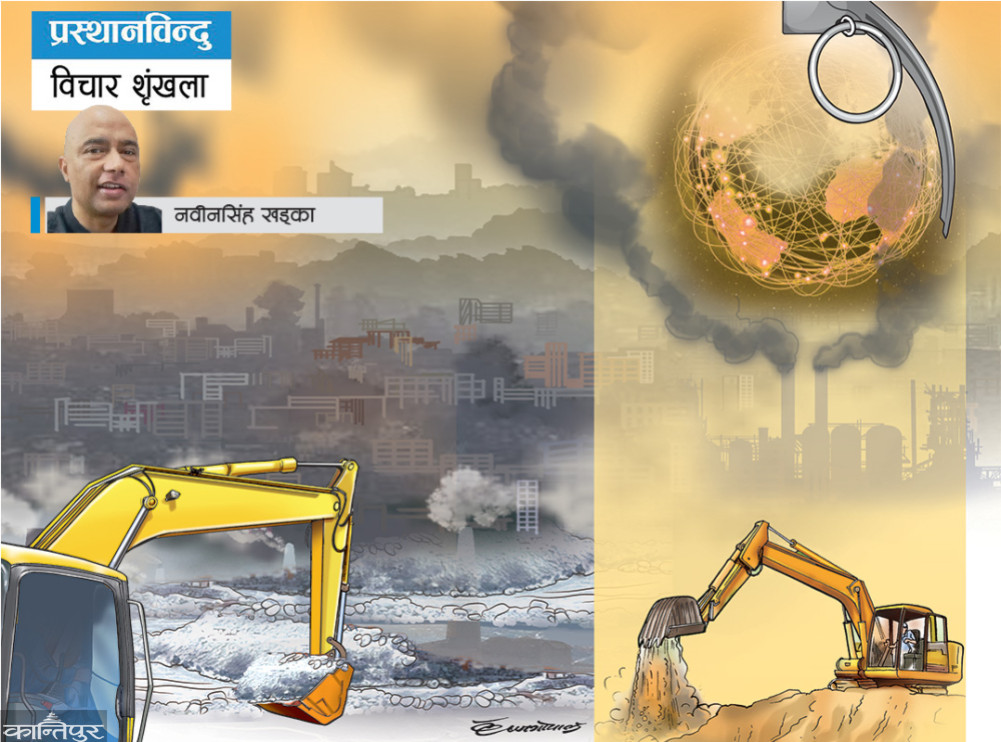
Development of infrastructure such as roads, electricity, drinking water, hospitals, schools, airports, highways etc. is for common people, clean climate, healthy soil and biological diversity, disaster risk reduction etc. are also for their benefit.
We use Google Cloud Translation Services. Google requires we provide the following disclaimer relating to use of this service:
This service may contain translations powered by Google. Google disclaims all warranties related to the translations, expressed or implied, including any warranties of accuracy, reliability, and any implied warranties of merchantability, fitness for a particular purpose, and noninfringement.
Do you remember Vikram Tempo, who blows black plumes of smoke while holding his nose and makes his ears ring? In the nineties, those three-wheelers running on the roads of Kathmandu and Lalitpur made transportation in the valley easier for many people. The blue colored Bikram Tempo was a cheap and accessible option for the public who were forced to travel by coach in mini and shared buses.
For common man it was a kind of symbol of progress and development. But due to the hollow geography, the air pollution level increased rapidly in Kathmandu Valley, where Bikram Tempo's smoke increased within a short period of time. Problems like respiratory diseases and eye lids started increasing. Vikram Tempo's role in Kathmandu's declining air pollution became a topic of discussion everywhere. While all this was happening, regular checks had been started to 'regulate' the pollution caused by vehicles.
black smoke, green sticker !
Vikram Tempo also had to undergo that examination. What is interesting is that such a pollutant, which was visible with the naked eye, emitted black smoke, also came out with a green sticker that had passed the inspection. And he would run along the path of the valley without fear. That symbol of progress used to slap environmentalists on the cheek and beat them to the punch. Could it mask or deny the problems of the general public suffering from respiratory and other diseases? How serious this problem was at that time, there was no study. If the public health had not been in such danger, would there have been a solution for a clean tempo to replace Vikram Tempo? Finally, Vikram Tempo took leave of Kathmandu forever. However, it was too late. And by that time the health of many suffered a great loss, of which there is no account.
Kathmandu did not take the issue of air pollution very seriously by giving a green sticker to Vikram Tempo for passing the pollution test even though he was throwing black mud openly. Unbearable pressure of vehicles, and scattered bricks in the same pit. If not, in the name of development and progress, stone and gravel were exploited from the surrounding mountains and crushers were also allowed to operate around the capital. As a result, Kathmandu often ranks high (some years at number one) on the list of the world's most polluted cities. The World Health Organization estimates that air pollution kills 7 million people worldwide every year. If the breathing air in the capital of the country is made a ventilation issue, think now, what will happen outside?
Dojre Vikas
I was watching in a recent miniature how happy the locals were when the vehicle reached a very remote place in Humla for the first time. Naturally, as fascinating as those hills and mountains are to the outsider, they are equally challenging to the inhabitants. But if we really want to dig and develop a path for his happiness, digging alone is not enough. After digging the top of the mountain, without studying what kind of risk will arise below and without taking the necessary precautions, the destruction brought about by the random Dojre development for those locals is well known.
Also, hilly and mountainous environment is very sensitive. In addition, the crisis of climate change has made the geography, which has become more weak after being shaken by earthquakes, even more relaxed. A report issued by the American space agency NASA and the National Oceanic and Atmospheric Administration (NOVA), another agency related to the oceans and atmosphere of the United States, has shown that landslides may increase by 30 to 70 percent in the future in the border areas of Nepal and China.
Snowy altitude rain
After last year's monsoon floods and landslides in India's Uttarakhand and Himachal Pradesh killed dozens of people, an investigation I did for the BBC found that high places in our hilly and mountainous regions, where earlier it usually snowed, are now getting more rain. In the same report, I noted that about 75 percent of the precipitation at Everest Base Camp last year was water, compared to 32, 43, and 41 percent in the three previous years, according to National Geographic's weather monitoring station.
Various scientific studies have shown that this kind of change caused by the increase in global temperature has also been seen in other mountain regions of the world, such as the Alps of Europe, the Andes of South America, etc. Snow and the ice that forms from it keep the topography of the high mountain region largely stable, like cement holding bricks and stones together. But when rain falls instead of snow in that place, those places become not only unstable but also dangerous, as a result of which avalanches, landslides, floods with mud and rocks etc. are seen to be increasing in the Himalayan region. What will happen if there is no study and early warning of such risks - the damage that happened in the Melamchi water supply project three years ago has already shown.
environment or development?
Especially when building infrastructure, it causes some kind of change in the natural condition of the related place, which experts call environmental impact. To evaluate the same, a study is done before starting a big project. It is a theoretical belief that if the environmental impact of the project is very large, the concerned body will not approve it, but if the impact can be minimized by adopting some measures, it is a theoretical belief that it should be done. But the process of environmental impact assessment is also very controversial, especially in places where the debate about development or environment is heated. The clash between camps that take the extreme stance that development should be done at any cost and that the environment should not be destroyed at all is seen in many developing countries.
is the challenge of how to maintain coordination between those two ideas. Development is definitely needed. The environment is also essential. Development of infrastructure such as roads, electricity, drinking water, hospitals, schools, airports, highways is for common people. Clean climate, healthy soil and biological diversity, disaster risk reduction etc. are also for their benefit. Before the challenge of climate change became so serious, pollution of air, water, soil and biodiversity due to various human activities were major environmental problems.
In 1992, through the Rio Convention, the world promised to gradually free the earth from these problems in the 21st century, but human society is failing in this. There is an argument in that, the rich countries developed by destroying the environment and now the developing countries have to compromise on the development work to protect and restore the environment. The analyst says that it cannot be said that it is baseless in international politics related to development and especially in geopolitics. But the trouble is, if you try to cover up the environmental issue by showing the rich countries, the developing countries will suffer. Poor communities in poor countries are also affected the most. Scientific reports have shown that climate change is the main factor, which will make environmental problems more complicated and destroy the development that has been done. As seen in Melamchi.
tripartite crisis
The triple crisis, that is, three crises—climate change, rapid decline in biological diversity, and pollution—is threatening human society and threatening human civilization itself. That is, these three crises have to be addressed in an integrated manner. One glimmer of hope is that if nature is preserved or restored in damaged areas, it will go a long way in addressing all three crises and climate change.
On the one hand, uncontrolled urbanization has swallowed up the ponds, Tukucha, Tal Taliya, and on the other hand, due to climate change, it has been seen all over the world that there is a huge loss of people's wealth in those cities due to widespread rains in a short period of time. Experts say, "If ponds, lakes and ponds can be preserved or restored in such places, they can absorb the flood water to a greater extent, like a sponge." And the damage can be greatly reduced. Experts say that protecting the wetlands will help in controlling forest fires.
Due to climate change, it has been seen that droughts have increased in many places and that has made the disaster of forest fires serious in many places including South Asia. Two years ago, fierce wildfires caused by prolonged drought in the mountainous and border Terai regions of Nepal and India spread to the highways. While I was reporting on the disaster, officials from both countries said that the wetlands within protected areas and national parks were mostly protected, so there was not much damage.
In some African countries, forest protection has also been started with the aim of combating climate change-related disasters. As the impact of the current sea storm in Mozambique increases, the help of the old forest is used to avoid the storm that it brings. Experts there say, 'Such forests act as a shield between human settlements and destructive sea storms.' While discussing all these natural remedies, one cannot forget the need to address the root causes of the triple crisis of climate change, biodiversity and pollution. But at least in the issue of climate change, Nepal's share in the global emission of greenhouse gases is negligible. While the effects of climate change including disasters are very serious.
Rising heat
The 2015 Paris Agreement aims to limit the global average temperature rise to 1.5 degrees Celsius compared to pre-industrial times. Despite this, scientists warn that this limit will be broken within this decade. This year, the average temperature has increased by 1.7 degrees in February. However, there may be other reasons behind it. Last year, the average surface temperature of the earth increased by 1.48 degrees compared to pre-industrial times. Although science has shown that the only way to prevent the temperature increase from reaching such a dangerous level is to reduce greenhouse gases including carbon, that step has been found to be insufficient in the policies of countries.
In order to limit the increase in average global temperature to 1.5 degrees, science shows that global carbon emissions must be cut by 40 percent by 2030. But according to the UN itself, the carbon emission reduction plan submitted by the countries to the United Nations Climate Change Organization will only reduce by 9 percent. That too if he did what he said on paper.
Record growth in clean energy The
is not without work in the renewable energy sector. According to the International Energy Agency, last year there was a record increase of 50 percent in the addition of renewable energy such as solar and wind. It is said to have reached 510 gigawatts of global renewable energy connections, with solar accounting for two-thirds of that. The data came last January. Two months before that, at the 28th United Nations Climate Change Conference COP-28 held in Dubai in November, it was agreed to triple the capacity of renewable energy by 2030. But if the main source of carbon emissions is to significantly reduce the consumption of biofuels, the scientist says that a very large increase in renewable energy is essential.
According to officials of the International Energy Agency, if biofuels are to be replaced, if one dollar is invested in biofuels, eight dollars should be invested in renewable energy. But looking at the ratio, for every dollar invested in biofuels, only $1.5 goes to renewables. According to a recent report by the International Energy Agency, the share of the oil and gas industry is only 1 percent of the total global investment in renewable energy.
The politics of energy security and climate change, especially after the start of the Russia-Ukraine war, some Western countries have increased the production of biofuels, citing energy security. In particular, they have been investing a large amount of money in the construction of new sources for gas supply and infrastructure for its transportation. And by showing that, countries like China, India, and Indonesia, which are still largely dependent on coal for energy, have argued, "Why should we go to clean energy?" The main culprits for climate change are developed countries. If they themselves can't give up biofuels, how can we?' So there is not much accusation between developed and developing countries. It was because of the policy of "hush-hush" that it was possible to agree on the issue of energy at the climate change meeting of the group of major economies of the world (G20) held in Delhi last year.
Although the G20 countries have set the goal of making carbon emissions zero, no one is doing carbon reduction to achieve it, according to a recent report by the United Nations Environment Agency. What all this means is that global warming is unlikely to slow down any time soon. If this happens, scientists warn that the temperature will rise up to 3 degrees. The current average 1.1 degree global temperature increase has dramatically increased the number of disasters such as floods, landslides, droughts, fires, and sea storms and the damage they cause. Scientific organizations related to climate change have shown that the effects of climate change in some of the world's ecosystems and regions have reached the point where they cannot be tolerated or live with them.
Environmental challenges from north and south
Another important point that should not be forgotten is the geography of Nepal. Its neighbor to the north, China, is the world's largest carbon emitter, while its neighbor to the south is the third largest. While Nepal is talking about benefiting from its market, the regional impact of carbon emissions and pollution cannot be underestimated. But for that, scientific study becomes the first condition. Such study should be according to Nepal's own needs and not according to the program of any foreign body. This is possible only when environment becomes Nepal's own agenda. And Vikas gets to join its neck with it.
– Khadka is BBC World Service's Environment Correspondent.