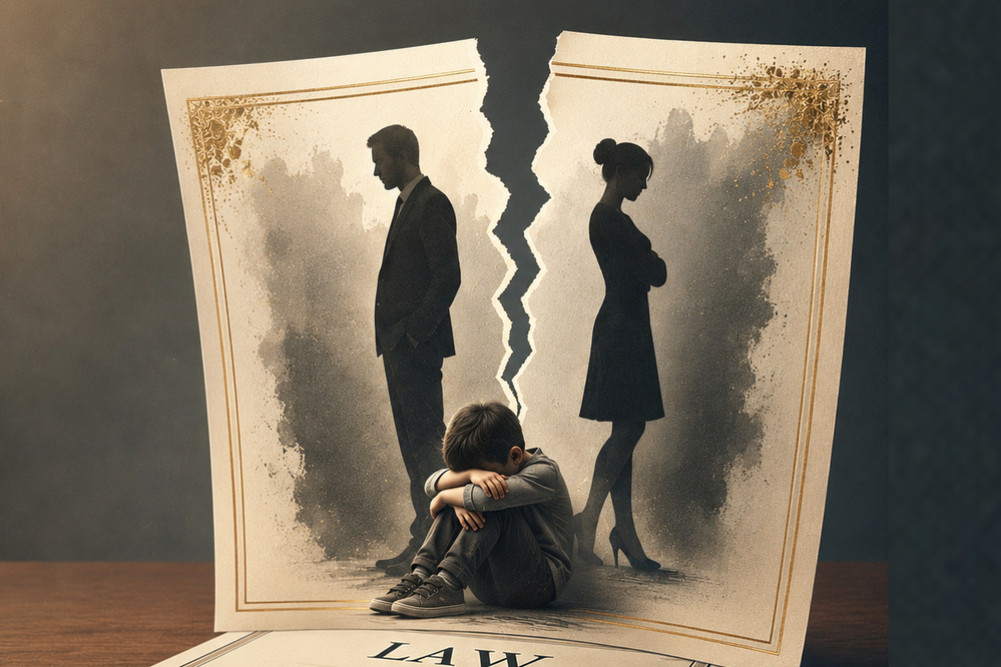
Experts in the field say that divorce should be viewed not only as a legal process but also as a social issue related to children's rights, mental health, and future.
We use Google Cloud Translation Services. Google requires we provide the following disclaimer relating to use of this service:
This service may contain translations powered by Google. Google disclaims all warranties related to the translations, expressed or implied, including any warranties of accuracy, reliability, and any implied warranties of merchantability, fitness for a particular purpose, and noninfringement.
Divorce of parents is legally the end of the marital relationship between two people. But its effects are often carried by their children for years.
Losing the warmth of the family, feeling inferior by comparing themselves to others, experiencing financial and emotional insecurity, and experiencing mental health problems are common realities faced by many children and adolescents after a divorce. According to psychiatrists, even if parents separate, the responsibility and relationship towards the child should not be broken, otherwise it can affect their personality development and future.
When 21-year-old Khushi Gurung (name changed) from Kaski was two years old, her parents divorced. Her mother went abroad. Since then, she has been raised in her maternal uncle's house. At first, she did not know anything because she was young. As she grew older, the reality that her parents were not together hurt her repeatedly.
'When I saw my friends' parents loving them, hanging out together or celebrating their birthdays, I wondered what my family would be like,' she says. 'I couldn't sleep at night thinking about it.'
After the divorce, both her parents remarried. Although they met their father from time to time, their relationship with their mother almost broke down. She says that now that she is busy with her studies and work, it is easier to manage. She went to Japan to study just a few months ago.
A teenager from Kathmandu also has a similar experience. After her parents' divorce, her father initially agreed to pay for her education, but after a while, he stopped taking responsibility. 'After her father remarried, he even stopped paying her school fees,' he says. At that time, it was very difficult for the family to cover everything from house rent to school fees because her mother had no income.
'The worst thing was feeling like my own father didn't care,' he says. Even though his mother's business has made him financially comfortable now, those childhood experiences still hurt him.
He says that since his mother is his source of income, he doesn't have to call his father for money now. 'But sometimes I call when I remember,' he says, 'I remember something from when I was little. When we had to make time to meet up and have fun with the family, and my father didn't have time, it's sad to think about it now.'
According to psychiatrist Dr. Amit Jha, the impact of divorce varies depending on the age of the child. 'The role of both the mother and the father is important for the overall development of the child,' he says. 'Divorce makes them feel like they have lost an important emotional support.'
According to him, if young children cannot understand why their parents separated, teenagers start comparing themselves with their friends' families. That can lead to problems like inferiority complex, sadness, anger, low self-esteem, and 'adjustment disorder'. If stress is not managed for a long time, problems like depression, anxiety, drug abuse, and excessive screen use can also appear.
According to Dr. Jha, regular meetings, communication, and emotional support are necessary with children even after a divorce. Parents living with children should try to play the role of both mother and father as much as possible, while the support of grandparents and other family members can also help children reduce loneliness.
Experts also say that if stress is not managed for a long time, serious problems like depression, anxiety, and drug abuse can arise. Jha says that children can resort to the Internet to relieve stress, which can make them 'screen addicts'. Divorce is only a legal concept, not a complete end to social or human relationships. But when parents are forever away from the responsibility of their own children, it affects children for a long time.
Family disintegration puts the future of children in doubt, says Laxman Prasad Sharma, an associate professor at Tribhuvan University. ‘The lack of a harmonious and emotional relationship can have a negative impact on the learning and upbringing of children,’ he said. ‘This is a matter of serious concern for what tomorrow’s society will be like.’
Section 114/115 of the Civil Code, 2074 BS, provides for the guardianship and care of children after divorce. Advocate Bhavesh Gautam says that guardianship will be determined by keeping the age and interests of the child in mind. ‘The court has always given priority to the best interests of the child while deciding on divorce,’ he said.
‘There is a provision for keeping a minor child under the age of five regardless of whether the mother has remarried or not,’ he said. ‘If the mother wants to keep the child and the father has to bear the expenses, the child can be kept with the mother or the father can also keep the child.’ According to him, in the case of a child above the age of 10, their opinion has been asked and they are placed under guardianship with their consent.
According to the Supreme Court’s statistics, the number of divorce cases is increasing every year. In 2080/81, 40,320 cases were registered in various courts across the country. Out of which 31,752 cases were settled. Out of 42,739 cases registered in 2081/82, 33,050 were settled. In the current fiscal year 2082/83, 42,703 cases have been registered till Jestha. It mentions that 29,131 cases have been decided in the data.
It is difficult for the other party to meet the children after a divorce, and class also influences this, says Gautam. ‘Although there is a legal provision to allow visitation at any time, it seems to be not very implemented in Nepali society,’ he said. ‘As upper-class families take their children abroad, it is difficult for the other party to meet,’ he said. ‘In the middle class, the problem of children feeling the lack of paternal protection after a divorce is more. In the lower class, the practice of divorce is generally less common until women are sure of remarrying. Due to this, the problem of abandoning children is comparatively less here.’
For the proper upbringing and development of a child, the love of both the father and mother should be equal. But the misunderstanding between them and the separation that it causes are also adversely affecting the mental health of the child. ‘There are many incidents of children choosing the wrong path or falling into addictions in society,’ says child protector Geeta KC Darnal.
According to her, it is very difficult for children to accept new parents after their parents’ divorce. ‘Getting another mother or father seems to have the biggest impact on the child’s mentality,’ she said. ‘Although it seems that the child has accepted the new person in place of their biological father or mother from the outside, they seem to be going through a mental state where they cannot accept it from the inside.’
If children show symptoms such as being very sad, not talking, changing in behavior, not sleeping well at night or not wanting to eat, they should immediately seek the advice of a psychiatrist or counselor, says psychiatrist Dr. Amit Jha. ‘It is equally important for parents who take care of their children to take care of their mental health,’ he said.
Even if a court decision ends the relationship between a husband and wife, the wounds in the minds of their children cannot be erased immediately. Therefore, there is a growing need to view divorce not only as a legal process but also as a social issue related to the rights, mental health, and future of children, say experts in the relevant field.