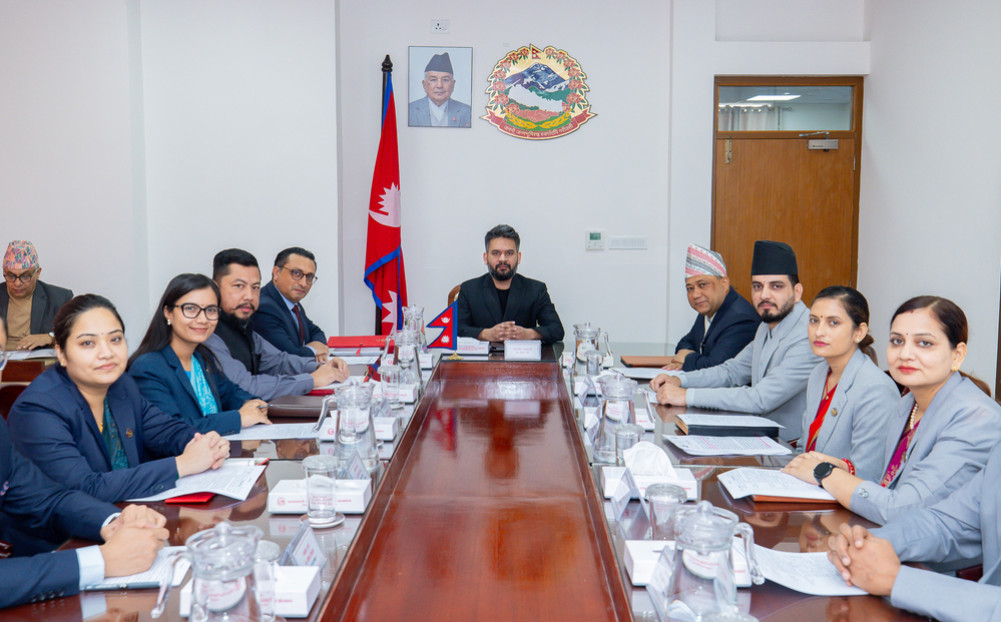
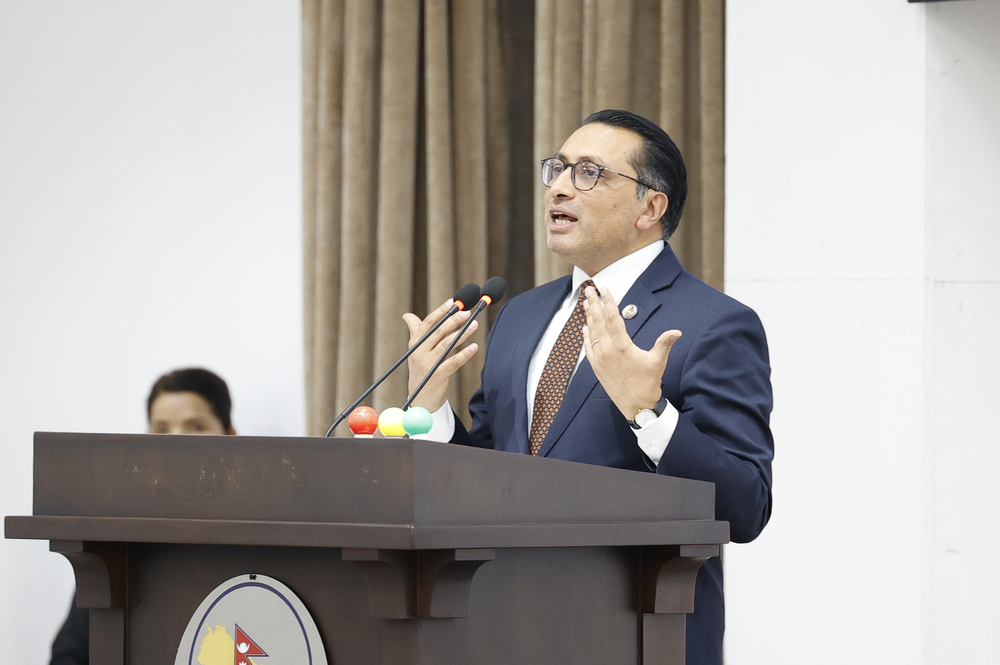
From the election campaign to the start of government, Prime Minister Balendra Shah and his ministers have been using punitive language outside the legal process, targeting contractors or critics.
We use Google Cloud Translation Services. Google requires we provide the following disclaimer relating to use of this service:
This service may contain translations powered by Google. Google disclaims all warranties related to the translations, expressed or implied, including any warranties of accuracy, reliability, and any implied warranties of merchantability, fitness for a particular purpose, and noninfringement.
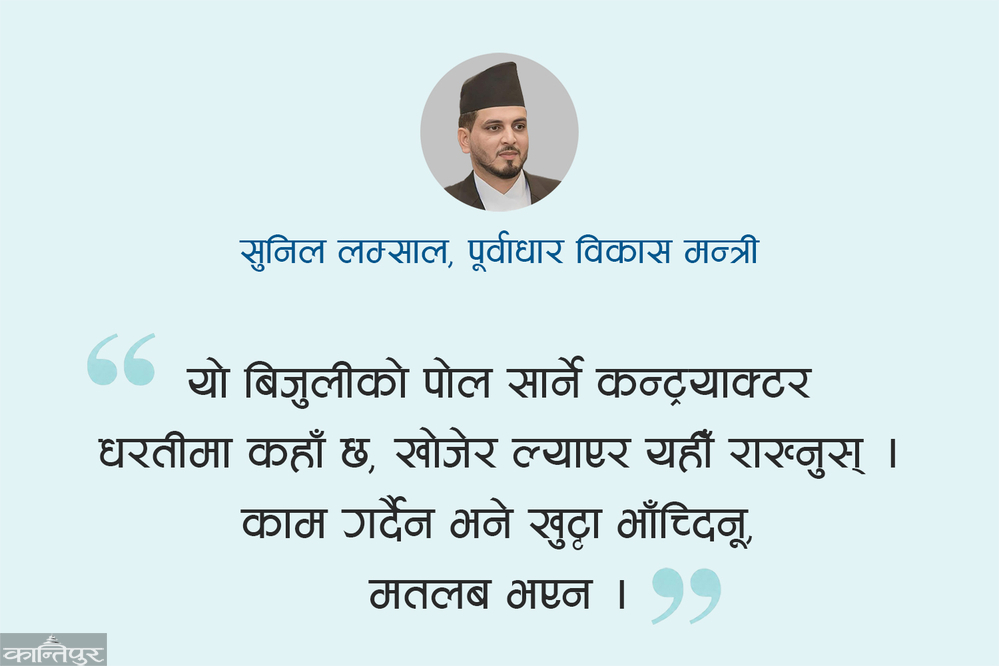
Minister for Infrastructure Development Sunil Lamsal, during the monitoring of the Nagdhunga-Muglin road project last Sunday, made the statement that the contractor who does not work should have his legs broken. Keeping Dhading Chief District Officer Laxmi Pandey Gautam and the district police and armed police chiefs by his side, he said, "Where on earth is this contractor who moved the electricity pole? Find him and keep him here. If he does not work, do not break his legs, it is pointless."
The video of him making such a statement has gone viral on social media, with some supporting him by saying that strict action should be taken against the contractor who does not work, while many have even criticized the minister's language as a warning against the rule of law. Former IGP of Nepal Police Chandrakuber Khapung himself has asked, ‘Is this order of the minister in accordance with the law?’
Dhading Chief District Officer Laxmi Pandey Gautam has said that everyone’s common desire is not to delay work. ‘The minister and all of us want not to delay work, nothing else,’ she told Kantipur.
However, this is not the first controversial statement from a responsible government official. From the election campaign to the government’s operation, Prime Minister Balendra Shah and members of the Council of Ministers have been using punitive language outside the legal process, targeting contractors or critics. Although the wording is different, these statements have raised questions about the limits of the use of state power and the rule of law.
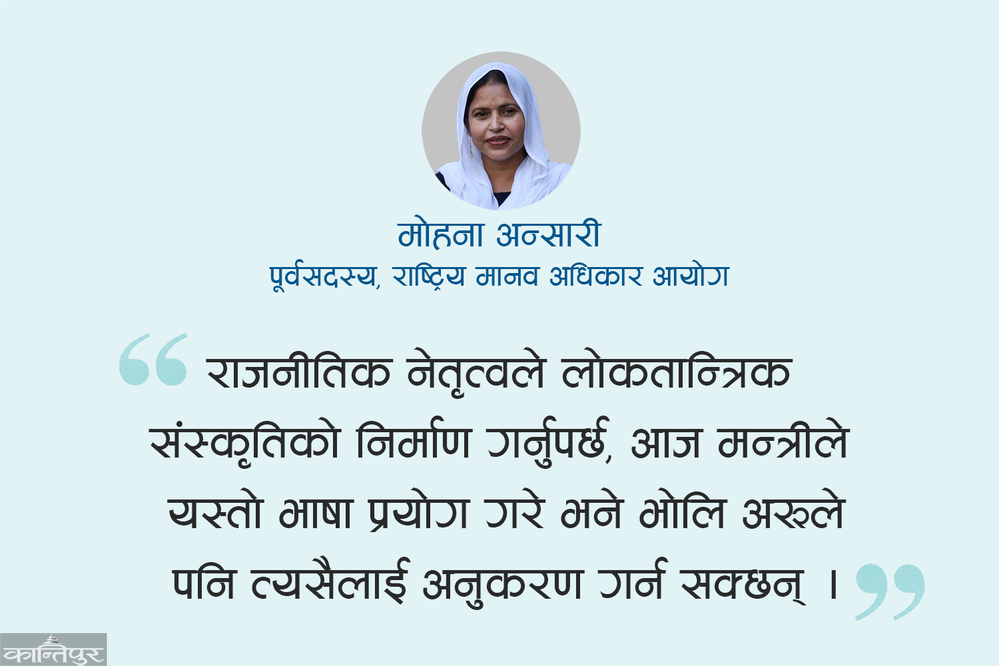
Advocate Mohana Ansari, who is also a former member of the National Human Rights Commission, says that even if someone violates the law, legal action can be taken, but it is not appropriate to use such language in public. ‘The minister of the relevant ministry may have to sit down with them tomorrow and discuss, may also have to take responsibility for the security of that person, or may even have to participate in some dialogue and negotiation,’ she said, ‘That is why it is not appropriate for the minister to make such a statement.’
In the case of Minister Lamsal, the controversy is not limited to just his statement. On his instructions, on April 28, the Valley Crime Investigation Office, Teku, took control of Sharma & Company Chairman Ramesh Sharma and Lama Construction’s Pitambar Badu and brought them to the ministry. They are businessmen related to the construction of the Nagdhunga and Dhulikhel road sections. Questions were raised even then that the Investigation Office, which is usually responsible for investigating heinous crimes, was being used in contract disputes. Retired Deputy Inspector General (DIG) of Nepal Police Hemanta Malla Thakuri says that the police is not the body responsible for bringing the contractor to the ministry. ‘If the contractor has not done the work, should the Road Department or any other relevant body be held responsible,’ he said, ‘It is not appropriate to use the police.’
Vice President of the main opposition party Nepali Congress, Bishwaprakash Sharma, has asked, ‘Are we heading towards such a society? If we are not going, then at least rein in the speech of your ministers, Prime Minister.’ He made the statement along with Minister Lamsal’s statement, referring to the incident in which a tempo was pushed off a cliff by an employee in Dhangadhi and a student’s mobile phone was submerged in water in Siraha.
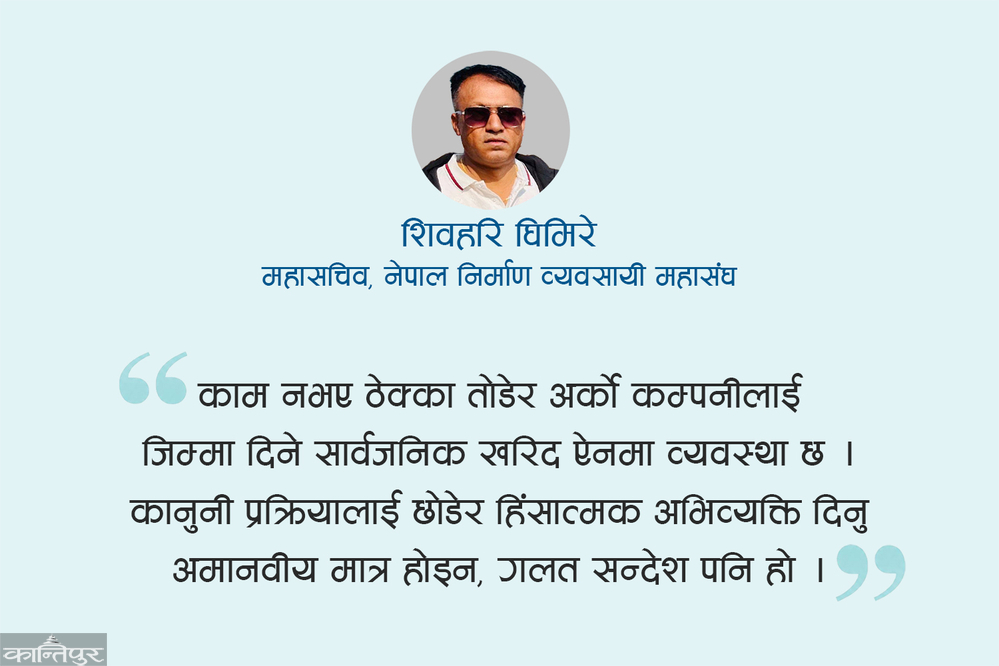
Shivahari Ghimire, General Secretary of the Federation of Nepal Construction Entrepreneurs, says that Minister Lamsal has intimidated the entire infrastructure development and private sector by using words that cannot be found in the dictionary, from the Public Procurement Act or any other rule. ‘That is not something that anyone can digest,’ he said, ‘First, we should have understood why there was an obstacle in moving an electricity pole. If the work is not done, there is a provision according to the Public Procurement Act to terminate the contract and hand over the responsibility to another company. In such a situation, leaving the legal process aside and making violent statements is not only inhumane, but also sends the wrong message.’
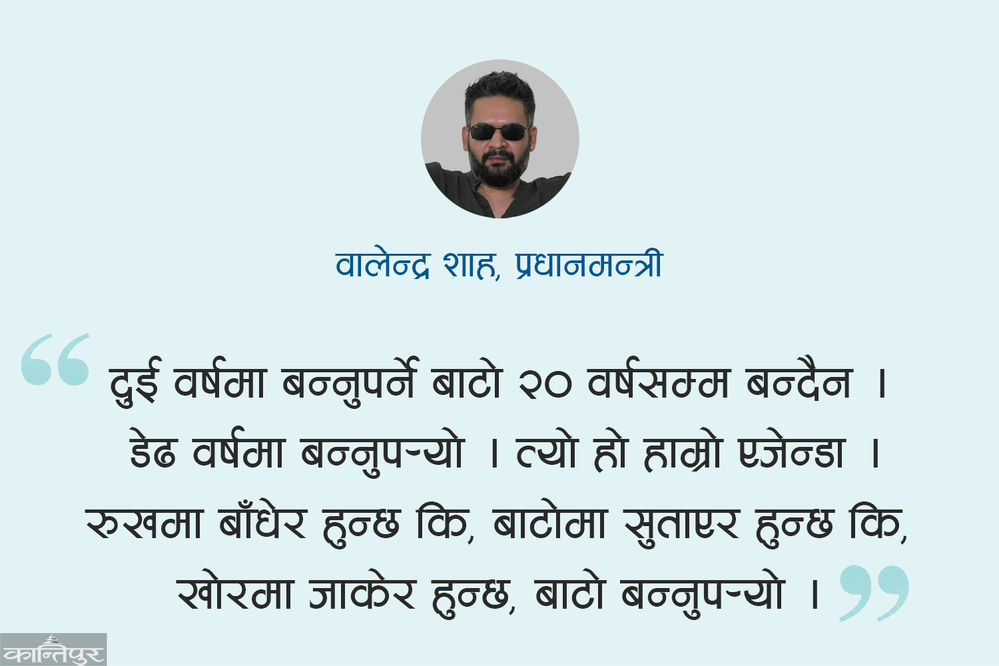
Prime Minister Balendra Shah himself had made a similar controversial statement targeting the contractor before 21 Falgun. Addressing the election meeting of the National Independent Party (RSWP) held in Dhangadhi, Balendra had said, ‘A road that should be built in two years will not be built for 20 years. It should have been built in one and a half years. That is our agenda. Whether it is tied to a tree, made to lie on the road, or put in a cage, the road has to be built.''
After questions were raised about Shah's statement, party president Ravi Lamichhane reached Itahari a week later and tried to correct it. On 12 Falgun, he had said that their policy is to tie contractors with law, not with ropes. He had said, 'The policy of the Rashtriya Swayamsevak Sangh is not to tie contractors physically, but to make them responsible through strict legal sanctions.''
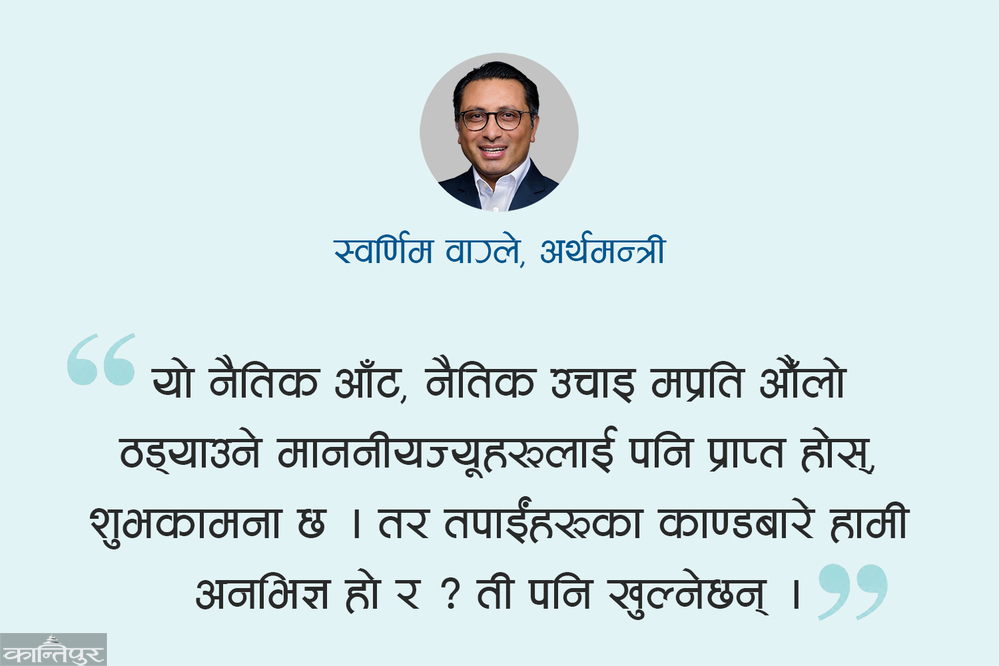
But even after becoming the Prime Minister, controversial statements have not stopped from government ministers. A few days ago, Finance Minister Swarnim Wagle, while answering questions raised on the budget in Parliament, had warned that he would make their 'scandal' public. When MPs started raising questions about the change in tax rates, he had warned that the scandal of those who questioned them was known and that the scandal would be exposed. ‘May this moral courage, moral height also be attained by the honorable gentlemen who pointed the finger at me, best wishes . But are we unaware of your scandals ? They will also be revealed,’ he said .
The nature of all three statements is not the same . Prime Minister Shah’s statement was a political statement made during an election speech . Even though the government led by him had instructed the police to take action against Krishnahari Pushkar, a special category employee, on the charge of sending a message to the Prime Minister . On 21 Jestha, the Valley Crime Investigation Office had taken him under control from his home for four hours, alleging that he had violated the ‘chain of command’ .
The next day, the Prime Minister wrote a sarcastic status on social media, ‘I also want to become an ambassador, if you have the Prime Minister’s number, please give it to me.’ Minister Lamsal, in the presence of the heads of the administration and security agencies, directed the contractor to ‘break his leg’, which many have linked to the rights of public office and the rule of law.
Opposition CPN-UML MP and former minister Padma Aryal immediately defended the statement made by Finance Minister Wagle. ‘You have threatened to open the file, I say it even today, the number one file should be opened for T-Estate,’ she said, ‘Whatever files are in your hands, whether they are Omni or Widebody, which are linked to the opposition, I want to tell the government to open them through this House. Whatever the truth is, let it be brought out.’ She insisted that the opposition would not run away from any investigation.
In other democratic countries, there are examples of violent or threatening statements made by public officials, which have led to immediate political and institutional reactions. In the UK, in 2022, Minister Gavin Williamson was forced to resign after being accused of using threatening language. In India, when Minister for Women and Child Development Maneka Gandhi made a statement that she would reconsider giving jobs to Muslim voters who did not vote during the 2019 Lok Sabha elections, the Election Commission banned her from campaigning for 48 hours, calling it a corrupt practice.
BJP MP Pragya Thakur was barred from attending a parliamentary party meeting for her remarks calling Mahatma Gandhi's assassin Nathuram Godse a 'patriot'. Later, the party also removed her from the defense advisory committee.
In a story published in the American newspaper Washington Post on May 25, 2026, regarding the violent statements made by politicians, Columbia University professor Helio Fred Garcia said, 'Language from above sets the pattern of expected behavior. If you create an environment where hatred and violence are acceptable, people will act on it. Sometimes by supporters, sometimes by opponents.' He said that the political dialogue in America is becoming more violent and that President Trump is adding that tone to the public debate.
In Nepal, on August 8, 2075, the then Law Minister Sher Bahadur Tamang had to resign after his remarks about a Nepali student studying MBBS in Bangladesh sparked controversy. After resigning, he apologized and said, 'I respect Nepali women, I believe that no one should commit violence against women.' In Magh 2078, the then Minister of Physical Infrastructure and Transport Renukumari Yadav also faced controversy when she threatened to repeat the Gaur massacre. At that time, the Human Rights Commission warned her not to make statements that incite violence or cause conflict. She later apologized publicly.
In this context, senior advocate Dinesh Tripathi said that the recent statements made by Minister Lamsal and others are against the dignity of their positions. 'If there is to be rule of law in the country, then a person who makes such unruly statements while holding a responsible position should not only be removed from his post, but should also be punished.'
Some experts say that such statements coming from the Prime Minister and ministerial level can increase the morale of the police and other employees and increase the abuse of power. ‘Under the guise of government authority, officials from other bodies may also have a tendency to threaten or pressure people, and people connected to the government may be extorted by themselves,’ says human rights activist Ansari. Former Secretary of the Ministry of Physical Infrastructure Keshav Kumar Sharma’s analysis is somewhat different. ‘It is not a situation where the minister breaks his leg as soon as he says, sometimes such language is used figuratively to get work done,’ he said. ‘However, instead of making such statements in a public place, it would have been more appropriate if he had called the ministry itself or brought the concerned person in contact and instructed them to work.’
Although the government claims that good governance, development and service delivery are its top priorities, legal experts say that the threatening, pressurizing or extra-legal statements from the Prime Minister to the ministers send a different message. Human rights activist Ansari says that the statements that have been made public now are not those used by the political leadership, but the language of hooligans. "Political leadership should build a democratic culture. If a minister uses such language today, others may imitate it tomorrow," she said. "Therefore, such a culture should not develop."
Senior advocate Tripathi also says that the tendency to weaken the legal process in the name of effective governance or to use vindictive language in public can weaken trust in state institutions. Since the process of reaching it is equally important than the result in a democratic governance system, he says that no one has the right to make such statements in a democratic country with the rule of law.